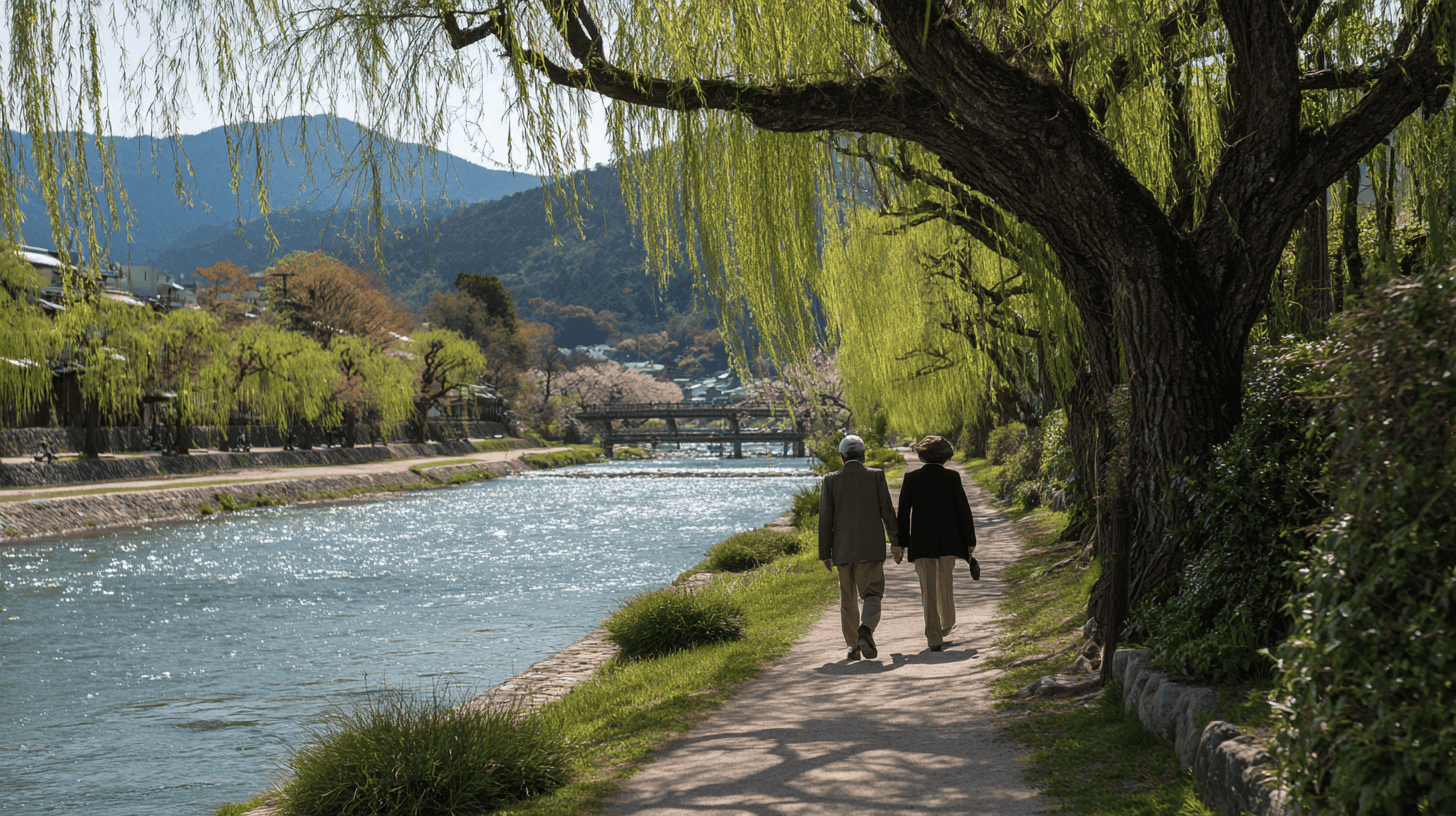
If you look up the Japanese word for connection, the first answer is usually 縁, read en. It is one short syllable. Yet it holds a whole way of seeing how people come into each other’s lives: a colleague, a neighbor, a friend met on a train.
This guide explains en from the ground up. You will learn how to say it, how the kanji is built, and what Japanese dictionaries actually record. You will also meet the everyday phrases people use, and how en differs from kizuna and unmei. All of it is language, the way people really speak at work and at home.
Finally, we look at what the word suggests for anyone thinking about relationship readiness. That idea also shapes our relationship readiness journal for single readers, though the word itself comes first.
What Is the Japanese Word for Connection?
The Japanese word for connection is 縁, read en. It means a relation or bond between people, and also the circumstance that brings them together. The same kanji can mean an edge or rim, as in 縁側, engawa, a veranda. Its thread radical, 糸, hints at the idea of ties that link one life to another.
En Meaning: What the Japanese Word for Connection Covers
In plain terms, en is the link between you and someone or something else. It is not a feeling, like love, and it is not a promise, like a vow. Instead, it names the relation itself, plus the small chance that started it.
What the dictionaries record
The standard Japanese dictionary Daijisen lists several senses for en. First comes the physical edge of a thing, its rim or border. Next comes connection: the way things relate to one another. Then come family ties, such as the bond between parent and child or between spouses. The word also names the board veranda of a traditional house (Kotobank, entry for 縁). Another major dictionary on the same page adds a useful sense. It calls en the opening that starts a relationship, a link from the past that shapes the present.
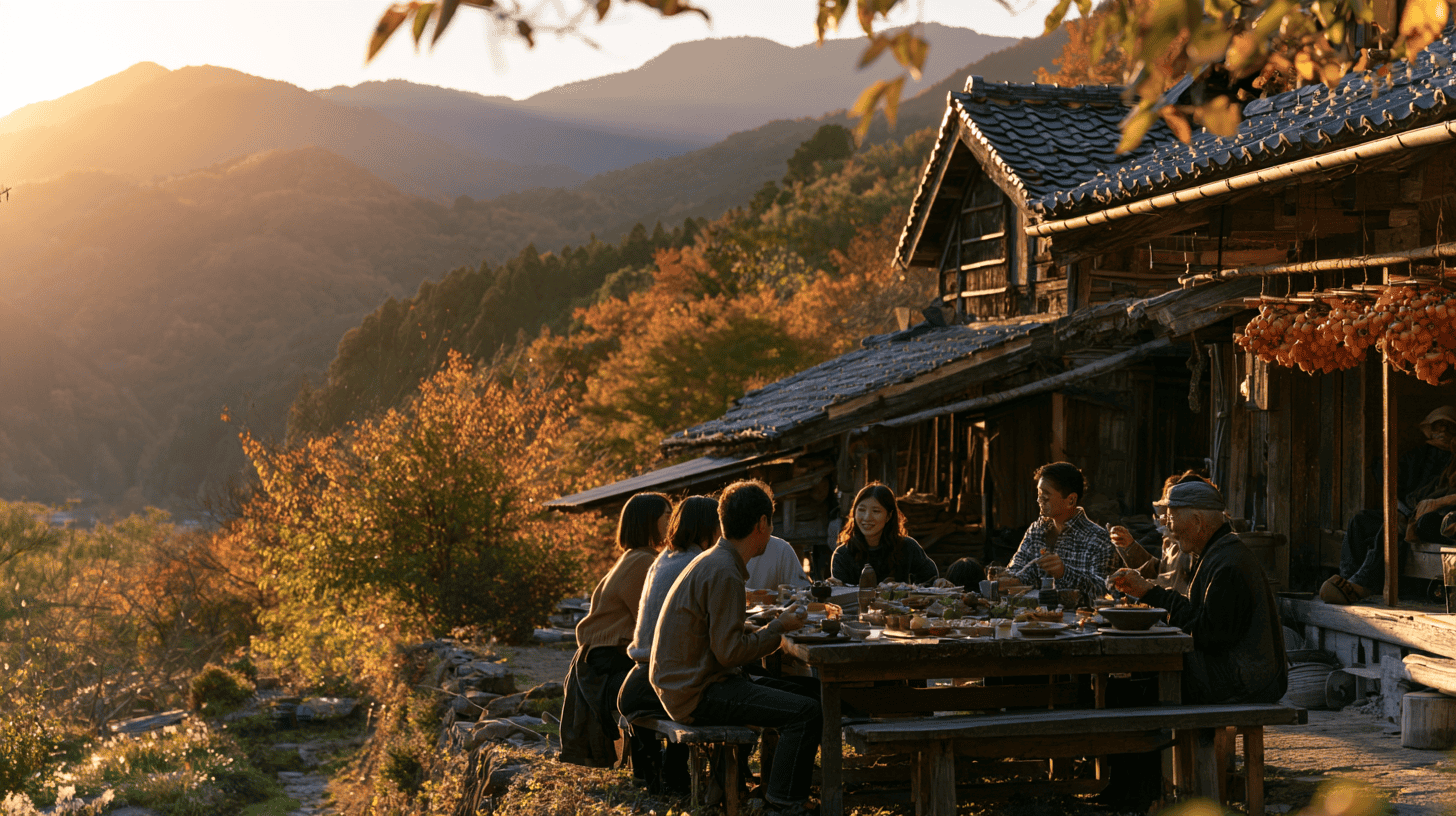
That last sense matters most for everyday speech. When people speak of en, they usually mean the situation that brought two people into the same room. You took the same class. Perhaps you moved to the same street. Or you sat at the same counter on a rainy evening. None of these is grand, yet each one counts as en.
Bilingual dictionaries sometimes add “fate” to the list. Still, in daily Japanese the word mostly works at a human scale. It points to relation and circumstance, the ordinary meetings that become something more. So the most useful English gloss is “connection,” with a note about the chance that makes it possible.

The Kanji 縁: A Thread at the Edge
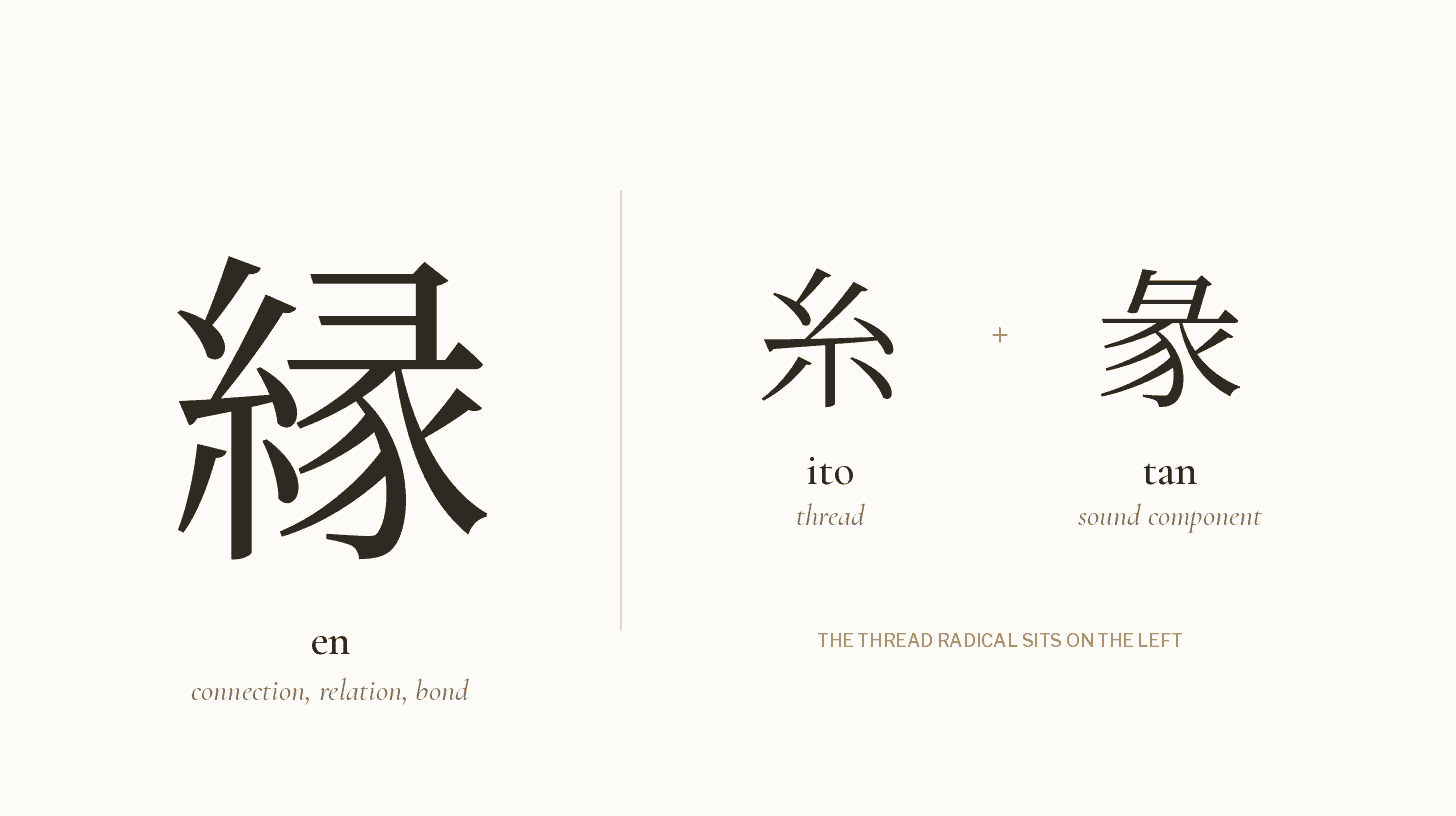
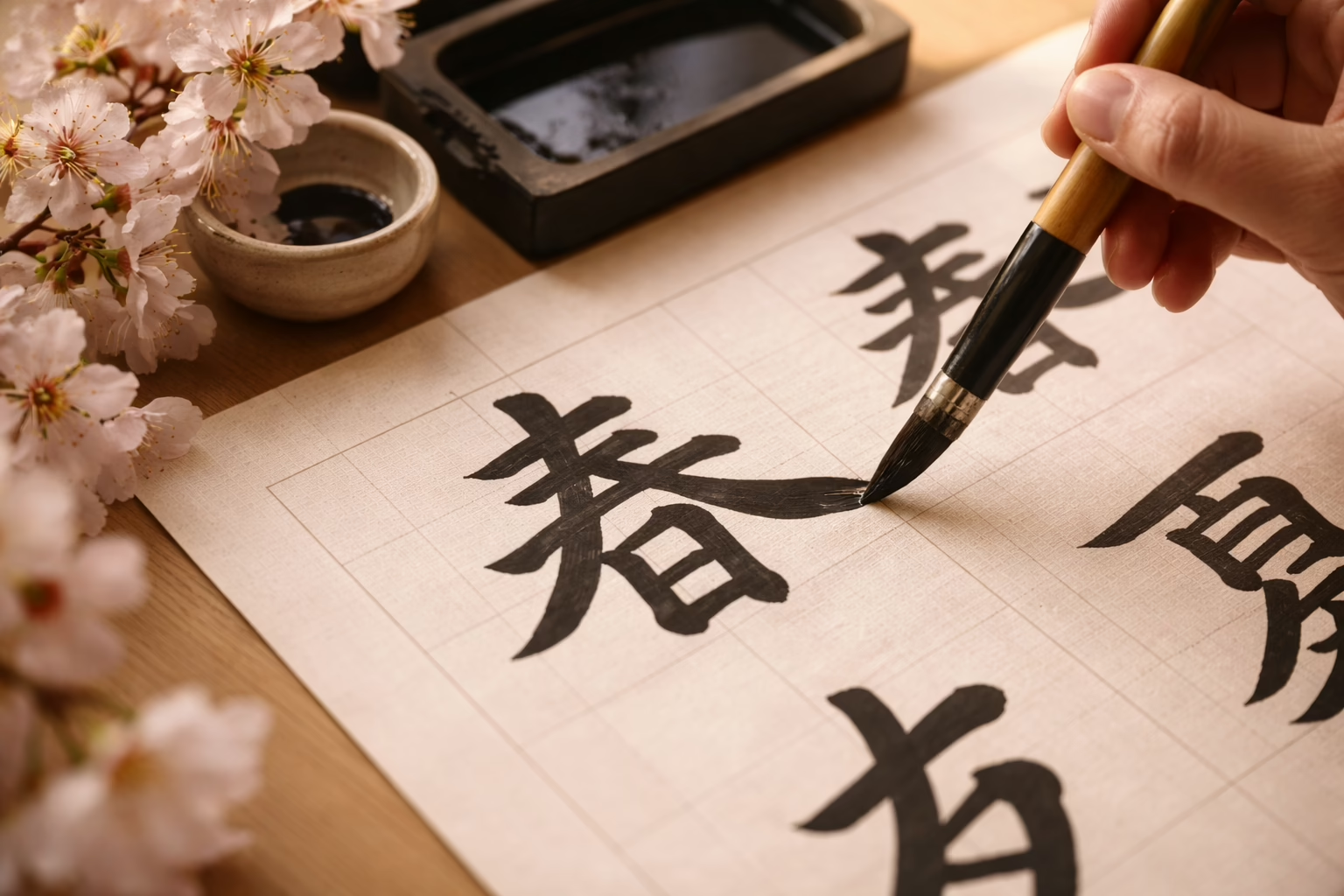
The kanji 縁 has fifteen strokes. Japanese students learn it in junior high school, and it sits at the top JLPT level, N1 (Jisho kanji entry for 縁). Its on reading is en. Its kun readings include fuchi (edge), heri (hem or border), yukari (a tie to a person or place) and enishi, a softer, literary word for connection.
Two parts, one picture
The left side is 糸, the thread radical. You see it in many kanji about cloth, cord and weaving, such as 結, to tie, and 絆, a bond. The right side is 彖. In this kanji, it mainly supplies the sound, so 縁 is a sound-and-meaning compound.
Its oldest sense follows from that thread. The character first described the trimmed edge of a garment, the band of cloth that runs around a hem. The Jitsū kanji dictionary, on the same Kotobank page cited above, glosses it as “hem trim,” then “edge,” and then “connection.”
It is a lovely image to keep. An edge is where one thing meets another, so connection happens at the borders of our lives. As a result, one kanji can name a veranda, the rim of a cup and the tie between two friends.
How 縁 Lives in Everyday Japanese Speech
You will hear the Japanese word for connection often, in polite speech, small talk and at work. These are the phrases a visitor meets most.
Go-en, en ga aru and nanika no en
ご縁 (go-en) is the polite form. People use it to honor a relationship, such as a new business tie. 縁がある (en ga aru) means “to have a connection,” for example with a town where you once lived. 何かの縁 (nanika no en), “some kind of connection,” marks a happy coincidence. You might say it when a stranger on a trip turns out to share your hometown. Then there is 縁を大切に (en o taisetsu ni), “take good care of your connections,” which makes a good motto.
Many of these meetings happen over food. In winter, that food is often a nabe, a hot pot set in the center of the table. Everyone reaches into the same pot, so the meal itself becomes a small act of connection. A good clay donabe and a few shared bowls make that kind of evening easy to host at home.
Notice what these phrases share. None of them describes a strong emotion. Instead, they describe a relation that already exists, often a slight one, and an attitude toward it. To say “this is some kind of en” is to treat a chance meeting as worth something. Japanese speakers use it to warm up small talk, to thank a client, or to close a letter.
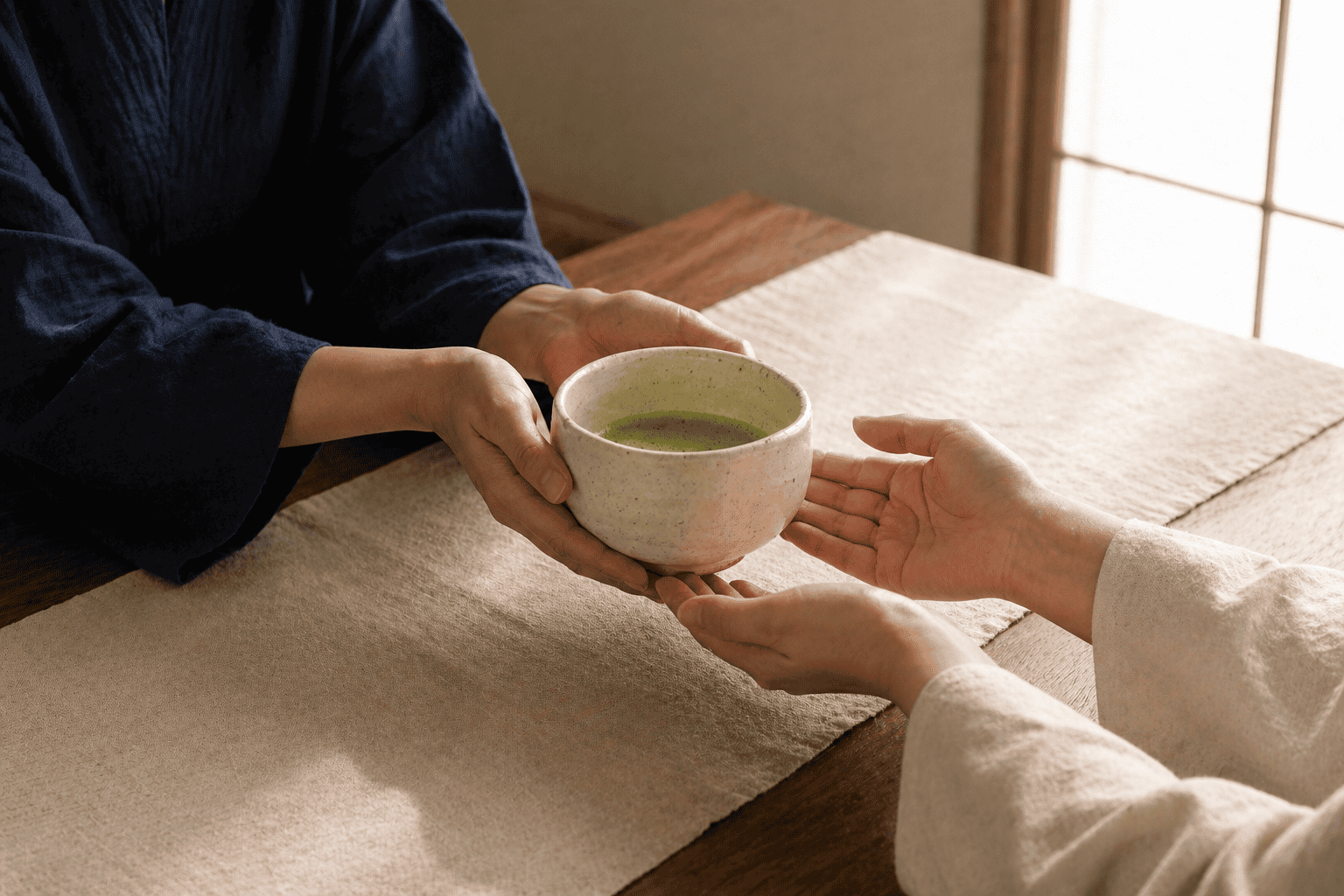
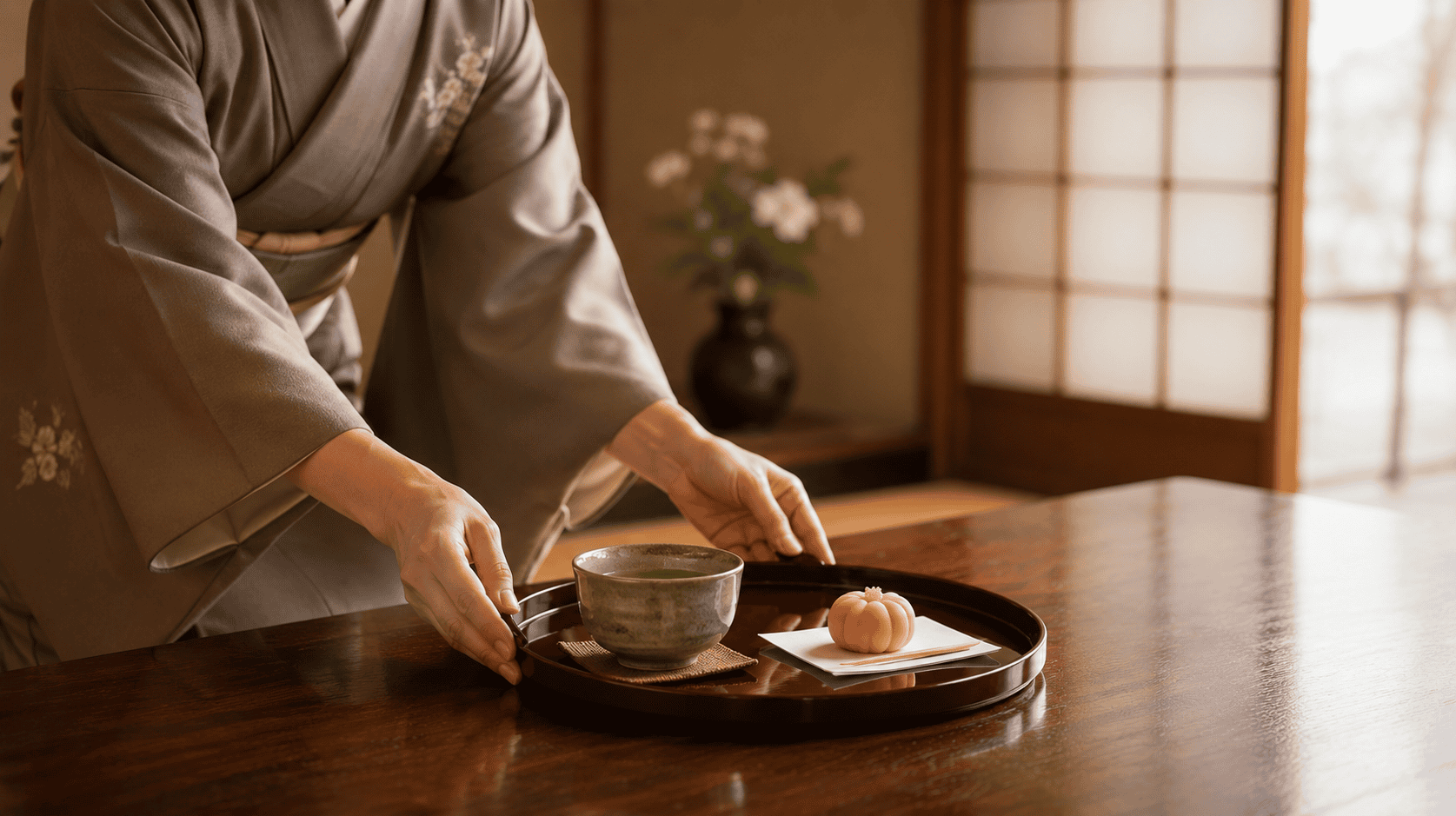
That attitude shows up in hospitality as well. A host who sets out tea and a sweet for a guest is, in a sense, honoring en. The visit may be brief, yet the care says that this meeting is worth making the most of. It is a habit of attention, not a belief.
En on the road
Travel makes this easy to see. On a trip, en piles up quickly: the innkeeper who suggested a walk, the couple at the next table, the friend who sat beside you on the bus. Most of these links fade unless you write them down. Some travelers keep a short record of each person they meet, with a line about where and how. A few lines each evening is enough, written before the details blur. Over a week, the pages turn into a map of people. Our blank Onsen travel journal suits this well, with room for names, places and the small talk that started it all.
Open pages for ryokan evenings and the seasons seen from the bath.
Unlined · 120 pages · Original cover art
Shop This Journal →Read back later, those pages show how en works. None of the connections was planned. However, each one needed someone to say hello or stay for one more cup.
En, Kizuna and Unmei: Japanese Words for Connection Compared
English uses “connection” for almost everything. Japanese splits the idea into several words, and three are worth knowing next to en.
Kizuna, the bond that holds
絆, kizuna, is a strong bond between people, the kind that is hard to break. Its older meaning is plainer, though. It first named a rope used to tether a horse or other animal (Kotobank, entry for 絆). So kizuna stresses holding on, while en stresses the meeting point.
You could put it this way: en is how two people met, and kizuna is what they built after. A family has kizuna. Teammates after a hard season have kizuna. Two strangers who just shared a table have en, and only time will tell if it grows into more.
Tsunagari and unmei
繋がり, tsunagari, is the most literal “connection.” It covers phone lines and train links as well as people. It is neutral and practical. 運命, unmei, means fate in the large sense, a fixed course for a life. It is a strong, dramatic word, and it belongs to novels and songs. En sits between these two. It is warmer than tsunagari, yet far more everyday than unmei. Above all, en leaves room for what you do next. The table below sets the four side by side.
En names the meeting point; what grows from it depends on how it is tended.
| Word | Kanji | Core sense | Typical use |
|---|---|---|---|
| En | 縁 | A relation and the circumstance that began it | Chance meetings, work ties, places you feel linked to |
| Kizuna | 絆 | A strong bond that holds | Family, teams, communities after hard times |
| Tsunagari | 繋がり | A link of any kind | People, networks, train lines, ideas |
| Unmei | 運命 | A fixed course for a life | Novels, songs, dramatic moments |
Seen this way, en is the most hopeful word of the group. It does not claim the outcome is fixed. Nor does it demand that the bond already be strong. Instead, it notes that a link exists, and it invites care. That is why the word suits a slower, steadier way of thinking about relationships.
Our guide to Japanese words for love and affection covers the feeling side of this vocabulary. En, by contrast, is about structure. You notice a connection, then give it a little time each day, which is also the shape of a daily writing practice. The short film below shows a hand writing one morning prompt in The Return, the first journal in our Cultural Reflection Collection, on a tablet. Likewise, the En Journal uses the same one-prompt-a-day format.
Twenty seconds inside the journal
The digital edition in use — a morning prompt, answered by hand while the coffee is still warm. Tap to play, with sound.
One page, one intention, one single quiet moment.
The Japanese Concept of Connection: Conditions You Can Tend
Here is the most practical lesson inside the Japanese word for connection. En is not luck alone. A meeting needs a setting, and a bond needs time. Both are things you can shape, even if you cannot control who walks in.
Connection takes hours, not luck
Research on friendship points the same way. A University of Kansas study by Jeffrey Hall estimated the time it takes to form a friendship. It found that moving from acquaintance to casual friend takes about 40 to 60 hours. Becoming a close friend takes more than 200 (University of Kansas News, 2018). Also, the hours that counted most were relaxed ones, such as hanging out and joking around.
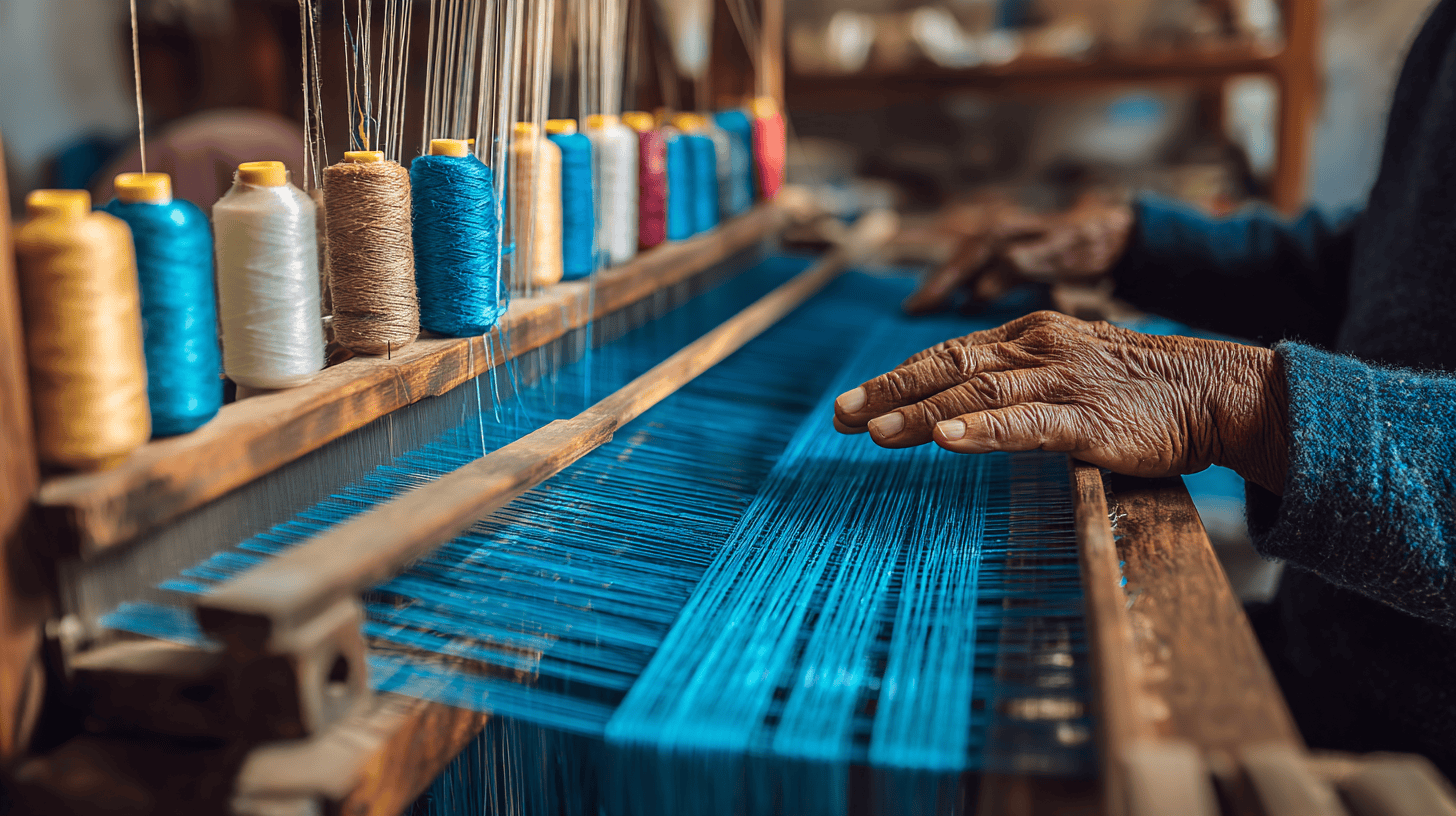
In other words, en gives you the first thread, and time does the weaving. A weaver cannot rush indigo cloth. Each pass of the shuttle adds a little strength, and the pattern only shows after many rows. Friendships and partnerships grow in much the same way, through ordinary hours that add up.
Why checklists fall short
A second study adds a twist. Psychologists Samantha Joel, Paul Eastwick and Eli Finkel used machine learning on speed-dating data. They found that traits and preferences measured beforehand could not predict which pairs would click (Joel, Eastwick and Finkel, Psychological Science, 2017). The spark between two people seems to emerge only when they actually meet. That is en in modern terms: a link that forms in the meeting, not on paper.
If a trip to Japan is where you would like to meet new places and people, we can design a custom Japan itinerary around shared tables and small towns, with time built in for the conversations that happen along the way.
Occasional letters on relationship readiness, inner work before dating and the Japanese words for connection, with news of the Cultural Reflection Collection.
Occasional letters. Unsubscribe anytime.
So what can you actually tend? Three conditions stand out. First, presence: showing up in places where meetings can happen, again and again. Next, attention: noticing the people already around you. Then comes readiness: knowing yourself well enough to stay open when a new link appears. The first two are about where you spend time. The third is inner work, and most people skip it.
That third condition is where self-knowledge comes in. If you are unsure whether you are there yet, our guide on how to tell if you are ready for a relationship walks through honest questions to ask yourself. For deeper or painful patterns, a qualified therapist is the right person to help.
Inner Work Before Dating: En as a 90-Day Practice in Connection
If en is the meeting point, then readiness is how you show up to it. This is where the word turns into a routine. Inner work before dating means getting to know your own habits, needs and limits before a new relationship begins. It does not promise a partner. Instead, it helps you meet people with a clearer head and a steadier heart.
Five threads, ninety days
Our guided journal of inner work before dating takes its name from en, and it borrows the thread image directly. It has 90 daily prompts, one a day, woven from five threads. 整 totonoi is The Prepared Self. 心 kokoro is The Known Heart. 間 ma is The Interval, the pause explored in our piece on what ma means in Japanese culture. 結 musubi is The Tie, and 逢 au is The Encounter.
Recommended
Each thread runs for 18 days, and the threads rotate, so no single theme takes over. The three months also have names. The Ground comes first, then The Opening, and finally The Thread. Along the way, weekly synthesis pages pull each week’s answers together. Monthly reviews then step back further. On Day 1, you answer a ten-question readiness self-assessment. On Day 90, you answer the same ten questions again and compare.
That repeat is the heart of it. Growth is hard to see from inside a single day. Two answers, ninety days apart, make it visible on the page. You see what shifted, and what still needs time.

Why the threads rotate
Patterns rarely live in one area of life. A habit of rushing may show up in how you rest, how you talk and how you choose. Rotating the threads lets you see the same habit from five angles. As a result, you start to notice links between them, which is fitting for a practice named after connection. For example, a prompt about rest may echo an earlier one about saying no. Seen together, the two answers often explain each other. That is the kind of insight a single theme, repeated for weeks, tends to miss. If old patterns keep returning, our guide on breaking relationship patterns before your next relationship goes further.
Gathering at one pot
Inner work does not happen only on the page. It also happens at the table, with the people already in your life. Few dishes say this better than yosenabe. The name comes from yoseru, “to bring together,” and the dish does exactly that. Many ingredients go into one pot, and everyone at the table shares it. It suits a cold evening with friends, a neighbor, or anyone you would like to know better. Besides, it is forgiving to make, so the host can sit down and talk. Everything is cut in advance, and the cooking happens at the table, in small rounds, while people eat.
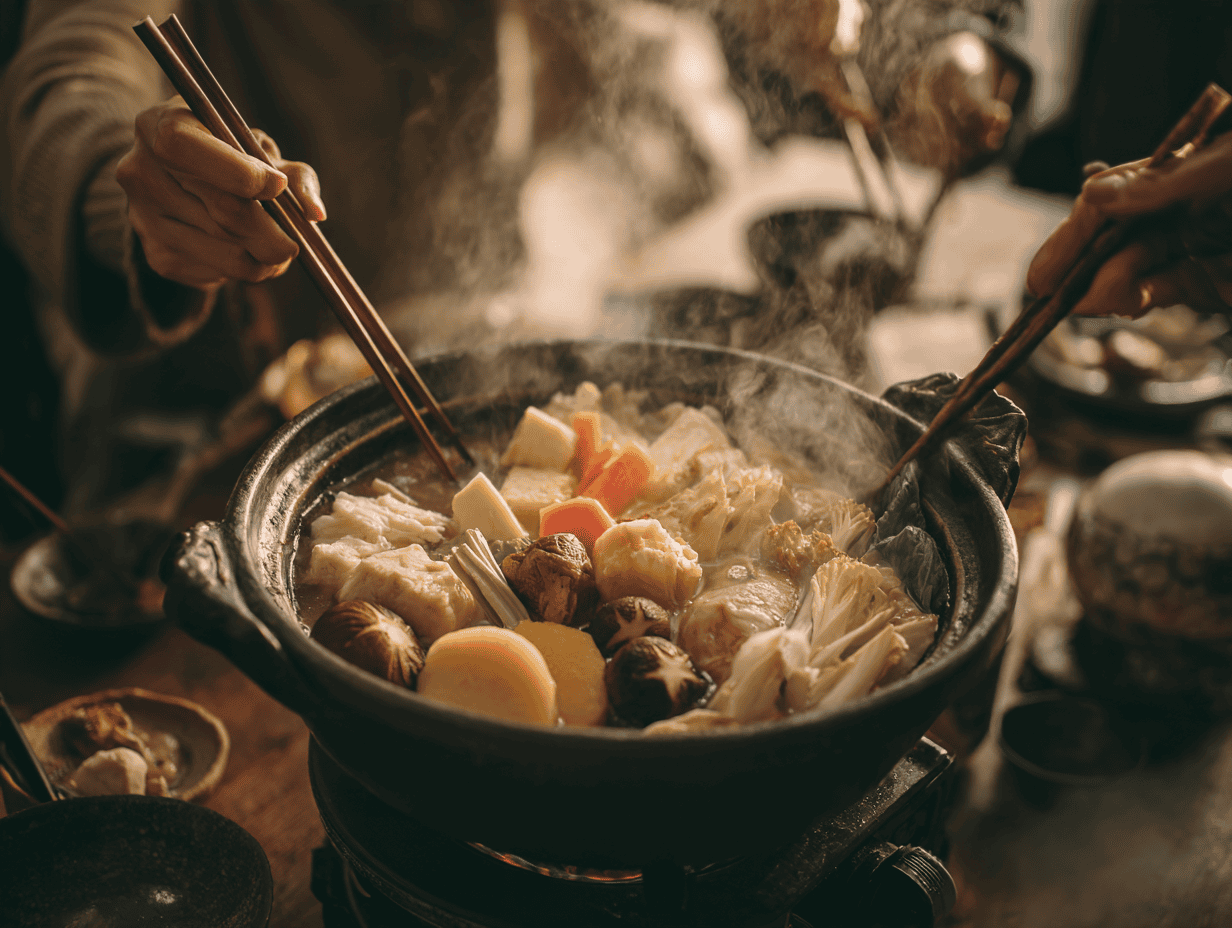
A winter favorite in Japanese homes, yosenabe takes its name from yoseru, to bring together. There is no single fixed list; cooks gather whatever is in season into one seasoned dashi.
- 2 cups dashi
- 2 tbsp sake
- 2 tbsp mirin
- 2 tbsp light (usukuchi) soy sauce
- 1/2 tsp salt
- 4 oz chicken thigh or tenders, cut into bite-size pieces
- 8 oz cod or other white fish, cut into 2-inch pieces
- 4 shrimp, peeled and deveined
- 1/4 head napa cabbage, cut into 2-inch pieces
- 1/2 bunch shungiku (chrysanthemum greens), cut into 2-inch lengths
- 1/2 negi (long green onion), sliced on the diagonal
- 1/2 small carrot, sliced into thin rounds
- 4 shiitake mushrooms, stems removed
- 1 small pack enoki mushrooms, roots trimmed
- 7 oz medium-firm tofu, cut into 8 cubes
- Chopped green onion and shichimi togarashi, to serve
- Combine the dashi, sake, mirin, light soy sauce and salt in a donabe or wide pot. Bring to a simmer and taste for seasoning.
- Arrange the cabbage stems, carrot, chicken and tofu in the pot in separate sections. Cover and simmer for about 5 minutes.
- Add the fish, shrimp, shiitake, enoki, negi and cabbage leaves in their own sections. Cover and simmer for 6 to 8 minutes, until the fish is opaque and the chicken is cooked through.
- Lay the shungiku on top for the last minute, then bring the pot to the table.
- Let everyone serve themselves into small bowls, topped with green onion and shichimi. Add more ingredients to the broth as the pot empties.
The pot sets the pace of the evening. People wait for the next round to cook, and conversation fills the gaps. Then someone adds more cabbage, someone else refills the cups, and the meal stretches on. Nothing about it is formal, which is exactly why it works. In fact, this is en at its most ordinary: a few people, one table, and enough time for talk to deepen.
Tea often follows a meal like this. A pot of hojicha or sencha, poured into small cups and passed around, keeps people at the table a little longer. Japanese ceramic cups, made to be held in two hands, suit that unhurried hour well.
Being a regular
Not every connection begins over dinner, though. Some grow from repetition alone. Think of the café where the barista knows your order, or the shop where the owner asks about your week. Neither link was planned. Yet both formed because you kept coming back, and because someone on the other side noticed.
Japanese has a word for this kind of customer: jōren, a regular. Being one is a small form of belonging. It asks nothing dramatic of you, only that you return. Over months, those brief exchanges become a steady thread in your week, and sometimes the start of a real friendship.

This is the easiest form of en to tend. Choose a few places and return to them. Learn a name. Ask a question and remember the answer next time. These steps sound small, yet they build the relaxed hours that Hall’s study found matter most. They also train the same skills a relationship needs: attention, patience and care. Better still, they cost you nothing but a little time and a willingness to say hello first.
For more Japanese ideas that reward daily attention, our collection of Japanese concepts for everyday life sets en beside ikigai, ma and other words worth knowing.

A word that looks both ways
Before the questions, one last point about the word. En looks backward and forward at once. It names a link that already exists, and it invites you to care for it. So the most useful question is not “Will I find connection?” Instead, ask “Which connections are already here, and how can I tend them?”
That question changes where you look. Rather than waiting for one big meeting, you start to notice the many small ones. A neighbor, a colleague, a friend of a friend: each is a thread already in place. Some will stay slight. A few may grow strong. Either way, the care you give them is practice for every relationship to come.
Questions Worth Asking
How do you pronounce 縁 in Japanese?
Say it as a single short syllable, "en," like the "en" in "end" without the final d. In compounds the reading can shift, as in engawa, the veranda. When it appears alone in older poetry or songs, it may be read enishi, a gentler literary form of the same idea.
What does "go-en ga nakatta" mean?
It means "there was no connection," and it is a polite way to say something did not work out. Companies often use it when turning down a job applicant, and friends may say it about a flat they did not get. It softens disappointment by pointing to circumstances rather than blame.
Is en the same as kizuna?
Not quite. En is the link and the moment it began, often a slight one. Kizuna is a firm bond built over time, such as the closeness of a family or a team. A chance meeting gives you en; years of shared effort can turn it into kizuna.
Can en describe a connection to a place?
Yes. Japanese speakers often say they have en with a town, a school or a company. It might be a city where they studied, or a region where a grandparent lived. The phrase expresses a sense of belonging and a reason to return, with no romantic meaning at all.
Is 縁 a good kanji for a tattoo or a name?
It is a popular choice, because its meaning is warm and widely understood. Check the context, though. As a single character it reads as "connection" or "ties," but it can also mean "edge." For a name, ask a native speaker how the full name sounds and reads together.
What is a good Japanese word for a strong friendship?
Kizuna fits a strong, lasting bond best. For close friends who have shared a lot, Japanese speakers also say shin'yū, written 親友, which means best friend. En works better for the beginning of a friendship, when the link is new and still growing.
A Thread You Hold From Your Side
En is a small word with a generous view of people. It says that every relationship starts somewhere ordinary. It also says the link is worth tending, whether it becomes a friendship, a partnership or a warm hello at the same café each week. In the end, that is why it remains the best Japanese word for connection. It describes both the meeting and the care that follows.
You cannot choose who walks into your life. However, you can choose how ready you are when they do. If you would like a structure for that, a 90-day practice in connection gives you one prompt a day across five threads, in a digital write-on edition for tablet apps or a paperback. It sits within our wider family of guided Japanese philosophy journals.
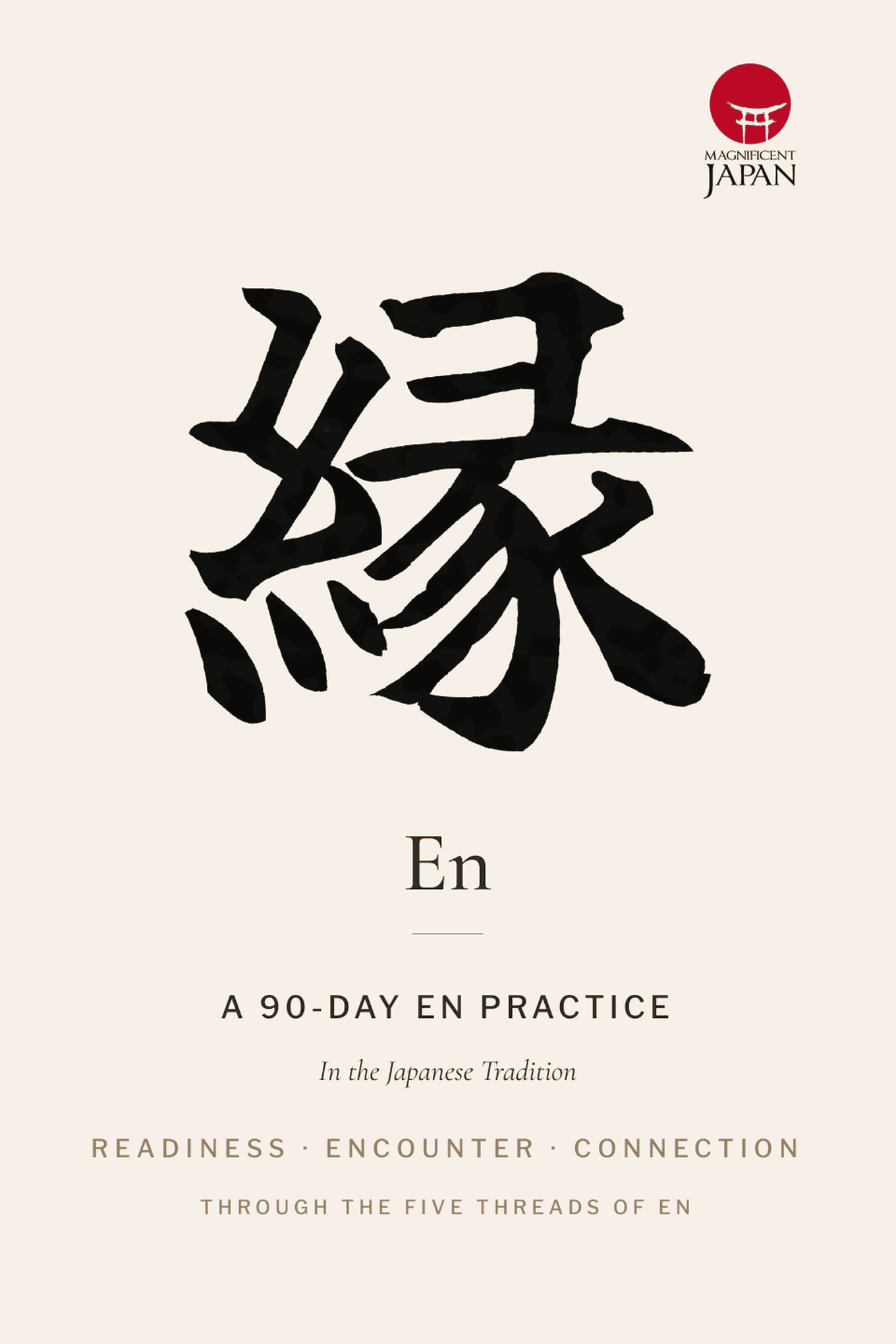
A guided journal for relationship readiness: ninety days of inner work before dating, shaped by the Japanese word for connection.
View the Journal →Start with one thread today. Write down a connection you already have, and how it began. Then do one small thing to tend it this week. A message, a visit or a shared meal is enough. That is en in practice.
The Editors, Magnificent Japan
We design routes built around encounters: a cooking class in a Kyoto home, a long lunch with a potter in Mino, an evening at a neighborhood counter where the chef remembers your name.
Plan Your Custom Japan Itinerary