Culture · Ceremony
The Japanese Tea Ceremony: A Considered Guide
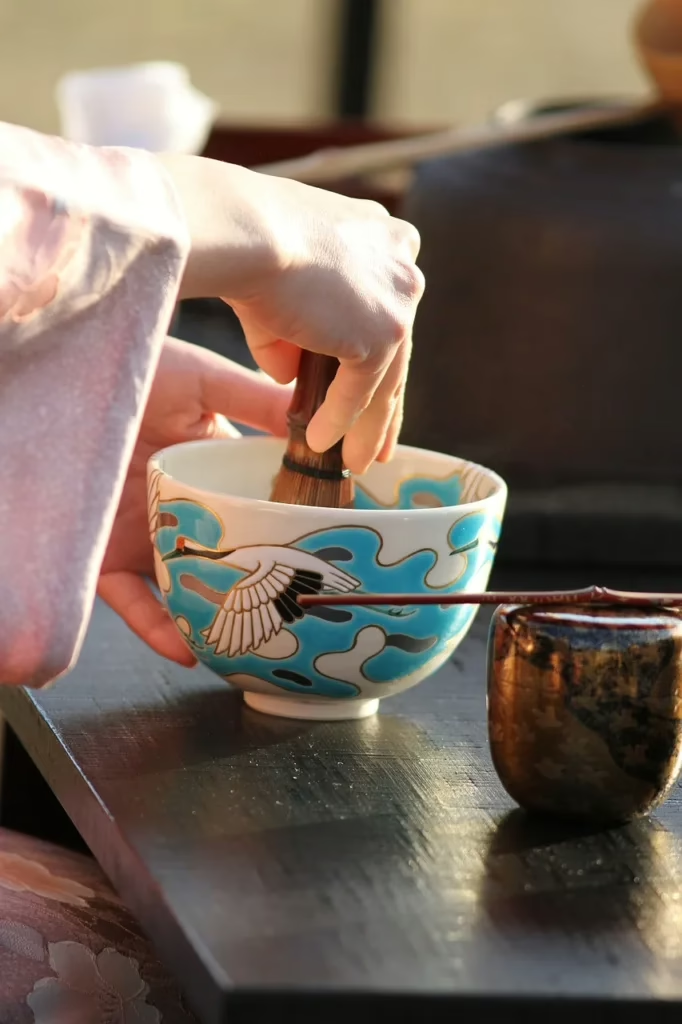
The Japanese tea ceremony — chanoyu — is a deliberate ritual in which a trained host prepares matcha for a small group of guests. It is built on four principles: harmony, respect, purity, and tranquillity. A short tourist sitting runs 30 to 45 minutes; a full chaji can last four hours.
Some traditions earn their gravity. The Japanese tea ceremony is one of them. It has survived nine centuries of warlords, monks, regents, and modern cynicism. It still holds together because the spirit at its centre is older than the rituals built around it. The ceremony is not really about tea. It is about the quality of attention two people bring to a single hour.
This guide is the cultural pillar — what chanoyu is, where it came from, what happens at a real ceremony, and how to attend one without disappointment. For step-by-step home practice, see the home guide to practising chanoyu. For the green teas served and grown in Japan, see the guide to Japanese green tea varieties.
What the Japanese Tea Ceremony Is
The Japanese tea ceremony, called chanoyu (茶の湯, “hot water for tea”) or sadō / chadō (茶道, “the way of tea”), is the codified preparation and serving of matcha green tea. A trained host performs each gesture in front of a small group of guests in a purpose-built room. Although the act looks simple, the rules behind it have been refined for more than four hundred years.
Beyond the tea itself, the ceremony is a vehicle for omotenashi — the Japanese ideal of looking after a guest wholeheartedly. The host has chosen the bowl, the scroll, the flower, and the sweet for this gathering and no other. In return, the guest pays close attention. Conversation is sparse. Movements are slow. The point of the gathering is the gathering itself.
Most travellers experience an abbreviated version. A short chakai sitting at a temple, garden teahouse, or hotel runs 30 to 45 minutes and centres on a single bowl of thin tea (usucha). A full chaji, which only the most committed students attend, lasts up to four hours and includes a kaiseki meal, thick tea (koicha), and thin tea, with seasonal art and floristry curated for the day.
A Brief History — From Buddhist Monks to Sen no Rikyū
Tea entered Japan in the early ninth century. According to the Nihon Kōki court chronicle, a Buddhist priest named Eichu prepared tea for Emperor Saga in 815, after returning from study in Tang China. For three centuries the practice stayed inside temples and the imperial court.
In the late twelfth century, the Zen monk Eisai brought matcha-style preparation home from China and planted seeds at a Kyoto temple. Drinking powdered green tea spread to the samurai class. By the Muromachi period, tea had become a status game among warlords who collected Chinese wares and competed to host the most lavish gatherings.
The shift that produced the ceremony as we know it began with the monk Murata Jukō (1422–1503), who treated tea as a path of meditation and stripped the gathering of its showier elements. His ideas matured under Takeno Jōō and reached their canonical form with Sen no Rikyū (1522–1591), tea master to the warlords Oda Nobunaga and Toyotomi Hideyoshi. Rikyū made the room smaller, the door lower, and the wares humbler. He elevated the rustic over the refined, and he wrote the principles still recited by every student today.
After Rikyū’s forced suicide in 1591 — politics and tea were inseparable in his lifetime — three of his descendants founded the schools that survive: Omotesenke, Urasenke, and Mushakōjisenke. Together they form the san-senke, and they still teach the way of tea across Japan and abroad.
The Four Principles — Wa, Kei, Sei, Jaku
Sen no Rikyū’s teacher Takeno Jōō handed him four words. Rikyū wrote them down, and every tea student has carried them since. Together they describe the spirit a host and guest agree to bring into the room. They are the most quoted phrase in chanoyu, and they are routinely confused with wabi-sabi or ichigo ichie, which sit alongside them as related but separate ideas.
Wa (和) — Harmony
Harmony between the host and the guests, between the gathering and the season, and between the people present and the objects in the room. Wa is the working agreement of the ceremony. Everyone leaves their rank at the door, and the room composes itself as a single instrument.
Kei (敬) — Respect
Respect for the guest, the host, the utensils, and the lineage of teachers behind every gesture. Kei is the reason a bowl is rotated before drinking, the reason the host bows at the doorway, and the reason a 400-year-old chawan is handled the same way in a hotel teahouse as in a Kyoto sub-temple.
Sei (清) — Purity
Purity of the room, the utensils, the body, and the mind. Guests rinse their hands and mouths at the stone basin (tsukubai) before entering. The host cleanses every implement in front of the guests, in a precise order. Sei is also internal — the work of setting daily concerns aside before the gathering begins.
Jaku (寂) — Tranquillity
Tranquillity is the quality that arrives last. It is what the first three principles produce when they are honoured properly. A still mind in a still room, watching tea being made. Many practitioners describe jaku as the feeling that the room has fallen out of ordinary time for an hour.
Wabi-Sabi and Ichigo Ichie — The Aesthetic Frame
The four principles describe how the gathering is conducted. Wabi-sabi and ichigo ichie describe how it is perceived. Both terms appear constantly in writing about the tea ceremony, and both are routinely mistaken for the principles themselves. They are not. They are the aesthetic and philosophical climate inside which the principles operate.
Wabi-Sabi — Beauty in Quiet Imperfection
Wabi names the beauty of simplicity, restraint, and rustic understatement. Sabi names the grace that age and use bring to a thing — the patina on a tea caddy, the chip on the rim of a bowl, the mossed stone in the garden. Together, wabi-sabi is the aesthetic that Sen no Rikyū made canonical: rough Korean and Japanese pottery valued above polished Chinese imports, a single seasonal flower instead of an arrangement, a hut-sized room instead of a hall.
Ichigo Ichie — One Encounter, One Chance
Ichigo ichie (一期一会) translates as “one time, one meeting.” It is the idea that this gathering, at this temperature, with these guests and this scroll and this flower, will not occur again. Even if the same group meets in the same room next month, the season will have moved, the host will have aged a little, and the bowl chosen will be different. The phrase encourages full attention because what is happening cannot be repeated.
10 Japanese Proverbs Worth Writing Down
A free, beautifully typeset printable. Sign up brings early access to new journals and occasional reader-only offers.
One email a fortnight. Unsubscribe any time.The Three Schools — Urasenke, Omotesenke, Mushakōjisenke
Sen no Rikyū’s three great-grandchildren founded the three schools that still anchor chanoyu today. All three trace their lineage back to him directly, all three teach the same essential ritual, and all three differ in small matters of procedure that students recognise and outsiders rarely notice. Together they are called the san-senke.
Urasenke
Urasenke is the largest school by membership and the most active outside Japan. It runs branches and study groups in dozens of countries and is the school most responsible for the international visibility of the way of tea. A traveller looking for an English-language ceremony or an introductory class abroad is most often dealing with an Urasenke teacher. The Urasenke Foundation publishes a wide library of beginner material.
Omotesenke
Omotesenke preserves a more conservative line. Its procedures stay close to the historical record, and its students often describe the school’s spirit as quietly austere. It is less visible internationally but carries serious authority inside Japan.
Mushakōjisenke
Mushakōjisenke is the smallest of the three and the least visible to travellers. Its teachers tend to balance traditional practice with the realities of a contemporary student’s life, which makes it a thoughtful choice for residents in Japan who want disciplined training without ceremonial heaviness.
Chakai and Chaji — Two Forms of Gathering
Travellers often arrive at a tea ceremony expecting a single, fixed thing. In practice, the word covers two distinct events. Knowing which one you are attending sets the right expectation.
Chakai — The Informal Gathering
A chakai (茶会) is the shorter, lighter form. It runs 30 to 60 minutes and centres on a bowl of thin tea (usucha) served with a seasonal sweet. The host may serve several guests in succession or work through a small group. Almost every public ceremony available to travellers in Japan is a chakai. The format is honest about its scale; it does not pretend to be the full thing.
Chaji — The Formal Gathering
A chaji (茶事) is the long form. It begins with a kaiseki meal of seasonal courses, moves through thick tea (koicha) shared from a single bowl, and finishes with thin tea. A chaji can run four hours. The full version is rarely offered to travellers because it requires close knowledge of procedure on the guest’s side as well as the host’s. Students of the schools attend chaji as part of their training.
If you read a venue listing that promises “the full tea ceremony” in 45 minutes, you are reading a chakai under a different name. There is nothing wrong with that. It is simply useful to know.
The Ritual Flow — What Actually Happens
Procedures vary slightly between schools, seasons, and venues, but the broad arc is consistent. What follows is the shape of a chakai sitting as most travellers will experience it.
Arrival and the Garden Path
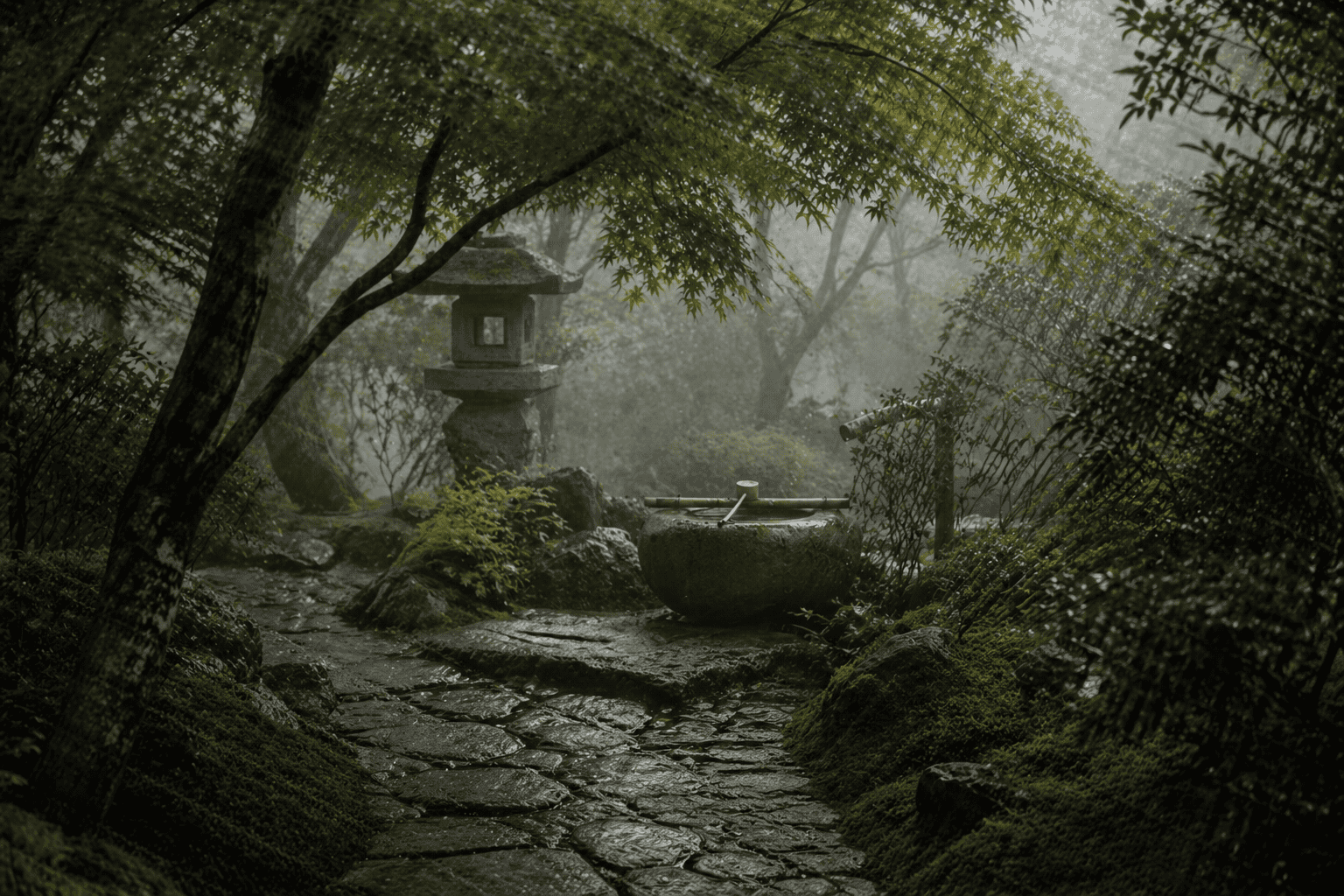
Guests arrive a little early and gather in a waiting room (machiai). When the host signals, they walk along a garden path called the roji (“dewy ground”). The path is deliberately quiet — no fragrant flowers, no bright colour. Its job is to settle the guest’s mind before the room.
Purification at the Tsukubai
Halfway along the path, guests pause at a low stone basin called the tsukubai. Each rinses hands and mouth with a bamboo ladle. The gesture is symbolic, drawn from Shinto purification, and it marks the point at which ordinary concerns are set down.
Entering Through the Nijiriguchi
In a traditional teahouse, guests enter through a small doorway called the nijiriguchi — usually no taller than 70 centimetres. Everyone bows to enter, including high-ranking guests. The doorway is one of Sen no Rikyū’s contributions, and it makes a quiet point about equality.
Admiring the Tokonoma
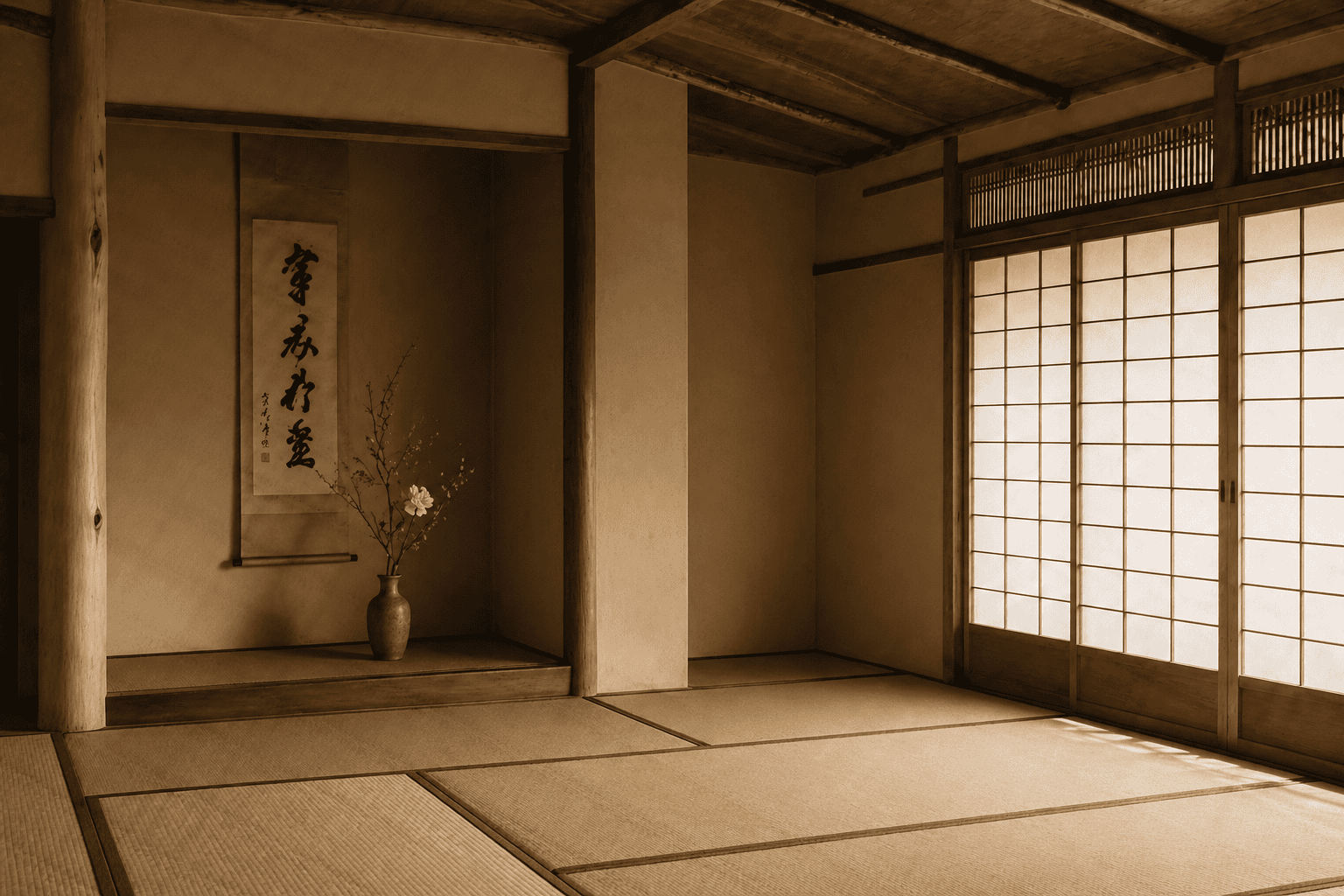
Inside, guests proceed first to the tokonoma, the alcove that holds the day’s calligraphy scroll and a single seasonal flower (chabana). The scroll usually carries a Zen phrase chosen for the occasion. Each guest pauses, bows, and takes in the choice before sitting.
Cleansing the Utensils
The host then cleanses each implement in turn — the tea caddy, the scoop, the whisk, the bowl — using a folded silk cloth (fukusa) and a linen cloth (chakin). The order is precise. Hygiene is not the point; the implements are already clean. The point is attention.
Wagashi and the Whisking
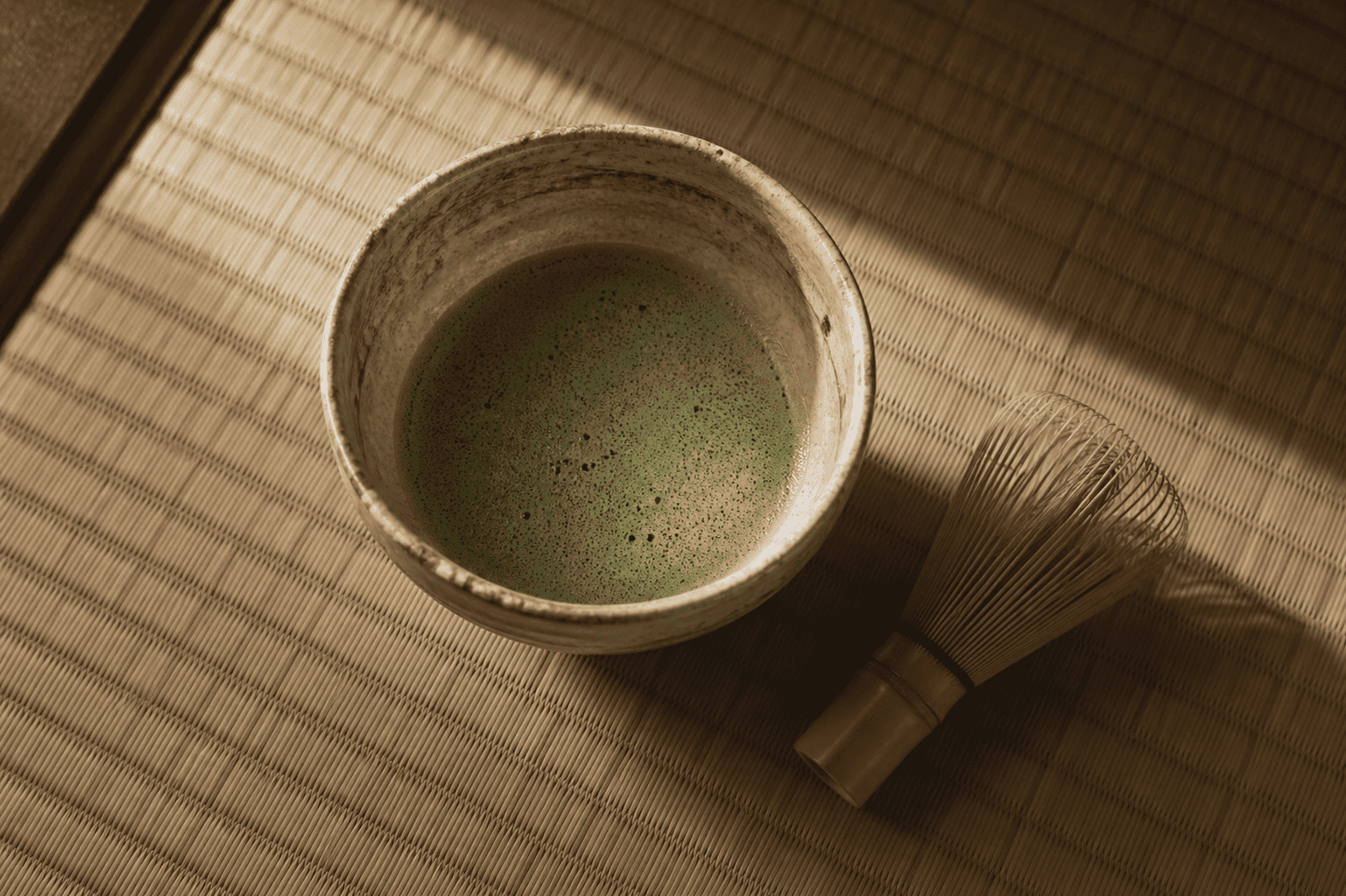
A seasonal Japanese sweet (wagashi) is served before the tea. Its sugar balances the bitterness of the matcha. The host then scoops matcha into the bowl, adds hot water, and whisks the powder into a fine, even foam with a bamboo chasen.
Receiving the Bowl
The bowl is offered to the first guest with the front facing them. The guest accepts it with both hands, bows, and rotates the bowl two short turns clockwise so as not to drink from its most beautiful side. They drink in three sips, wipe the rim, and rotate the bowl back before returning it.
Closing
After the bowl returns, guests are sometimes invited to inspect the utensils more closely and ask the host about their origin or their maker. The host bows, the guests bow, and the gathering ends. Outside, ordinary time resumes.
The Setting — Chashitsu, Tokonoma, and the Garden
A purpose-built tea room is called a chashitsu. The ideal floor area is four-and-a-half tatami mats — small enough that four or five people occupy the room comfortably and no further. Sen no Rikyū’s preferred chashitsu were modelled on a hermit’s hut: rough plaster walls, exposed timber, a low ceiling, and very little decoration.
The tokonoma alcove anchors the room. It holds one calligraphy scroll and one flower. Both are chosen for the day. A tea master will often own scrolls and bowls older than most countries, and the choice of which to use this morning is a quiet act of editorial. Guests are expected to notice.
Lighting is soft and filtered through paper shoji screens. The tatami mats define where each person sits, and seating order reflects the social geometry of the gathering — the principal guest (shōkyaku) closest to the alcove, then the others in descending position. Outside, the roji garden does the work of preparing the guest before they arrive at the door.
In the cool months (November to April), the host uses a sunken hearth (ro) cut into the tatami floor, which warms the room as the kettle heats. In the warm months (May to October), the hearth closes and a portable brazier (furo) takes its place, set further from the guests so the room stays cool. The seasonal switch is one of the year’s small ceremonies in itself.
The Utensils — Chawan, Chasen, Chashaku, Natsume
The collective term for tea utensils is chadōgu. A working set has more than twenty named items. The half-dozen below are the ones a guest will see in any chakai sitting. For a complete toolkit and a step-by-step home practice, see the home guide to practising chanoyu.
- Chawan (茶碗) — the tea bowl. Heavier and deeper for winter, lighter and shallower for summer. Each chawan has a “front” — the most beautiful face — which the host turns toward the guest.
- Chasen (茶筅) — the whisk. Carved from a single piece of bamboo, with 80 to 120 fine tines. A new chasen is one of the most quietly demanding crafts in Japan. A 100-prong bamboo chasen is the standard for usucha.
- Chashaku (茶杓) — the scoop. A slim bamboo spoon, often signed by the artisan and named.
- Natsume (棗) — the tea caddy. A small, lacquered container that holds the matcha. Natsume are often heirlooms.
- Fukusa and Chakin — silk and linen cloths. The fukusa cleanses the caddy and scoop; the chakin wipes the bowl. The folds are part of the choreography.
- Kama, Hishaku, Mizusashi — kettle, ladle, water jar. Together they handle the water, and each has its own seasonal etiquette.
For practice at home, a starter set is enough. A complete matcha kit with bowl and whisk covers the essentials. A ceramic chawan with a built-in whisk holder keeps the chasen in shape between uses. For the matcha itself, a stone-ground ceremonial-grade powder is the right starting point — culinary grade is too rough for a bowl of usucha.
Recommended
Etiquette as a Guest — What to Know Before You Go
Etiquette at a chakai is more forgiving than reputation suggests. Hosts know their guests are first-timers, and most public ceremonies offer brief guidance in English at the start. The points below are the ones that count. For broader cultural form, see the guide to Japanese etiquette.
Dress
Modest, neutral, and quiet. Avoid loud patterns, white socks with holes, jewellery that scrapes, and any strong scent — perfume can travel through a small room and overwhelm the matcha. Western clothes are perfectly acceptable. Some venues offer kimono rental, which adds a pleasant layer to the experience without being required.
Arrival and Phones
Arrive a little early. Walk the garden if there is one. Phones go to silent before you sit down. Photographs are usually allowed before and after the ceremony itself, but rarely during it.
Receiving the Bowl
Take the bowl with both hands. Bow. Place it on your left palm. Rotate it two short turns clockwise so the front faces away. Drink in three sips, with a small finishing sip that signals you are done. Wipe the rim with your right hand and rotate the bowl back. Return it with thanks.
Conversation
Speak only when invited, and keep your voice low. The right time to speak is when the host invites questions about a utensil or the scroll. Compliments on the bowl, the season, or the choice of sweet are welcome. Idle chatter is not.
Where to Experience the Tea Ceremony in Japan
Tea ceremonies range from refined sub-temple sittings to staged hotel demonstrations. Quality varies. A short list of patterns to look for: a small group (under eight), a participatory rather than spectator format, and a venue with its own garden or tatami room rather than a function suite. With those three filters, the chance of a memorable hour climbs sharply.
Kyoto
Kyoto is the spiritual home of tea, and most of the country’s tea is grown an hour south in Uji. The three schools all have their headquarters here, and the city carries the highest concentration of serious venues anywhere in Japan. Sub-temples within Kennin-ji and Daitoku-ji periodically host public ceremonies. Camellia in Higashiyama runs accessible, English-led chakai for travellers. For two days of context around the tea, see the Kyoto two-day itinerary.
Tokyo
Tokyo is often overlooked for tea, which is a mistake. The capital has been the home of major collectors and tea masters for a century, and several luxury venues run beautifully — Hotel Chinzanso’s Zangetsu room, Happō-en in Shirokanedai, and the public teahouse at Hamarikyu Gardens, which sits on water with the city skyline in the distance. Hotel ceremonies in Tokyo are often more refined than their Kyoto equivalents, and almost always available in English.
Kanazawa
Kanazawa carries a samurai-quarter tea culture that is distinct from Kyoto’s monastic line. The tea garden at Gyokusen-en is a small jewel, and the geisha district of Higashi Chaya has working teahouses. Crowds are lower, the rhythm is slower, and the setting suits a traveller who has done Kyoto already and wants the same tradition with more breathing room.
Uji
Uji, between Kyoto and Nara, is where the tea grows. Several venues along the path between Uji Station and Byōdō-in temple offer tasting flights and short chakai sittings, often within sight of the tea fields. A morning in Uji pairs naturally with a chakai in Kyoto in the afternoon.
What to Skip
Stage demonstrations in large hotel ballrooms tend to drain the spirit out of the ceremony. So do “tea ceremony experiences” in shopping centres. Both are technically accurate; both miss the point. If a venue lists a 15-minute slot, it is a demonstration, not a ceremony.
Is It Worth Doing on a First Trip to Japan?
Yes, with the right venue. Several thoughtful travel writers — Robert Schrader at Japan Starts Here, Chris Rowthorn at Inside Kyoto — have written honestly about how a poorly-chosen ceremony can feel staged or stiff. The critique is fair. Plenty of public ceremonies in Japan have over-rehearsed themselves into a performance that makes guests anxious rather than calm.
The fix is the venue. A small chakai at a Kyoto sub-temple, a Tokyo garden teahouse, or a Kanazawa samurai-quarter venue tends to keep the ceremony’s spirit intact. Avoid the largest tourist halls. Choose participation over demonstration. Ask whether the host will speak some English, and whether you will receive a bowl yourself. With those filters, the answer to “is it worth doing?” is almost always yes.
Beyond the Ceremony — Bringing the Spirit Home
Few travellers will study chanoyu seriously. Many take small things home with them — a slower morning matcha, a single seasonal flower on the table, a habit of sitting still for ten minutes before a difficult conversation. The tradition is generous about its borrowing. The principles that apply in a tatami room apply equally well in a kitchen.
For tea at home, the guide to Japanese green tea varieties covers matcha, sencha, hojicha, and genmaicha — what each is, where it comes from, and how to brew it. For a structured home practice, the home chanoyu guide walks through preparation step by step. And for the philosophy in writing, the Magnificent Japan Tea Ceremony journal at the foot of this page carries the ceremony’s spirit into a notebook designed to be written in slowly.
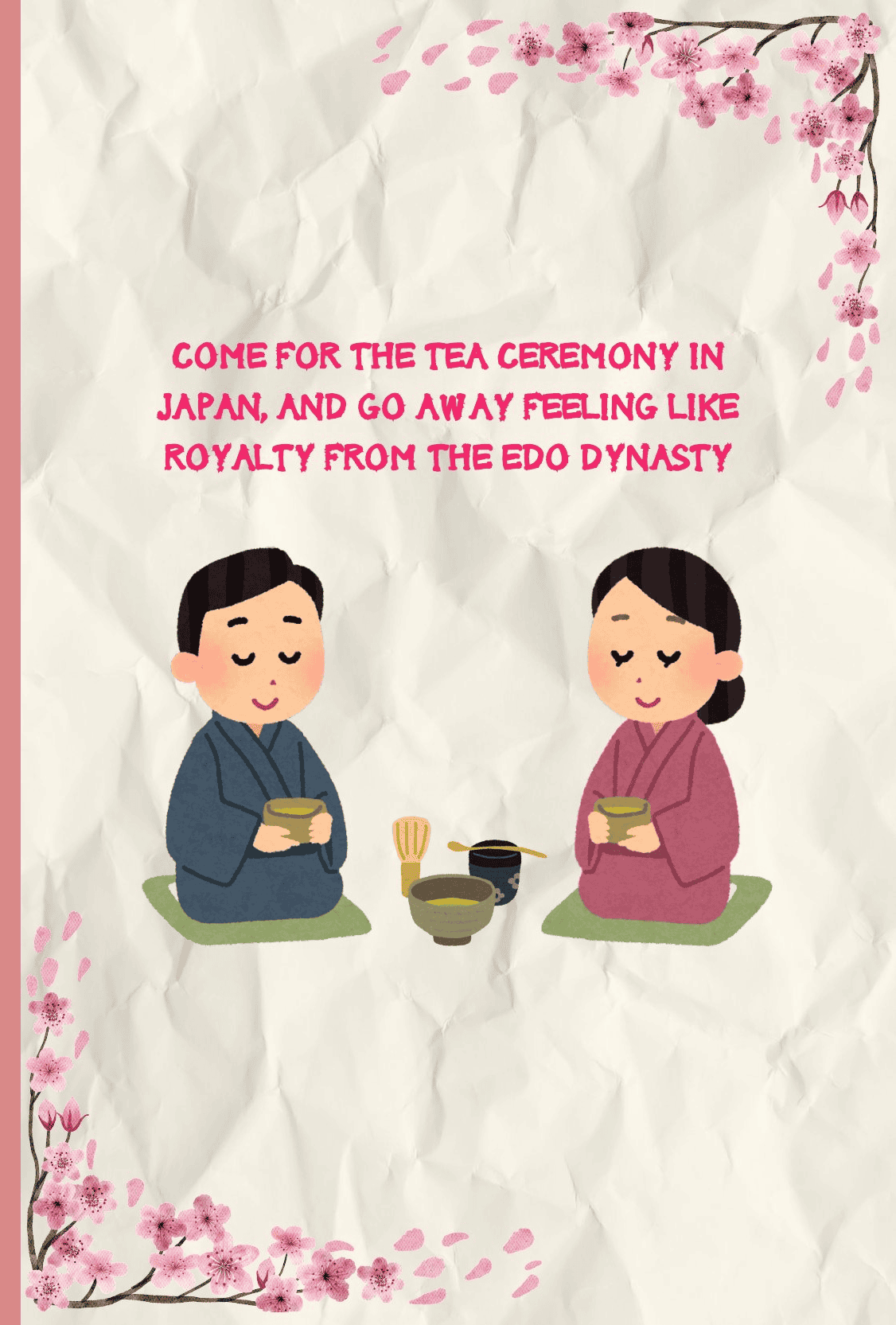
Tea Ceremony
Come for the tea ceremony, and leave feeling like royalty from the Edo dynasty.
6×9 in · 120 blank pages · Matte softcover
Shop This Journal →Questions, Answered
What happens at a Japanese tea ceremony?
A trained host prepares matcha for one to five guests with deliberate movements. Guests purify their hands, enter through a small doorway, admire a scroll and seasonal flowers, then receive a bowl of whisked matcha. The host cleanses each utensil in view. Guests rotate the bowl, drink in three sips, and return it with thanks.
How long does a Japanese tea ceremony last?
An informal chakai runs 30 to 45 minutes and is the format most travellers experience. A formal chaji can last up to four hours and includes a kaiseki meal, thick koicha tea, and thin usucha tea. Most public venues offer the shorter chakai-style sitting.
What are the four principles of the Japanese tea ceremony?
The four principles, set down by Sen no Rikyū in the sixteenth century, are wa (harmony), kei (respect), sei (purity), and jaku (tranquillity). Together they describe the spirit a host and guest bring to the gathering. They are sometimes confused with wabi-sabi, which is a separate aesthetic concept.
What should you wear to a Japanese tea ceremony?
Modest, subdued clothing without strong patterns or scent. Western dress is acceptable at all public ceremonies. Remove watches, rings, and jewellery before entering the room to protect the utensils. Wear clean socks since shoes come off at the doorway. Some venues offer kimono rental if you want the full experience.
Is a Japanese tea ceremony worth doing on a first trip to Japan?
Yes, with the right venue. Choose a small participatory chakai over a stage demonstration, and the experience repays close attention. Kyoto sub-temples, Tokyo garden teahouses, and Kanazawa samurai-quarter venues tend to keep the spirit of the ceremony intact. Avoid the largest tourist halls if you want depth over volume.
Plan a Considered Trip to Japan
Magnificent Japan designs custom itineraries for travellers who want depth over volume — the right tea ceremony, the right ryokan, the right two days in Kyoto.
Request a Custom JourneyFurther reading: JNTO on the tea ceremony · The Met’s essay on chanoyu · The Urasenke Foundation.