
Kanji radicals change the way a new character looks. Take 海, the kanji for sea. At first it is a tangle of nine strokes. Look again, and the three short drops on the left read as water. That one familiar part tells you the theme of the whole character before you know a single reading. This is the habit worth building, and it is a calm one: stop memorising the whole and start reading the parts.
This guide shows how. You will see what a radical is, where it sits inside a character, and how a few shared parts open hundreds of kanji. It also covers the radicals that hide inside a shape and the places where the clue misleads. Then come a few tools for studying the parts and a fried tofu pouch that makes a fair picture of the idea.
Radicals, called bushu in Japanese, are the parts that kanji are built from and filed under in dictionaries. A radical often hints at meaning: 氵 (water) sits in 海, sea, and 言 (speech) sits in 話, talk. Reading the parts turns a new character into a few familiar pieces.
What Kanji Radicals Are
A radical is a part of a kanji that does a job. In Japanese the word is bushu, which means section or part. Every kanji is filed under one radical in a dictionary, the way a book is filed under a shelf. Traditional dictionaries use a set of 214 radicals, laid out in the Kangxi dictionary of the early 1700s, and that set is still the base of many lookup systems today.
Some radicals are whole characters that also work on their own, such as the one for water. Others appear only as a part, and they change shape to fit. Water is the plain example. Alone it is the full character for water, but on the left side of a kanji it shrinks to three drops, 氵. It is the same part wearing a narrower coat. Once you know this, a whole group of kanji stops looking strange.
Kanji radicals do two jobs. First, they sort: they decide where a kanji lives in a dictionary. Second, they hint: they often point to the theme of a character, such as water, speech, hand or heart. The second job is the one that matters to a learner.
Where a Radical Sits: Left, Right, Top, Bottom
A radical can sit in different places, and Japanese has a name for each. The left side is called hen, and the right side is called tsukuri. A part across the top is a kanmuri, a crown, and a part along the bottom is an ashi, a foot. Some radicals wrap around the rest of the character, and some sweep underneath it from the left.
Position tells you where to look first. Take 池, the word for pond. Its water drops stand on the left, so the left side is the theme and the right side is something else. The hand radical 扌 also sits on the left, as it does in 指, finger. Over 雲, cloud, the rain radical sits like a lid. And the heart sits at the bottom of 悲, sad, carrying the weight of the character, which suits the meaning.
The open KanjiVG project, which supplies the stroke data behind many learning tools, marks these places for the characters it draws. Its KanjiVG data tags the position of each component, such as left, right, top or bottom, so the idea is not a teacher’s habit but a feature of how the characters are built. Treat the labels as a map, not a rule you must recite.
Reading the Parts Instead of the Whole
Most learners meet a new kanji as one picture and try to memorise it whole. That works for ten characters and fails at a hundred. A better habit, and the reason kanji radicals matter to a learner, is to cut the picture into parts you already know. Ask three quick questions. Which part is the radical? What does it usually point to? What is left over once you take it away?
Try it on 話, talk. The speech radical 言 sits on the left, and a second part, 舌, the tongue, sits on the right. Speech plus tongue is an easy way to hold the shape, and it needs no drawing or story. You are only naming the parts that are already on the page. The same steps work on a kanji you have never seen, as long as one part is familiar.
Reading parts also helps when two kanji look alike. If you can say that one has the water radical and the other has the hand radical, you no longer confuse them by shape alone. You separate them by what each part points to. For now, the goal is a habit: split, name, then recall.
If you also like memory stories, our guide on how to remember kanji covers those. Here the method is plainer. You read the structure that is already there.
Water, Speech, Food: Radicals That Carry Meaning
Some radicals are generous with meaning. The first is water, 氵. It sits on the left of 海, sea, and also of 池, pond, 泳, swim, 河, river, and 湖, lake. Every one of them has to do with water, and you can guess the field of a new water kanji before you look it up. That small guess is worth a lot. It turns a blank character into a question you can answer.
The second is speech, 言. It appears in 話, talk, and in 詩, poem, 説, explain, and 謝, thank. Each of them is about words, spoken or written. The third is food, a radical that sits on the left of many words about eating and drinking. You do not need all of these today. You need only the habit of asking, when a character has a left-hand part you know, what field that part is pointing to.
A short note on the hand radical, 扌, and the heart radical, 忄. Both sit on the left and both change shape from their full forms. The hand radical appears in 打, hit, 投, throw, and 押, push, all of them actions. The heart radical sits in kanji about feeling and thought. When the same left-hand part keeps returning, you are not meeting new material. You are meeting an old friend in a new place. Say its name aloud when it appears, even if you only whisper it. Naming a part turns a passing glance into a small act of recall, and that act is what builds a memory that holds up when you meet the character again.
Radicals That Hide Inside a Shape
Not every radical sits at an edge. Some are tucked inside a shape, and the character looks like a single block until you know where to cut it. Take 電, electricity. It looks dense, with thirteen strokes in a square. But the top is the rain radical, the same part that covers 雲, cloud, and 雷, thunder. Rain on top points to weather, which is where the word began: lightning.

The meaning has since moved from the sky to the wall socket, yet the weather clue is still there for anyone who looks. Radicals keep a trace of where a word began, even when its use has moved on, and that trace is worth finding.
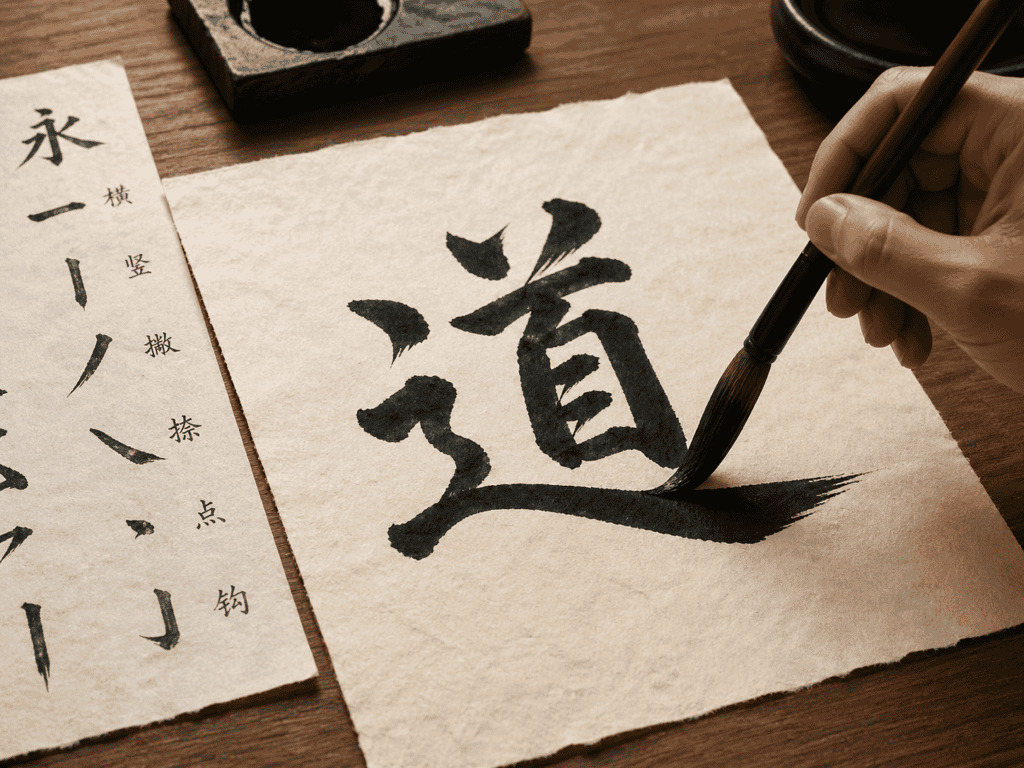
The same skill works on a character that looks like a solid block. Cover half of it with your finger and ask what is left. If one half is a part you know, name it. Look for the smaller piece at the top, the bottom or the corner, because radicals love to hide there. With a week of practice, your eye begins to cut kanji along their natural seams without being asked.
You may also like

One Radical, Many Kanji: Why a Few Parts Go a Long Way
Here is the main reason kanji radicals repay your time. A small number of parts shows up in a large number of kanji. The tree radical gives 林, grove, 森, forest, 桜, cherry tree, 橋, bridge, and 板, board. Each of them has to do with trees or things made of wood. Learn the tree once and you meet it again and again, usually in a form you can already name.

This is why a learner who studies radicals tends to speed up. The first fifty kanji are slow, because every part is new. Later kanji are faster, because their parts are old. Volume 1 of the MJ series shows the idea in a modest way: its hundred kanji are filed under seventy-five different radicals, so most parts appear in only one or two characters, and a handful of radicals gather several. The pattern is a gentle one, not a list to learn by heart.
There is a second pattern worth knowing. Many kanji pair a meaning part with a sound part. In 河, river, the water radical gives the theme and the right-hand part 可 gives the sound ka. In 湖, lake, the water again gives the theme and the right-hand part gives the sound ko. This does not work every time, because sounds have drifted over the centuries. When it works, though, it is a lovely shortcut.
When the Clue Misleads: Radicals Are Hints, Not Rules
Kanji radicals are hints, not rules. Dictionaries file a kanji under one radical for lookup, and that choice is sometimes a matter of convenience rather than meaning. Take 本, which means book and also origin. Dictionaries file it under the tree radical, yet nobody thinks of a book as a tree. The mark across the lower part was drawn to point at the root, and the idea of root grew into origin and then into the thing that carries the text.
So the tree is not wrong, only old. It records how the character began, not how it is used today. The same is true across the system. A radical can point to an earlier sense, a sound, or a sorting decision made centuries ago. Treat it as a first guess. If the guess fits the meaning, you have a handy memory aid. If it does not, you have lost nothing but a few seconds.
The Radical Reference in Volume 1
Reading the parts of kanji radicals is a skill, and a skill needs a place to practise. Volume 1 of the MJ kanji workbook series was built with that in mind. It carries a radical reference at the back, beside sets of look-alike kanji and an answer key, so you can check a part the moment you wonder about it.
The aim is to make the look-up a habit, not a chore. Each time you check a part, you also see its neighbours on the page, and those neighbours are often the very parts that will appear in the next character you meet. The reference works as a small map of the territory, drawn for a reader who is still finding the way.
A radical reference is useful for a simple reason: nobody holds every part in mind at once. You will meet a part that looks familiar and cannot place it, or two parts that look alike and cannot tell them apart. A reference at the back of the book answers that question in a few seconds, without a trip to a search engine and without losing your place on the page. That small saving keeps a session moving, and a session that keeps moving is a session you finish.

The workbook does not ask you to learn radicals as a separate subject. It asks you to meet them in the characters you are already writing. Spot the part, say what it points to, then write the kanji. That order keeps the parts connected to real characters, which is where they stay in memory. If you want to see how the first hundred kanji are laid out, the Volume 1 page shows a sample.
You may also like

Daily Review
For daily review, the five-a-day kanji flashcards give you a short session each morning, and they pair well with the habit of naming the radical aloud. Keep the sessions short. Ten calm minutes with a few parts beat an hour of staring at a page of shapes.
Tools for Studying the Parts
A few small objects make the habit easier. None of them is needed on day one. They simply help your eye hold a part still while you look at it, and that is half the work. Think of them as a reading kit for small shapes: colour to mark a part, light to see it, a clip to hold your place and a cup for the pause between sessions. Add each one when you feel the gap it fills.
Zebra Mildliner Highlighters, double-sided
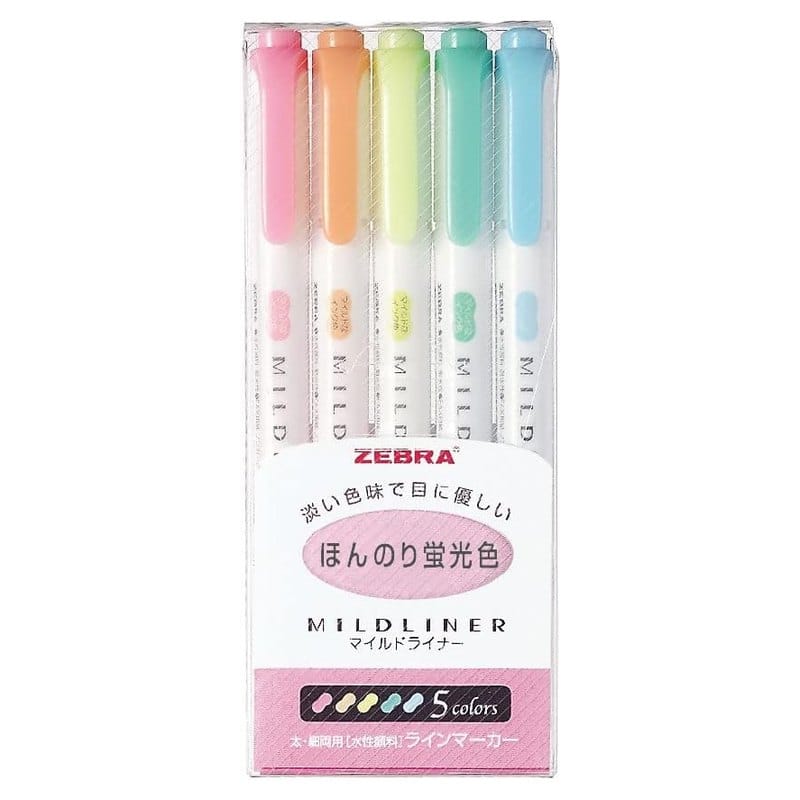
Colour is the simplest way to separate a radical from the rest. The Zebra Mildliner double-sided highlighters have a broad end and a fine end, and the soft shades do not turn a printed page into a blur. Pick one shade for water and another for speech, and mark that part in every character you study. After a week your eye finds the part before you decide to look for it. Use the fine tip for tight shapes, and keep the colours few so the page stays easy to read. A set of five covers every radical you will need for a season of study.
Some learners prefer to mark nothing at all, and that is fine. A pencil circle around the radical does the same job and rubs out when you change your mind. The point of the colour is not the colour. It is the pause: the half second in which you decide that this part is the water, or that part is the speech. That pause is the skill, and any mark that triggers it will do. Try both for a week, one page marked in colour and one in pencil, and see which page you remember better when you come back to it. Whatever you choose, keep the marking light, because the aim is to notice, not to decorate.
Mark Lightly
Mark lightly, and always on your own copy. A highlighted part is a note to your future self, and a page covered in colour stops being a note. A good rule is one colour per radical and no more than three on a page. That keeps the idea clear: a few parts, seen often. When a colour starts to feel like decoration, drop it and go back to pencil. The method works with a pencil, a pen or a fingertip, because what changes is the way you look, not the tool in your hand. Choose one method and stay with it for a month before you judge it, since a habit needs time to show its worth.
BenQ e-Reading Desk Lamp for small print

Small shapes need good light. The BenQ e-Reading desk lamp is built for long reading, with a wide, even beam that does not leave a hot spot on the page. Dimmable settings let you match the light to the time of day. When a character has twelve strokes packed into a square, a clear view of the lower left corner is often what lets you spot the part hiding there. Set the lamp to the side of your writing hand so it does not cast a shadow on the line. A steady light also helps tired eyes late in the day, when small shapes tend to swim.
Posture counts too. Sit so the page is flat in front of you and the light falls from the side. A tilted page makes the shapes look tilted, and a shadow can hide a small stroke. A minute spent on the setup saves a lot of squinting later.
The last group is smaller, and each item has a plain job. A clip keeps your place at the reference page, and a fine pen lets you write a part small enough to fit beside a character. A pair of cups turns the study break into a small ritual. Together they make a short session feel complete, which is why they earn a place on the table.
Three Pieces for the Study Table
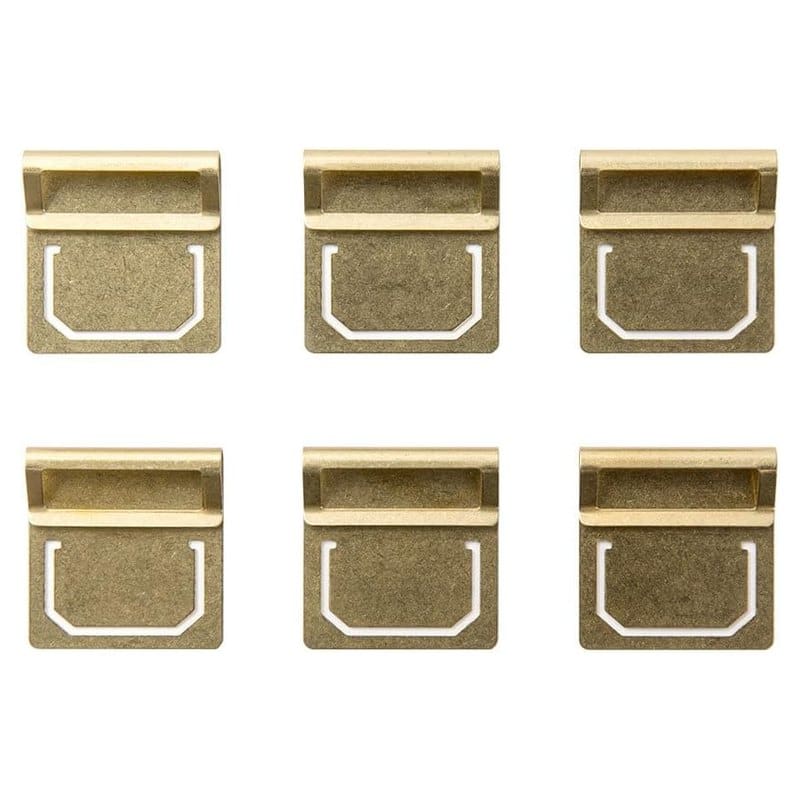
A slim brass clip that holds the reference page open or marks the page you left.
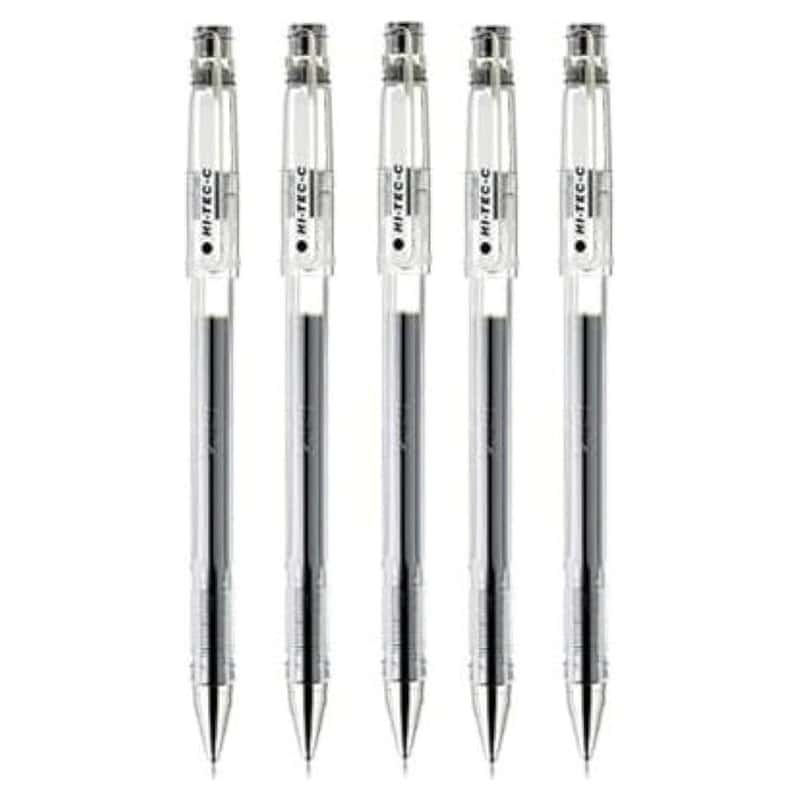
An extra-fine pen for writing a radical small, beside the character it belongs to.
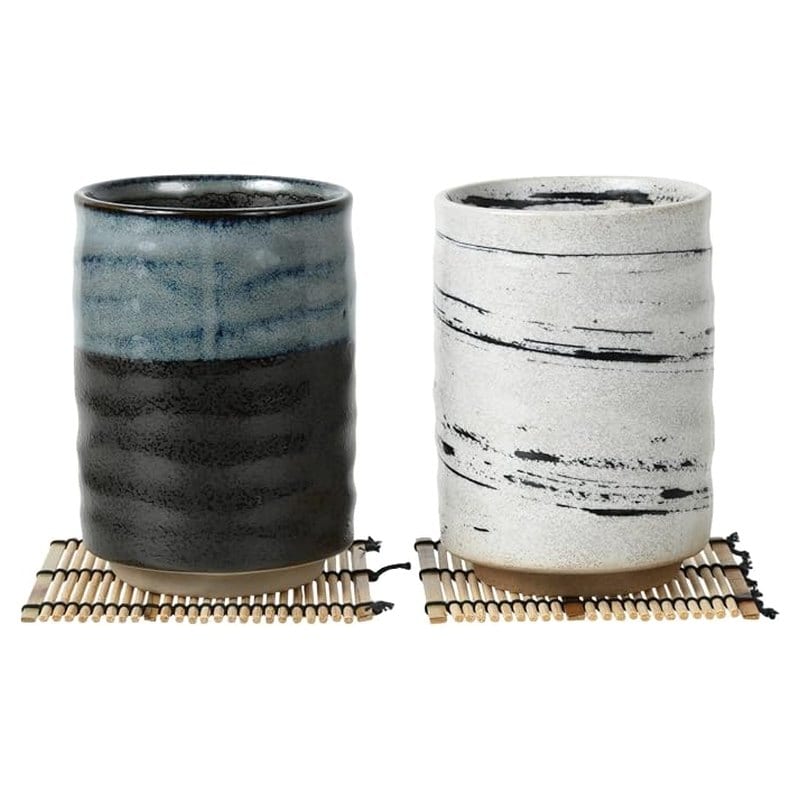
Two tall tea cups with bamboo coasters for the pause between sessions.
A Pouch That Holds Its Shape: Inari Zushi
Between sessions, a small plate of food is a good pause. Inari zushi is a pouch of fried tofu filled with seasoned rice, and it makes a fair picture of a radical. One part holds another. The pouch gives the shape, and the rice gives the substance, just as a radical gives a kanji its frame while the other part supplies the sound.
Sweet, Salty, Sharp
The flavours are simple and balanced. Simmering turns the tofu skin sweet and savoury, and the rice inside is seasoned with vinegar, so each bite has a gentle lift. Many cooks add toasted sesame seeds for a little crunch. The pouches keep well at room temperature, so they suit a study table as easily as a picnic.
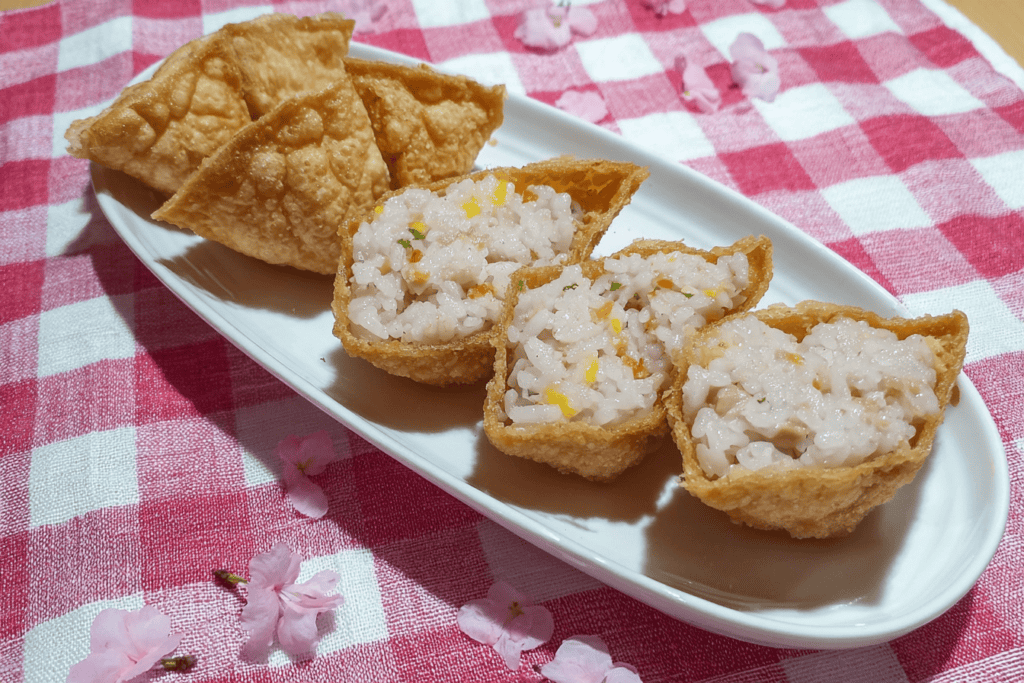
Inari Zushi — seasoned rice in a fried tofu pouch
Cook one and a half cups of short-grain rice, then fold in a dressing of three tablespoons of rice vinegar, one tablespoon of sugar and half a teaspoon of salt while it is still warm. Add a tablespoon of toasted sesame seeds and let the rice cool to hand warmth. Roll four sheets of fried tofu flat, cut each in half and open the halves into pouches.
Boil them for one minute, rinse and squeeze dry. Simmer the pouches in one cup of dashi with three tablespoons of sugar and two tablespoons of soy sauce for ten minutes, until the liquid has almost gone. Let them cool. Fill each pouch with a small ball of rice, fold the open edge under and serve.
Make a batch on a slow afternoon, and eat the pouches the same day. Then go back to the page with a clear head. Pick one character, find its radical and say aloud what the radical points to. Short, small and repeated: that is the whole method.
One Part at a Time
You now have the method. Cut a new kanji into parts. Name the radical. Ask what field it points to. Check the guess against the meaning, and expect it to miss now and then. Do this for a few minutes each day, and kanji radicals stop being a topic and become a habit. Some weeks it will feel like progress and others like standing still. Over a season, the parts begin to recur, and a page of strange shapes turns into a page of familiar ones.
Keep a Running List
Keep a short running list of the parts you have met, one line each, with the theme it points to. Do not copy a chart. Write only what you have seen in a character you were reading. After a month, the list is a map of your own progress, and every line came from a real kanji.
Recommended
Revisit the list once a week and cross out any part that now feels obvious. The ones left standing are the parts still worth your attention. This five-minute review keeps the method honest, because you only study what you found hard.

If you would like a guide beside you, the first hundred kanji, part by part, is a place to try the method with the radical reference close at hand. Take it one part at a time, and let each page show you what it can before you move on.

When the parts feel steady, widen the circle. Look at the signs on a station platform, the label on a tea tin, the name on a menu. You will not understand them yet, but you will begin to see water, speech, trees and hands where you once saw a blur. That change comes from practice, not talent, and it comes to anyone who keeps looking.
Ten Proverbs to Carry With You
A printable folio of ten Japanese proverbs, each set in kanji with its reading and a line on where you will hear it.
What to Do Next Week
Choose one radical, such as water, and look for it in every kanji you meet for seven days. Note each place it sits and each theme it points to. At the end of the week, count what you found. The number is usually larger than you expected, which is encouraging in itself.
Then choose a second radical and do the same. Two weeks of this is enough to change how a page of kanji looks to you, and that change is the point. Do not hurry the list. A part you have truly seen is worth ten you have only heard named, and the habit grows by repetition rather than by effort.

Reading the Signs in Japan
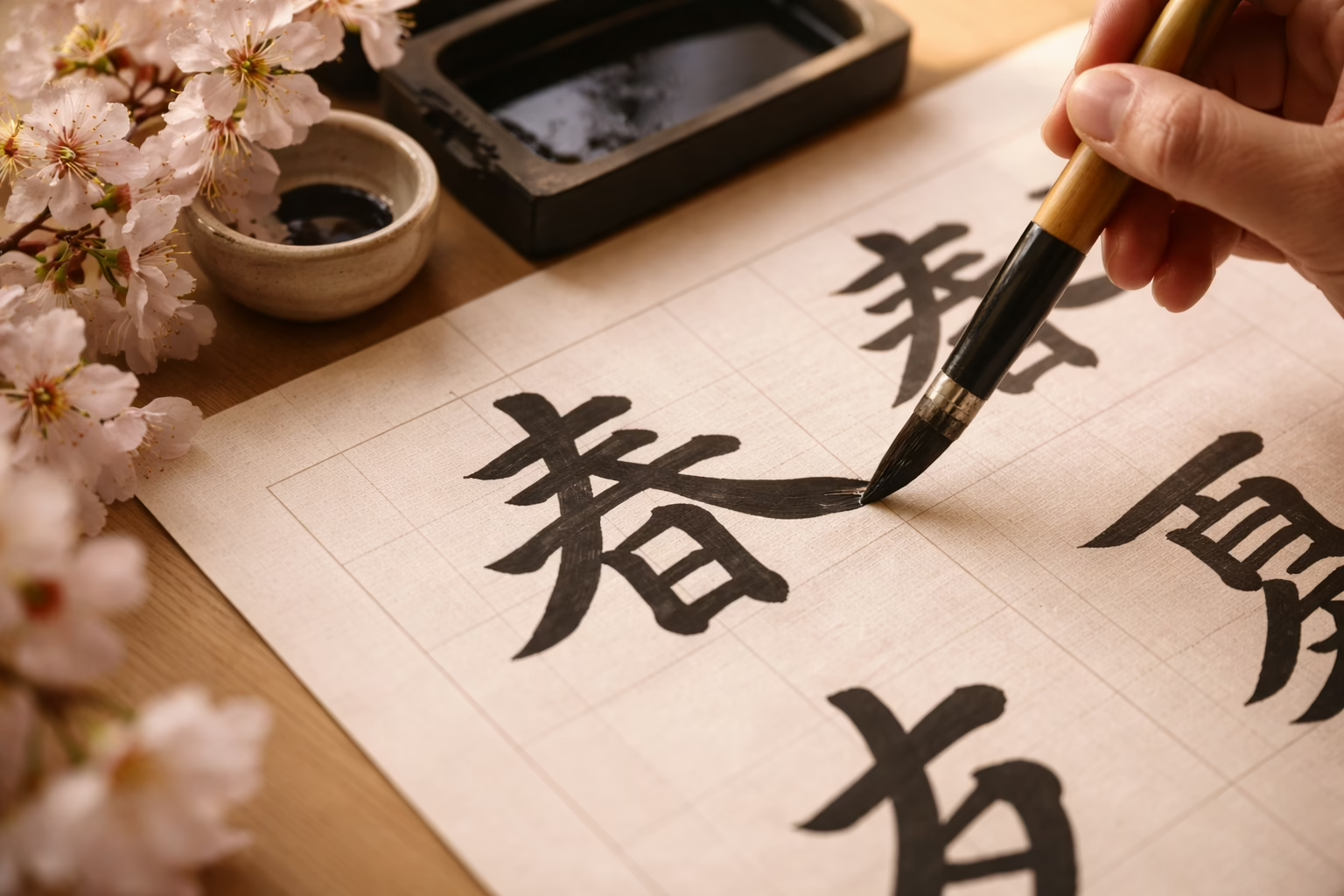
Some of the best moments with kanji happen in Japan itself. A station sign, a shop curtain or a menu suddenly shows its parts, and a place you could not read begins to speak. It also gives the characters you study at home a setting, which makes them easier to recall when you are back at your desk.
We build days around moments like that: a slow walk through an old quarter, a tea house where the menu is brushed by hand, a stationery shop in Kyoto. Every itinerary follows your pace and your interests, with the practical details handled for you. The characters you studied at home become streets, meals and conversations.
A Journey Planned Around What You Can Read
We can plan days around the details that make Japan legible: a walk where the signs begin to make sense, a morning in a Kyoto stationery shop, a slow afternoon with tea. Every itinerary is built around your pace and your interests.
Plan Your Custom Japan ItineraryQuestions Worth Asking
What are kanji radicals?
Radicals, called bushu in Japanese, are the parts that kanji are built from and filed under in dictionaries. Many of them hint at a theme, such as water, speech or hand. Reading a new character as a radical plus a few other parts makes it far easier to hold in mind.
How many kanji radicals are there?
Traditional dictionaries use 214 radicals, set out in the Kangxi dictionary of the early 1700s. You do not need all of them. A learner meets a few dozen again and again, and the rest appear mostly in rare characters.
Do I need to learn radicals before kanji?
No. Learn them alongside kanji, not before. A radical makes sense when you see it inside a real character, and it stays in memory there. Meet each part as it appears, name it, and note the theme it points to. The list builds itself over time.
Does a radical always tell you the meaning?
No. A radical is a hint, not a rule. It can point to an older sense of a word, to a sound, or to a sorting choice made for dictionaries. Treat it as a first guess, then check it against the meaning and the reading of the whole character.
Which radicals should a beginner learn first?
Start with the ones you can see easily and meet often: water, speech, hand, heart and tree. Each sits in many kanji, so each repays a little attention. Add a new one only when it appears in a character you are learning, not from a chart.
How do radicals help with remembering kanji?
They cut a crowded shape into a few familiar pieces, so your memory holds three small parts rather than one tangled picture. The theme of the radical also narrows the meaning. Both effects make a new character easier to recall and to tell apart from its look-alikes.