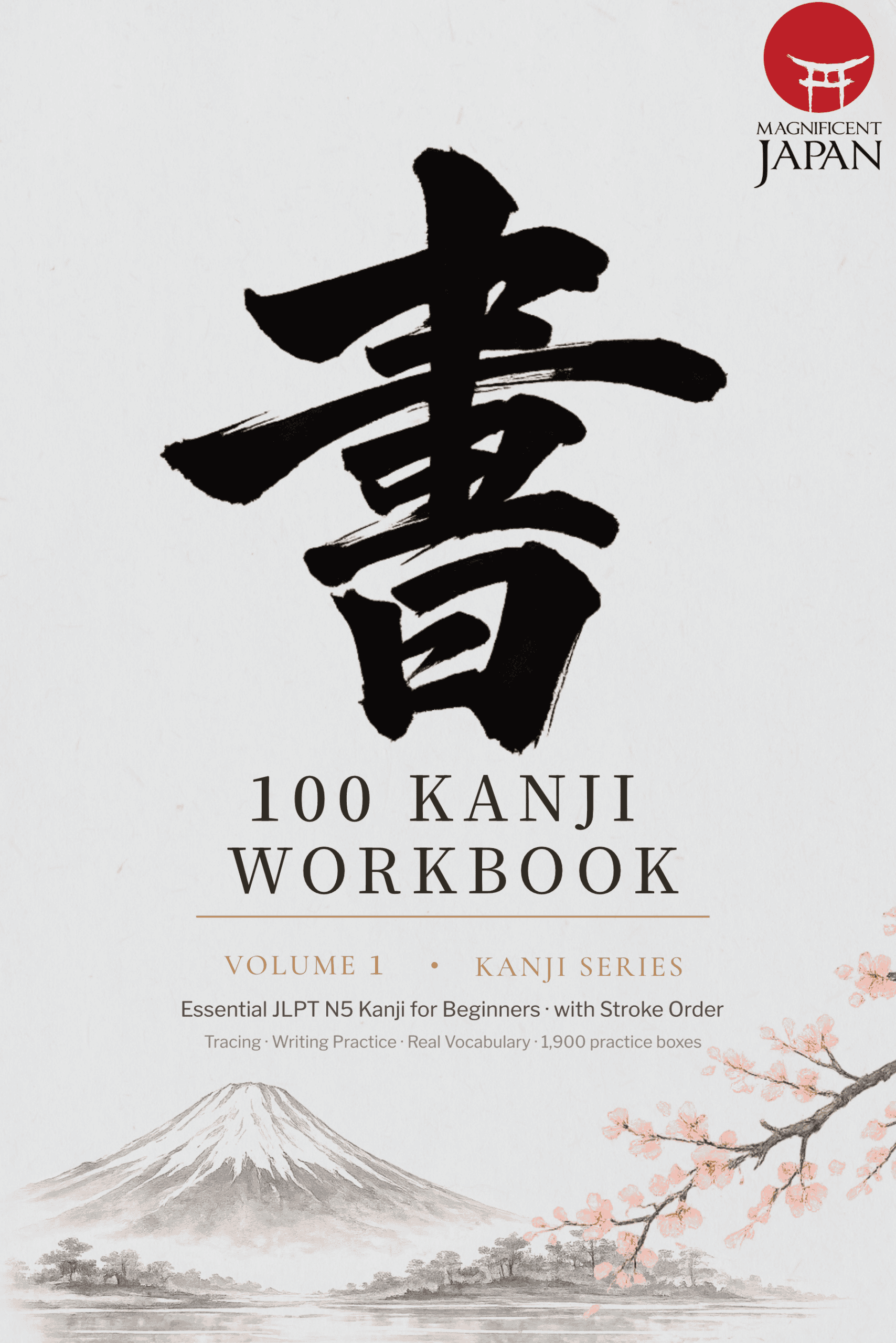
The JLPT N5 and N4 kanji workbook, one stroke at a time.
This JLPT N5 and N4 kanji workbook teaches 100 kanji by hand. Each one builds frame by frame, the new stroke in red. Then you trace it, half-trace it and write it alone.
343 pages · 100 kanji · 1,900 practice boxes · for tablets with a stylus

JLPT levels are unofficial, from the jlptsensei.com lists. The JLPT itself publishes no official kanji list.
What this JLPT N5 and N4 kanji workbook covers
Volume 1 teaches 100 kanji. Of these, 63 sit at JLPT N5 and 37 at JLPT N4. The JLPT publishes no official kanji list. So the levels here follow the jlptsensei.com lists and carry an unofficial label.
Each kanji gets a reference page and a practice page, and each comes with two common words. A stroke panel builds the character one stroke at a time. The practice page then moves you from tracing to writing on your own.
The aim is simple. By the last page, you should write all hundred from memory. The order and direction of each stroke should feel settled. In addition, you should read them inside real sentences.
How the stroke panels build each kanji
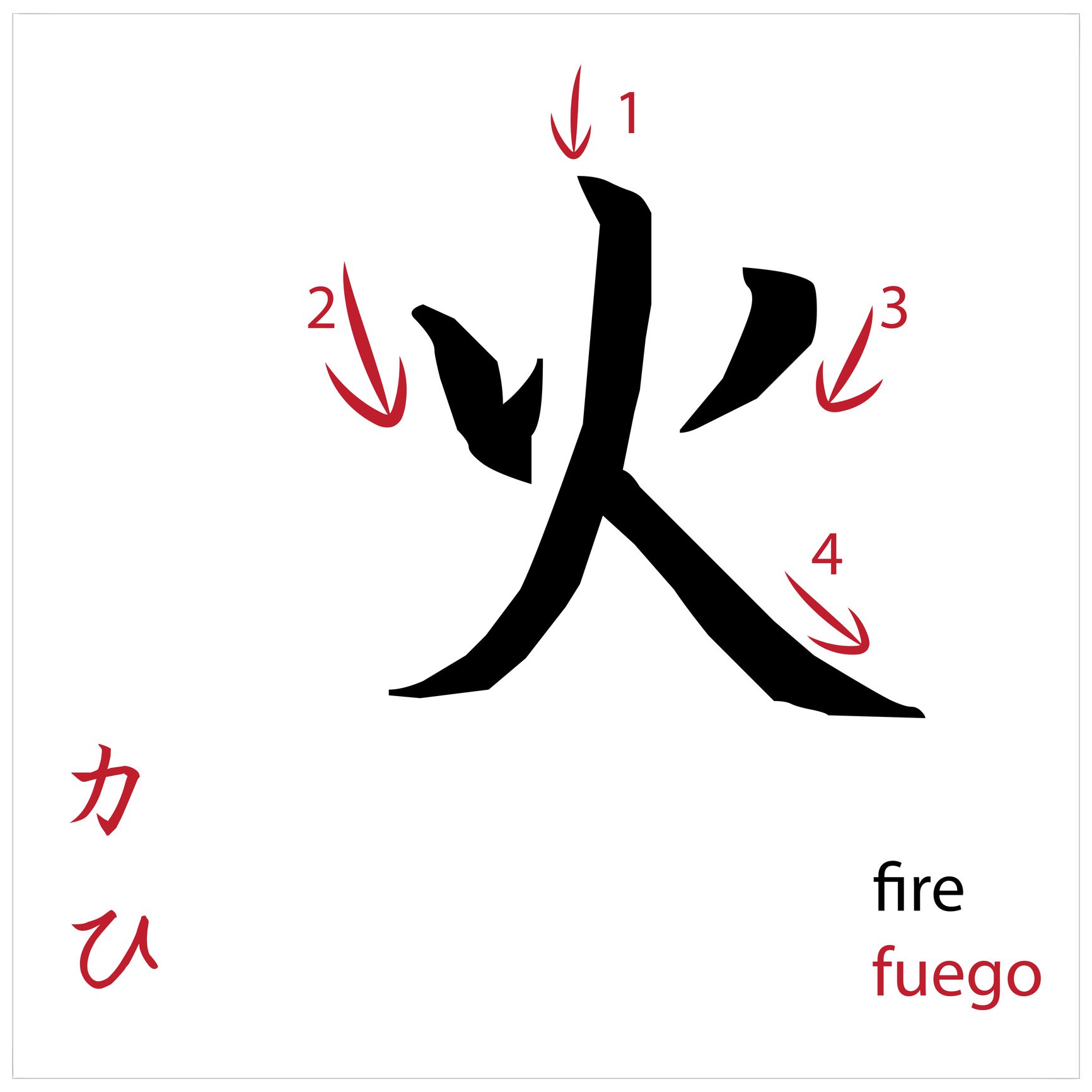
A finished character with numbered strokes shows the order, but it hides the sequence. In contrast, this JLPT N5 and N4 kanji workbook gives every stroke its own frame.
In each frame, the new stroke appears in red. Every earlier stroke stays behind it in a soft champagne tone. A thin arrow shows which way the stroke runs, and a number shows where it falls. As a result, your eye follows the kanji as it grows. It is the way a teacher writes on a board.
From the book · 名 (name), six strokes


Stroke order and geometry: KanjiVG r20250816, © Ulrich Apel, CC BY-SA 3.0.
Nineteen boxes, from trace to memory
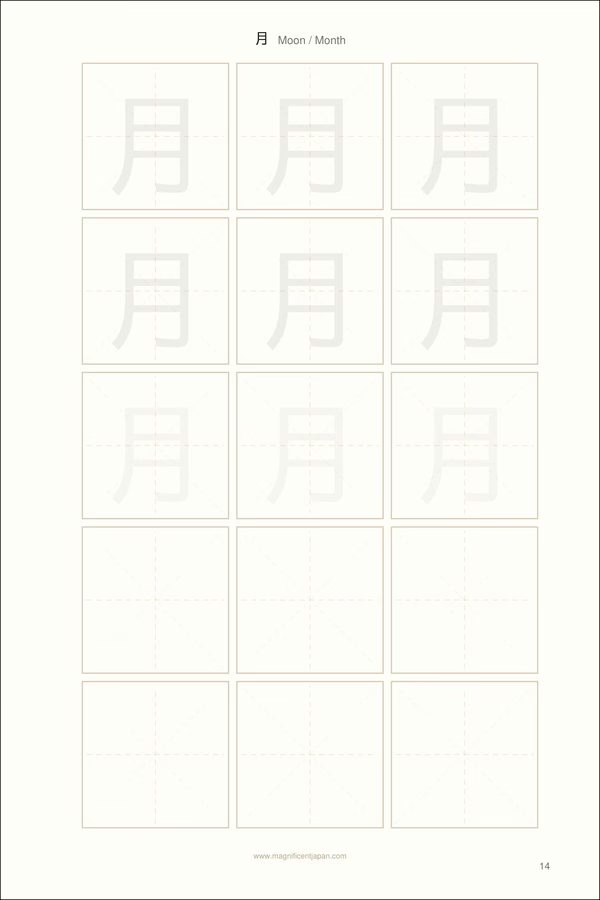
After the panel, each kanji gets 19 practice boxes, or 1,900 across the book. First, you trace guided boxes. Then the guide fades, and you half-trace. Next, you write freehand, from memory. Finally, word boxes set the kanji inside a common word.
That order matters. Tracing teaches the shape, fading removes the support, and freehand proves the memory. Meanwhile, the word boxes remind you that a kanji lives inside language, not on its own.
Who this JLPT N5 and N4 kanji workbook suits
This book suits a learner at the start of kanji. You may know some hiragana and katakana already, while kanji still look like pictures. Equally, it suits a learner who reads a few kanji but has never written them by hand.
Preparing for the JLPT N5 or N4? The book gives you a firm base of 100 characters. However, it does not claim to cover either level in full. The later volumes take you further, one step at a time.
Checkpoints, sentences and two short stories
Regular checkpoints test what you have learned, and a progress tracker shows how far you have come. Four-line example sentences give each kanji a setting, with furigana, hiragana, romaji and English on every line.
Every sentence obeys one rule. A kanji appears only once its lesson is done; any later kanji is written in kana. Therefore, you never meet a character the book has not taught you.
Two short reading stories close the book. Moreover, a radical reference, look-alike sets and an answer key sit at the back. Two indexes, one by English meaning and one by reading, help you find any kanji fast.
Using the JLPT N5 and N4 kanji workbook day to day
Short, regular sessions tend to hold better than long ones. For example, take one kanji at a time. First, watch the stroke panel frame by frame, and count the strokes aloud. Next, trace the guided boxes slowly, following the arrows.
Then move to the half-traced boxes, where the guide fades. After that, cover the model and write freehand from memory. Finally, write the common words in the word boxes.
Before each checkpoint, turn back to the pages you have finished. If a kanji slips, go back to its panel rather than its practice boxes. The panel shows exactly where the order went wrong.
One book, three editions
Each edition of this JLPT N5 and N4 kanji workbook has its own layout. The Digital Letter edition suits a tablet. It has side tabs, a tappable contents page, bookmarks and a back-to-contents link on every page. It also comes with a tablet set-up page.
The two print editions use facing spreads. The reference page sits on the left and the practice page on the right. So the model is always beside your pen. Margins follow the KDP gutter table for each page count.

Volume 1 is the first step of eight
The Kanji Series runs to eight volumes. Together, they teach all 2,136 jōyō kanji, the characters Japan lists for everyday writing. Each appears exactly once. Volumes 1 to 3 cover the JLPT N5 and N4 kanji and bridge into N3. Volume 4 completes N3, and Volume 5 teaches N2. Finally, Volumes 6 to 8 cover N1 and the jōyō kanji beyond the JLPT lists. Every volume uses the method you meet here. There are stroke-by-stroke panels, three editions, and sentences built only from kanji already taught. So the habits you form in Volume 1 carry you to the last page of Volume 8. Volume 1 is available now, and the later volumes follow one at a time.

A separate Kana Workbook, now in production, teaches hiragana and katakana by hand. It covers 276 units. They run from the basic sounds through voiced marks, combined sounds and small kana, to the extended katakana for loanwords.
JLPT levels unofficial (jlptsensei.com lists). See the Kanji Series.
Practice Online Between Pages
Browser-based practice for kanji, names and daily study. The workbook trains the hand; these train the eye.

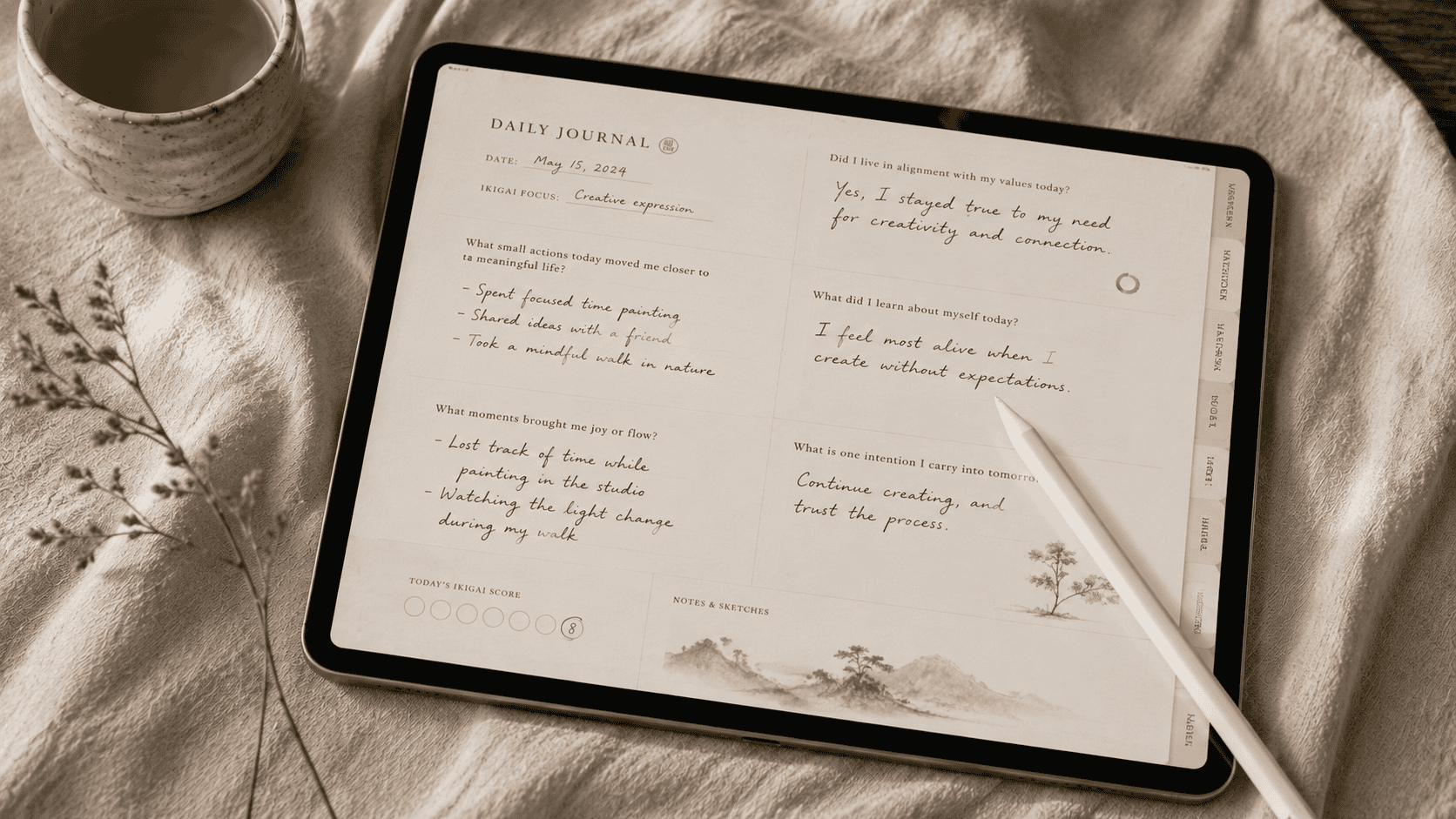
Practice sticks when it has a place in the day. For that reason, a short written reflection can help. Beginner’s mind is a good place to start.
Writing by hand rewards a few good tools: a pen that holds its line, and paper that takes the stroke cleanly.
Pens, paper and the small tools that make writing by hand a pleasure.
The print editions and the later volumes are in production. The launch list tells you the day each one goes live.
One email per release, and nothing else. You can leave with one click in any email.
A few questions come up often about Volume 1 and how it works.
Questions Worth Asking
How many kanji does Volume 1 teach, and at what level?
This JLPT N5 and N4 kanji workbook teaches 100 kanji. Of these, 63 are JLPT N5 and 37 are JLPT N4. The levels are unofficial and come from the jlptsensei.com lists, because the JLPT publishes no official kanji list.
How do the stroke panels work?
Each kanji gets one frame per stroke. The new stroke appears in red. Every earlier stroke sits behind it in a soft champagne tone. A thin arrow shows the direction, and a number shows the order.
How many practice boxes are in the book?
There are 1,900 practice boxes, 19 for each kanji. You trace, then half-trace, then write freehand, and then write each kanji inside a common word.
Which editions are there?
There are three editions. The Digital Letter edition (343 pages) is available now for $9.99. The Print 6×9 edition (386 pages) and the Print 8.5×11 edition (364 pages) are in production.
Do the example sentences use kanji I have not learned yet?
No. Every kanji in a sentence, story or checkpoint has already been taught. Any later kanji is written in kana instead.
What comes after Volume 1?
The Kanji Series runs to eight volumes. Together they cover all 2,136 jōyō kanji, each exactly once. A separate Kana Workbook teaches hiragana and katakana.