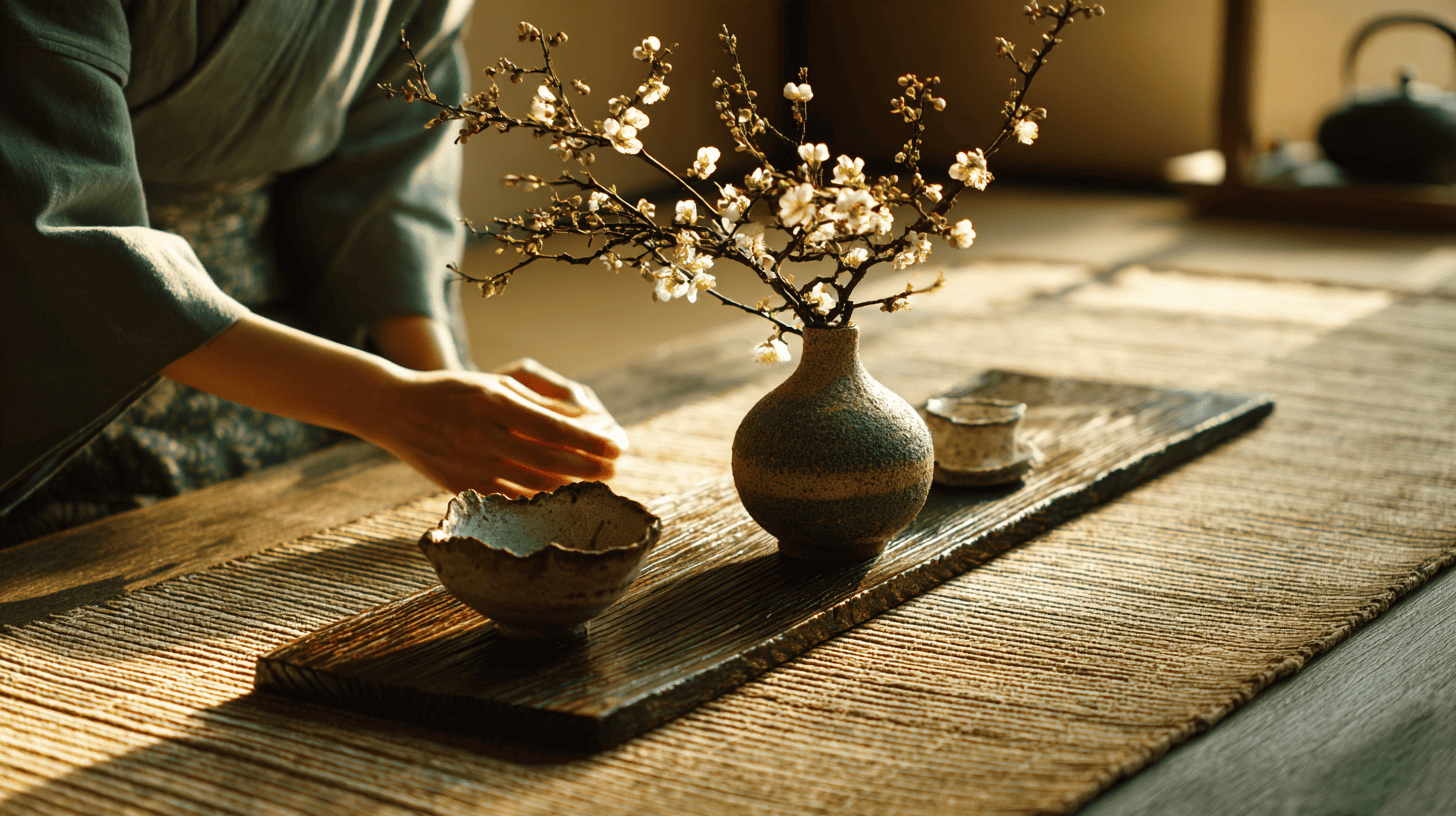
Search mono no aware vs wabi sabi and you will often find the two words used as twins. They are close, yet they are not the same. One names a feeling. The other names a look, a texture and a way of making things.
Mono no aware began at the Heian court, in poems and tales about blossoms, moons and people held dear. Wabi-sabi grew later, in the tea rooms of medieval Japan, where a rough bowl could outshine a flawless one. Both honor change. However, each honors it in its own way.
Below, we set the two side by side: what they mean, where they come from, how they differ, and simple ways to notice each at home. The same attentiveness shapes our 90-day guided journal in tenderness, with daily prompts for savoring ordinary moments.
Mono no Aware vs Wabi-Sabi: The Short Answer
Mono no aware is a feeling: a tender awareness that moments pass, which makes them feel precious. Wabi-sabi is an aesthetic: beauty found in simple, aged and imperfect things. In short, mono no aware lives in time, while wabi-sabi lives in texture. Both rest on impermanence, so they often appear together, like a petal resting beside a handmade tea bowl.
Mono no Aware vs Wabi Sabi: What Each Word Means
Before comparing them, it helps to hear each word on its own. The question of mono no aware vs wabi sabi is really a question of feeling versus form. So we start with the feeling.
Mono no aware: a feeling for passing moments
Mono no aware joins two ideas. Mono means things, and aware describes being deeply moved by them. The Stanford Encyclopedia of Philosophy entry on Japanese aesthetics renders the phrase as the pathos of things. It also ties that pathos to their transience. In other words, you feel more because the moment will not stay.
Think of the last warm evening of summer with friends. Nobody announces it, yet everyone lingers at the table a little longer. That lingering is mono no aware. It is not gloom. Instead, it is a heightened tenderness that makes the ordinary glow.
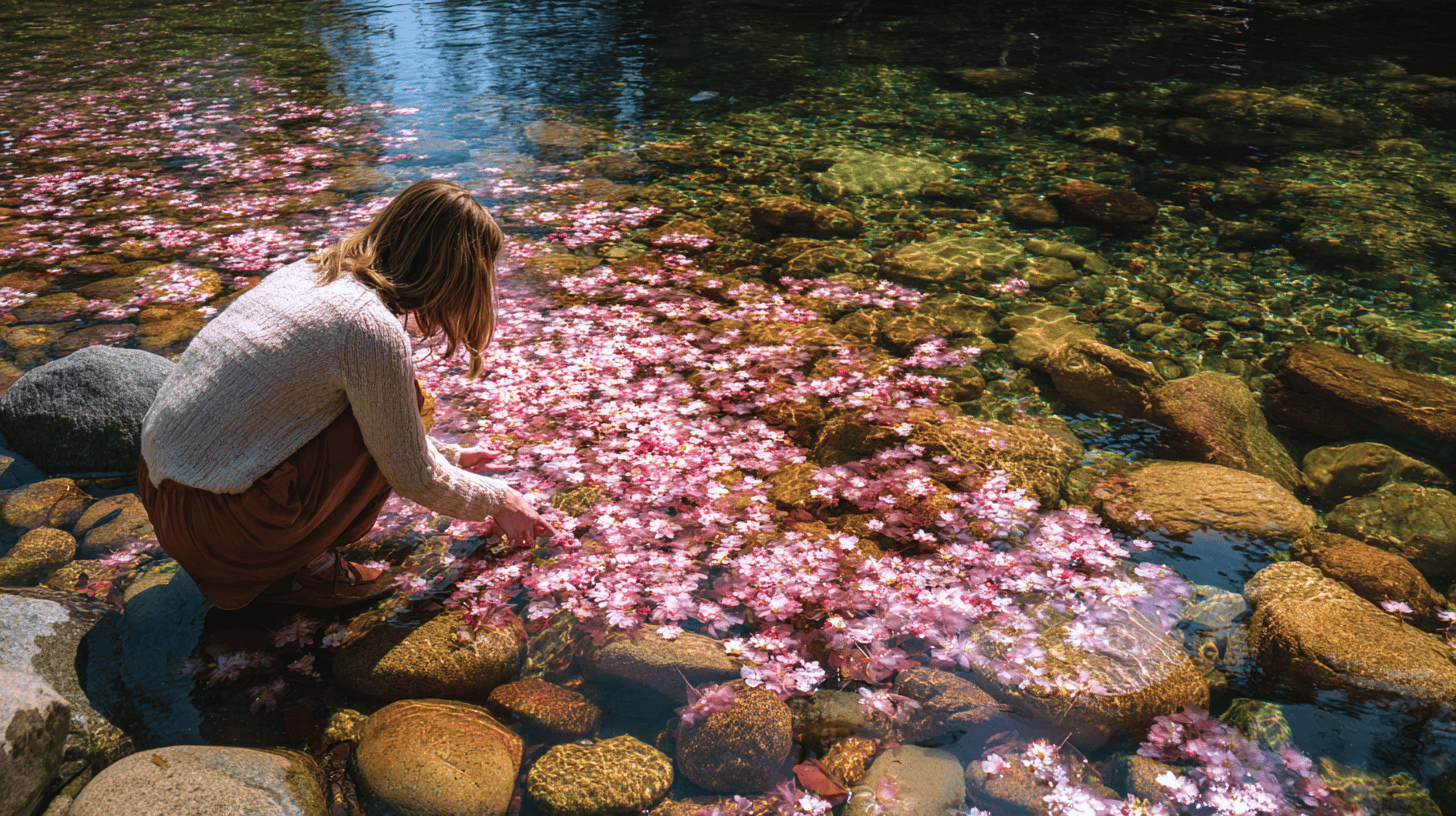
Cherry blossoms are the classic example, and for good reason. They open, peak and scatter within days. So each viewing carries a gentle urgency: see them now, with people you love. Older English translations lean on words like sadness. Read in context, however, the idea points to sensitivity, the openness to be touched by what is in front of you. The feeling does not need a famous tree, either. It lives in a child’s outgrown shoes, a friend’s handwriting, the first persimmon of autumn. For a longer look at the word itself, our guide to the meaning of mono no aware traces its history in detail.
Wabi-sabi: beauty in the simple and the aged
Wabi-sabi is also a pairing of two words, each with its own history. Britannica’s profile of the tea master Sen no Rikyū describes wabi as deliberate simplicity in daily living. It describes sabi as an appreciation of the old and faded. Together they form an aesthetic. It prizes the handmade over the machined, the weathered over the new, and the modest over the grand.
Where mono no aware happens inside you, wabi-sabi sits out in the world. You can also hold it. It is the soft sheen on a wooden rail worn by many hands, or a bowl whose glaze pooled unevenly in the kiln.
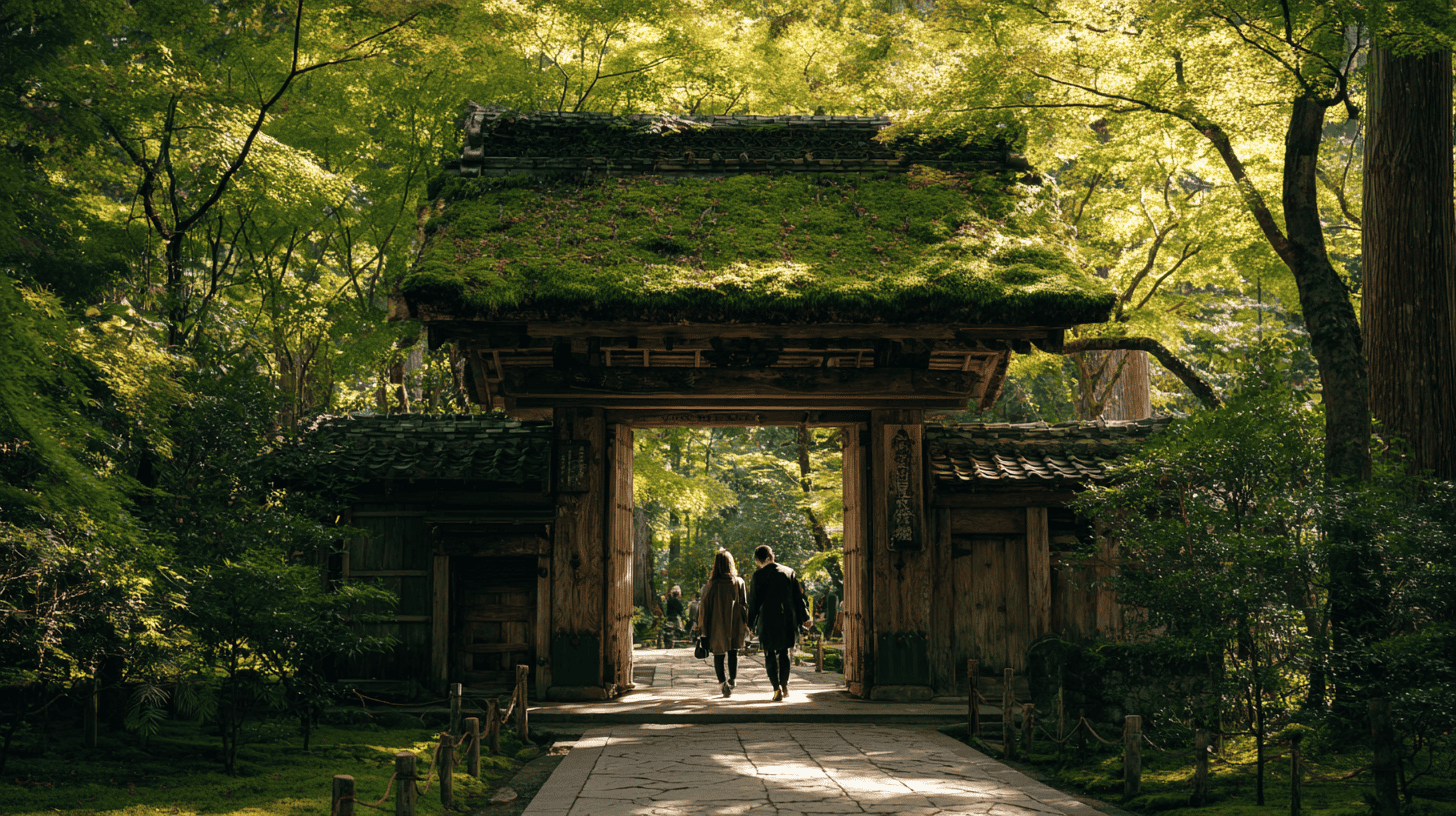
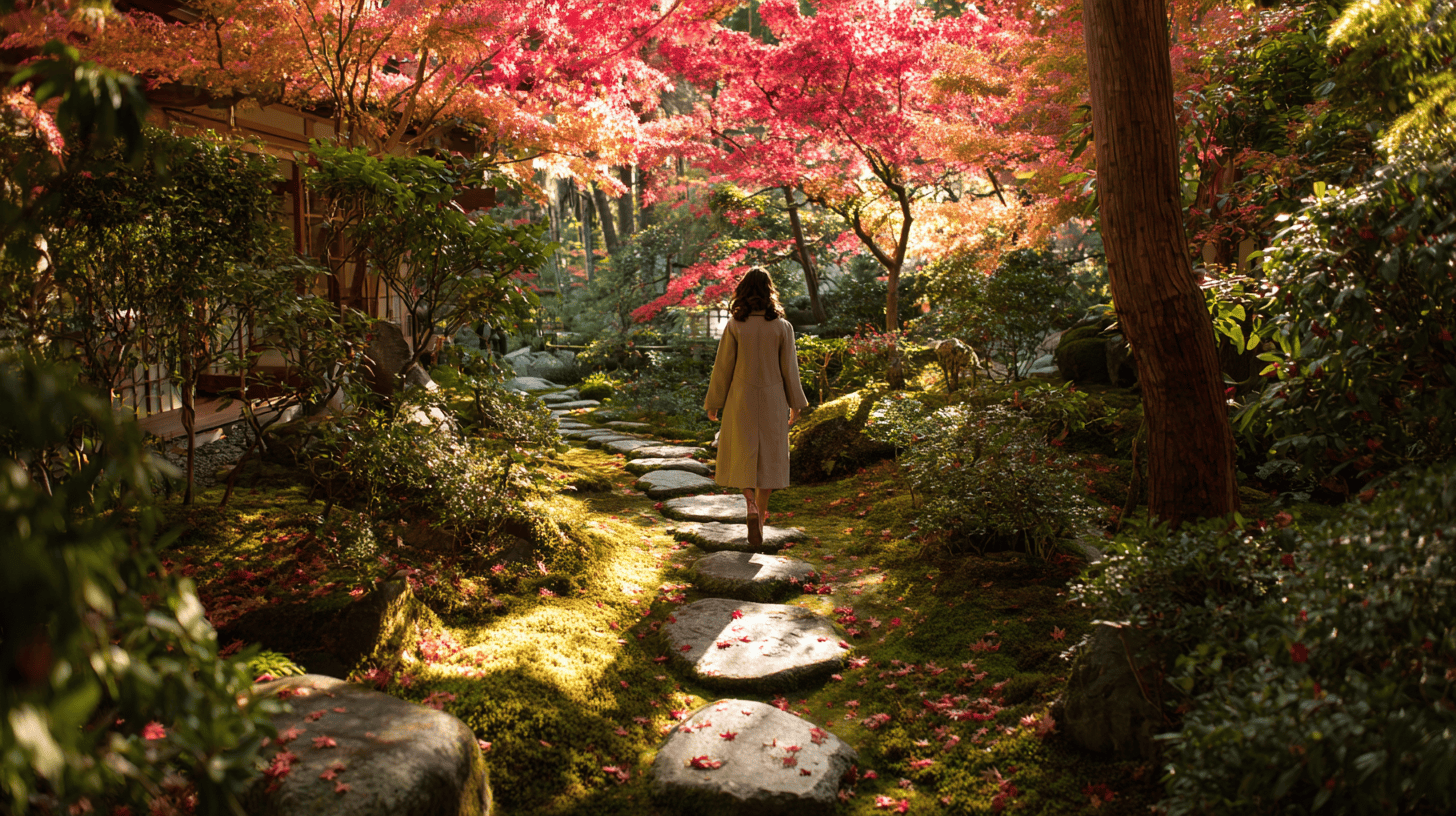
Temple gates in Kyoto, for example, show this well. The wood has faded to silver, moss softens the stone steps, and nobody rushes to repaint. The patina is the point, because it records time without hiding it. Wabi-sabi asks us to see that record as beauty rather than damage.
At home, the easiest place to begin is with tableware. A handmade cup changes the feel of a morning coffee. It warms unevenly in the hand, and its glaze never repeats exactly. Many loved Japanese pieces come from the Mino kilns of Gifu Prefecture. According to Japan House Los Angeles, ceramic production there reaches back to the seventh century.
The Difference Between Mono no Aware and Wabi-Sabi
So how do the two actually differ? Most confusion around mono no aware vs wabi sabi comes from their shared subject, which is change. Yet they approach change from opposite sides.
Feeling versus aesthetic
Mono no aware is an emotional response. It happens in a person, at a moment, often without warning. You cannot buy it or design it. You can only stay open to it. Wabi-sabi, by contrast, is a quality of things and places. A potter can aim for it, and a gardener can protect it.
Put simply, one is a movement of the heart, and the other is a style you can see. A cracked tea bowl has wabi-sabi whether anyone looks at it or not. The warmth you feel when a friend hands you the bowl she has used for years is mono no aware.
Time versus texture
The second contrast is about where change shows. Mono no aware lives in time. It notices the arc of a season, a visit or a childhood, and it treasures the present point on that arc. Wabi-sabi, however, lives in texture. It notices the evidence that time leaves behind: rust, moss, faded indigo, a worn step.

Picture two friends walking under golden ginkgo trees in late autumn. The leaves are at their peak and will soon fall. Neither friend says so, yet both slow their pace. Nothing about the scene is imperfect or aged, so it is not really wabi-sabi. Instead, it is pure mono no aware: a shared sense that this walk, this light and this company deserve savoring.
Moments like that pass quickly on a trip. A blank page on the road catches them before they blur into a general memory of a good journey. Our Tea Ceremony travel journal suits exactly that kind of note: a tea room under blossom, a stranger’s kindness, the taste of a station lunch.
Pages for tasting notes, tea rooms and the ideas they bring to mind.
Unlined · 120 pages · Original cover art
Shop This Journal →How the two work together
In one sense, mono no aware looks forward and feels the moment slipping. Wabi-sabi looks back and admires what the years have made. Both lead to the same place, which is appreciation. Neither idea asks for anything grand, either. A dinner, a walk or a teapot can hold them both, often at the same time.
Think of a teapot that has poured for decades, its lid worn smooth. Its patina is wabi-sabi. The pleasure of pouring from it for a friend on a cold afternoon is mono no aware. One lives in the object, the other in the hour. So the pairing feels natural.
That overlap explains why so many writers treat the two words as one. A spring picnic has both: the brief blossoms overhead and the well-used picnic box your family has carried for years. Our guide to cherry blossom season in Japan covers the blossoms, while the box needs no guide at all. Separating the two is still useful, because each word trains a different kind of attention. One sharpens the eye for surfaces. The other sharpens the heart for moments. Once you can name both, you notice twice as much. The table below lays out mono no aware vs wabi sabi at a glance.
One is felt in the moment; the other is seen in the object.
| Aspect | Mono no aware | Wabi-sabi |
|---|---|---|
| What it is | A feeling: tender awareness of passing moments | An aesthetic: beauty in simple, aged, imperfect things |
| Where it began | Heian court poetry and tales, such as The Tale of Genji | Medieval tea culture, refined by Sen no Rikyū |
| Where it lives | In time: seasons, visits, stages of life | In texture: patina, moss, uneven glaze |
| Classic image | Cherry petals on the water | A rustic tea bowl |
| What it asks of you | Be present and savor the moment | Be patient and value what time has shaped |
Read across the rows and a pattern appears. Mono no aware asks you to be present. Wabi-sabi asks you to be patient. That is why the two pair so well in daily life.
Keeping both on the page
Noticing either one also grows easier when you write it down. A line about the ginkgo walk, jotted the next morning, helps the feeling settle. The short film below shows that habit in action. It features The Return, the first journal in our Cultural Reflection Collection, with a morning prompt answered by hand on a tablet. The Mono no Aware Journal uses the same daily format. Try it for a week and see what you notice.
Twenty seconds inside the journal
The digital edition in use — a morning prompt, answered by hand while the coffee is still warm. Tap to play, with sound.
One page, one intention, one single quiet moment.
Where Mono no Aware and Wabi-Sabi Come From
The two ideas grew up centuries apart, in very different rooms. One began among poets at court. The other took shape among tea masters.
Mono no aware and the Heian court
Mono no aware is the older of the two. Its roots lie in the Heian period (794–1185), when court poets wrote about moons, blossoms and meetings that could not last. The Stanford entry notes that the feeling already appears in the eighth-century anthology Man’yōshū. It also names Murasaki Shikibu’s early eleventh-century Tale of Genji as a work built around this feeling.
Still, the phrase gained its modern fame much later. Motoori Norinaga (1730–1801), a scholar of Japan’s classical literature, studied Genji closely. According to Britannica’s entry on Motoori Norinaga, he stressed mono no aware as the central concept of Japanese literature. Thanks to him, a phrase from court poetry became a lens for reading a whole culture.
Wabi-sabi and the tea room
Wabi-sabi grew from different soil. In the fifteenth and sixteenth centuries, tea masters turned away from showy display. The Stanford entry traces this path from Murata Shukō (1423–1502) and his student Takeno Jōō to Sen no Rikyū (1522–1591). Rikyū then refined their approach into wabi-cha, the tea of simplicity.
These masters also changed the tools. The Metropolitan Museum of Art’s essay on the Japanese tea ceremony notes that they brought in rustic ceramics. They found beauty in unrefined, natural or imperfect forms. Rikyū even shrank the room itself, to just two mats with a small door for guests.

That tea-room ideal still guides potters today. A bowl thrown for tea may lean slightly, show a thumbprint, or carry a glaze that ran in the kiln. These marks are not errors to sand away. Instead, they give each piece a character that a factory cannot copy. Even the bowls made under Rikyū’s direction, Britannica notes, had a rustic simplicity.
Our feature on the Japanese tea ceremony follows how a host prepares and serves a bowl of tea. It also shows why hosts choose utensils that feel humble in the hand. Once you have held such a bowl, a perfectly uniform mug can start to feel a little flat.
If you would like to see the blossoms, moss gardens and tea houses for yourself, we can help you plan a Japan journey around the seasons you most want to feel.
Occasional letters on mono no aware, the Japanese calendar and the moments worth savoring, with news of the Cultural Reflection Collection.
Occasional letters. Unsubscribe anytime.
Japanese Aesthetics and Impermanence: Where the Two Meet
For all their differences, both ideas grow from one root. Classical Japanese thought sees reality as constant change, an idea known as mujō, or impermanence. The Stanford entry describes this condition as a foundation for the Japanese aesthetic tradition as a whole.
Impermanence can sound heavy. In practice, though, both ideas turn it into gratitude. If nothing lasts, then this cup of tea, this conversation and this light matter now. The fourteenth-century writer Yoshida Kenkō put it memorably: “Are we to look at cherry blossoms only in full bloom, at the moon only when it is cloudless?” For Kenkō, the half-open bud and the clouded moon could move us just as deeply.
Ma: the pause between
Two more words often sit beside mono no aware and wabi-sabi. The first is ma, the meaningful interval. It is the pause in music, the open space in a room, the breath between sentences. Ma is not a feeling or a texture. Rather, it is the gap that lets both be noticed.
A tea room with almost nothing in it gives a single flower room to speak. Likewise, a slow walk gives a passing moment room to register. Without ma, both ideas would get lost in clutter and hurry. Our essay on the Japanese idea of ma explores how it shapes rooms, gardens and daily rhythm.
Yūgen: grace beyond words
The second neighbor is yūgen. The Stanford entry calls it mysterious grace, and perhaps the most ineffable of the Japanese aesthetic ideas. Yūgen lives in suggestion: mountains half hidden by mist, a line of poetry that stops just short, a garden that hints at more than it shows.
If mono no aware is the feeling and wabi-sabi the texture, yūgen is the depth that invites imagination. Where wabi-sabi shows you the worn surface, yūgen leaves something unsaid on purpose. Ink landscapes that leave much of the paper blank often carry it. Together with ma, these four words form a small vocabulary for noticing more.
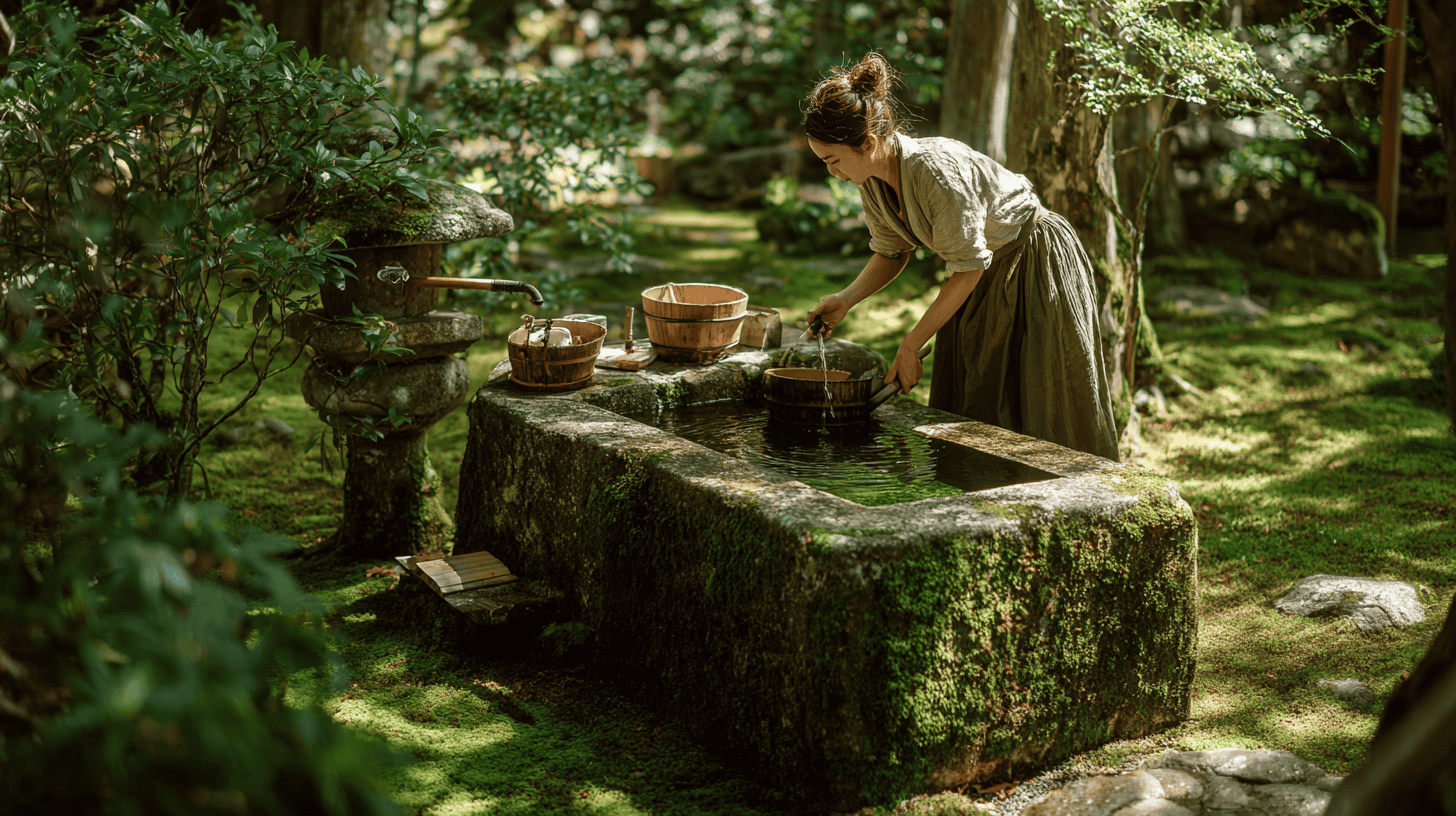
A Kyoto moss garden holds all four ideas at once. First, the moss and the worn stone basin carry wabi-sabi. Meanwhile, the open ground around them is ma. The shade beneath the trees also adds a touch of yūgen. And the visitor who pauses, knowing the morning light will shift within the hour, feels mono no aware.
You do not need to separate them while you stand there. Knowing the words simply sharpens your attention, much as knowing bird names helps you hear more birds. For more of this vocabulary, our collection of Japanese concepts for everyday life gathers the essentials in one place.
Recommended
How to Notice Mono no Aware and Wabi-Sabi at Home
Understanding mono no aware vs wabi sabi is one thing. Noticing each in your own day is another. Neither needs a temple or a tea room, because both begin with attention, and attention works anywhere. Here are three small places to start.
In the morning light
Mono no aware is easiest to catch at the edges of the day. Morning light shifts minute by minute, so it rewards anyone who pauses. Before you check a screen, notice one thing that will be different tomorrow. It might be the angle of the sun, a bud on the windowsill, or the sound of your household waking. Name it to yourself, then let it go. Our companion piece on simple ways to practice mono no aware offers more gentle exercises like this one.
At the table
The dinner table is where the two ideas meet most naturally. Wabi-sabi shows up in the dishes: a bowl with an uneven rim, a cup whose glaze runs thin on one side. Mono no aware, in contrast, shows up in the food and the company. Seasonal ingredients arrive and leave with the calendar, so each meal marks a moment in the year.
Kabocha, a dense and sweet Japanese pumpkin, tastes of the cooler months. Simmered gently in dashi and served in an irregular handmade bowl, it puts both ideas on one table. The recipe below is a long-standing favorite of Japanese home cooking.
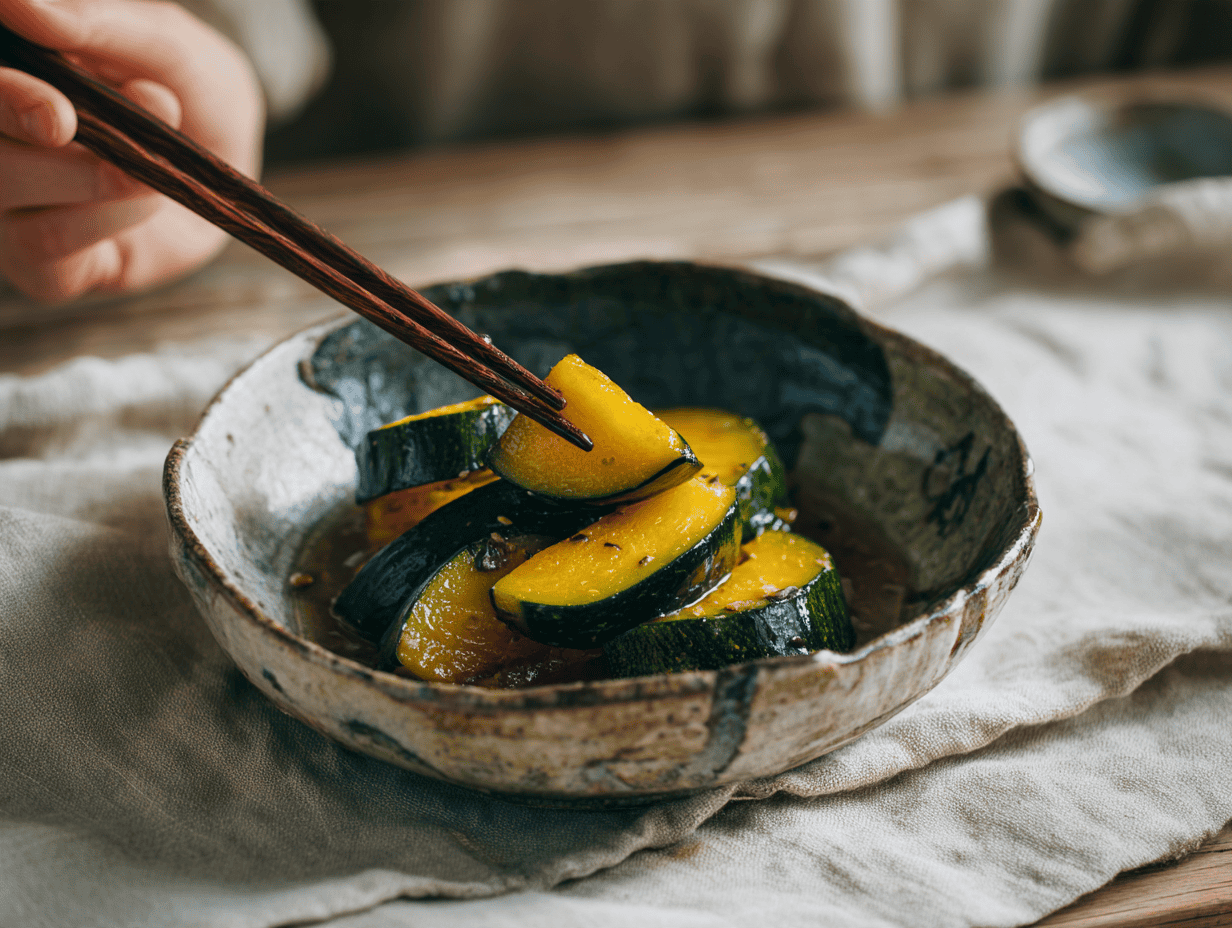
A long-standing dish of Japanese home cooking, served warm or at room temperature. It appears often in bento boxes and on ryokan breakfast trays.
- 1/2 small kabocha (about 1 lb / 450 g), seeds removed
- 1 3/4 cups (420 ml) dashi
- 2 tbsp sake
- 1 tbsp sugar
- 2 tsp soy sauce
- 1 pinch salt
- Thin strips of fresh ginger, to garnish (optional)
- Cut the kabocha into 2-inch pieces. Peel away a few patches of skin and trim the sharp edges so the pieces hold their shape.
- Arrange the pieces skin-side down in a single layer in a wide pot. Add the dashi, sake and sugar.
- Bring to a boil, then lower the heat to medium-low. Add the soy sauce and salt, and cover with a drop lid.
- Simmer for 15 to 25 minutes, until a skewer slides through the thickest piece with ease.
- Turn off the heat, cover, and let the pumpkin rest in the broth for 15 to 30 minutes to absorb the flavor.
- Serve warm or at room temperature in a handmade bowl, topped with a few strips of ginger.
The dish rewards patience in small ways. Because the pumpkin softens slowly, it tastes best after resting in its broth. Serve it warm or at room temperature. A few strips of ginger add brightness without hiding the sweetness. Then look at the bowl before you wash it. The glaze, the weight and the small flaws are also part of the meal.
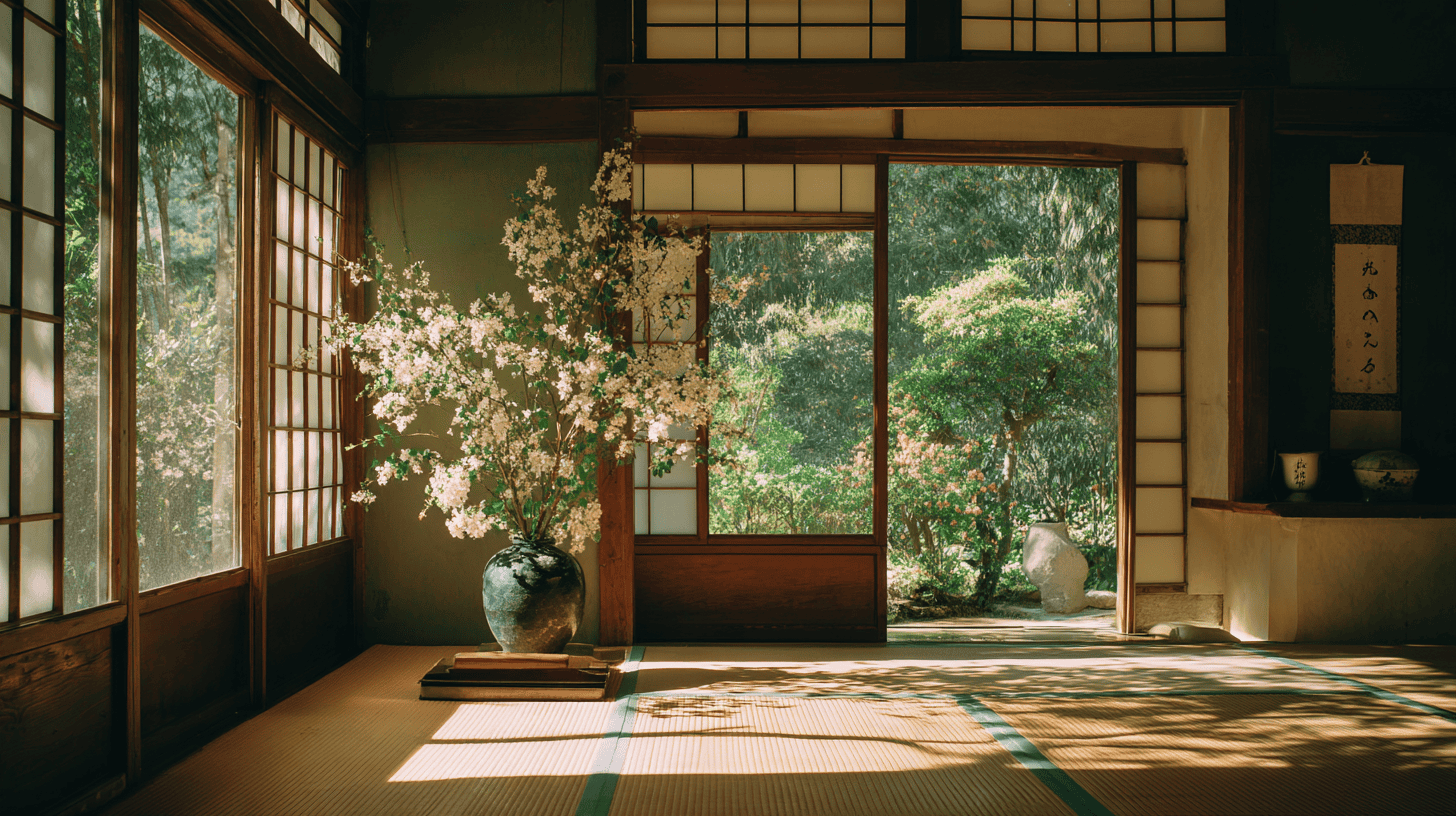
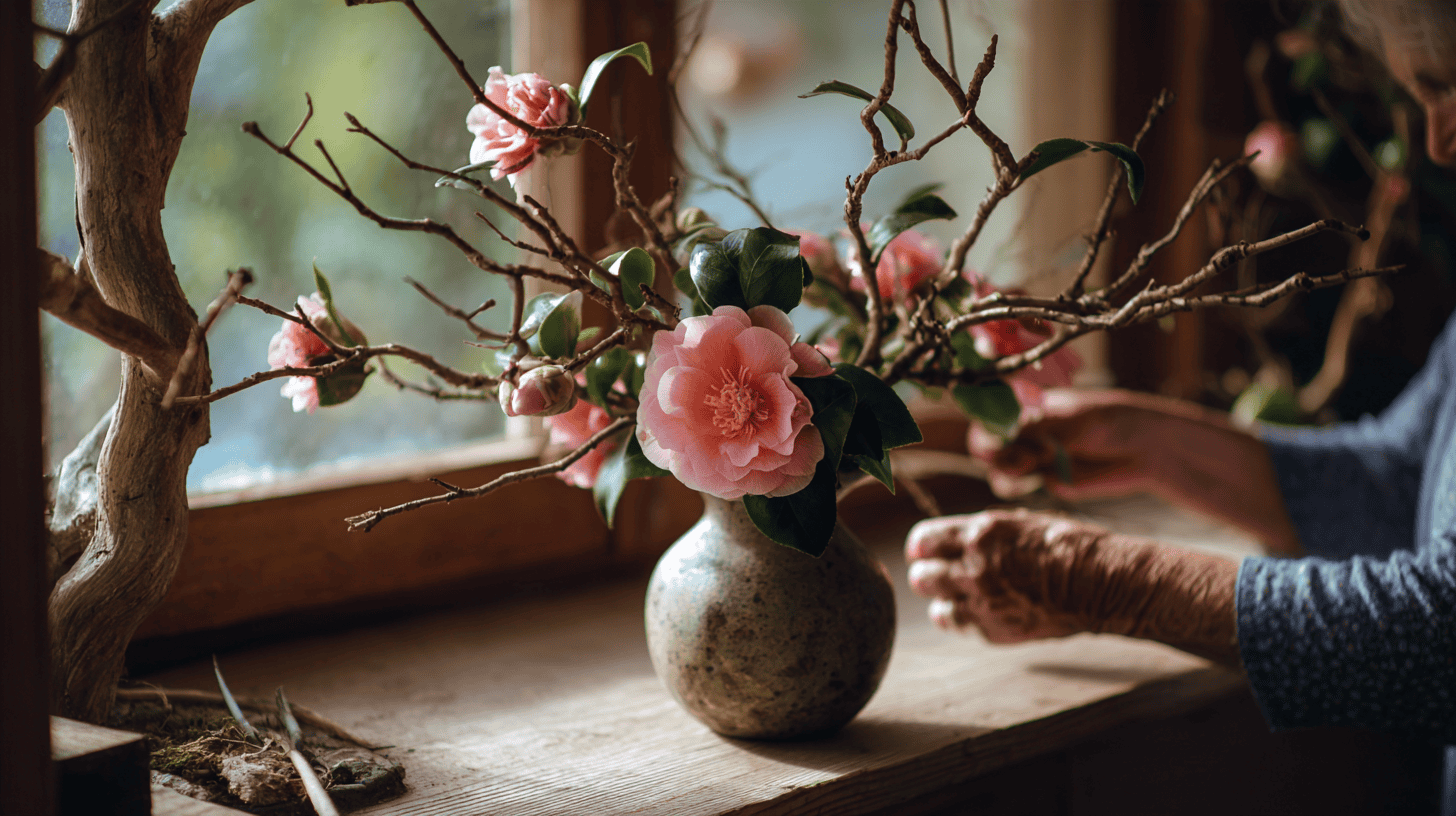
Flowers work the same way. A single seasonal stem in a rustic vase changes a room more than a large bouquet does. It also tells you exactly where you are in the year, which is mono no aware in its simplest form.
In the things you mend
An arrangement like this pairs a fresh bloom with a bare branch, so the vase holds two moments of the year at once. The flower will last only days, while the vase may last generations. Mending extends this thinking to broken things.
In kintsugi, a craftsperson rejoins a cracked bowl with urushi lacquer and finishes the seam with gold, so the repair becomes part of its story. The line of gold is wabi-sabi at its clearest. Meanwhile, the care it takes, and the memories the bowl holds, are mono no aware. A proper kit from Japanese lacquer makers lets you try it at home, slowly and over several sessions.
Kintsugi also changes how you see the rest of your shelves. The chipped mug, the faded cloth napkin and the wooden spoon worn flat on one side all carry a record of use. Instead of replacing them at the first flaw, you may start to keep them for that very record. That shift is the heart of wabi-sabi. A darned sweater tells the same story in wool.
Meanwhile, the small jolt of noticing how long you have owned them is mono no aware, turned warm. If you enjoy spotting these ideas in daily life, our list of everyday examples of mono no aware gathers many more.

In a few lines each evening
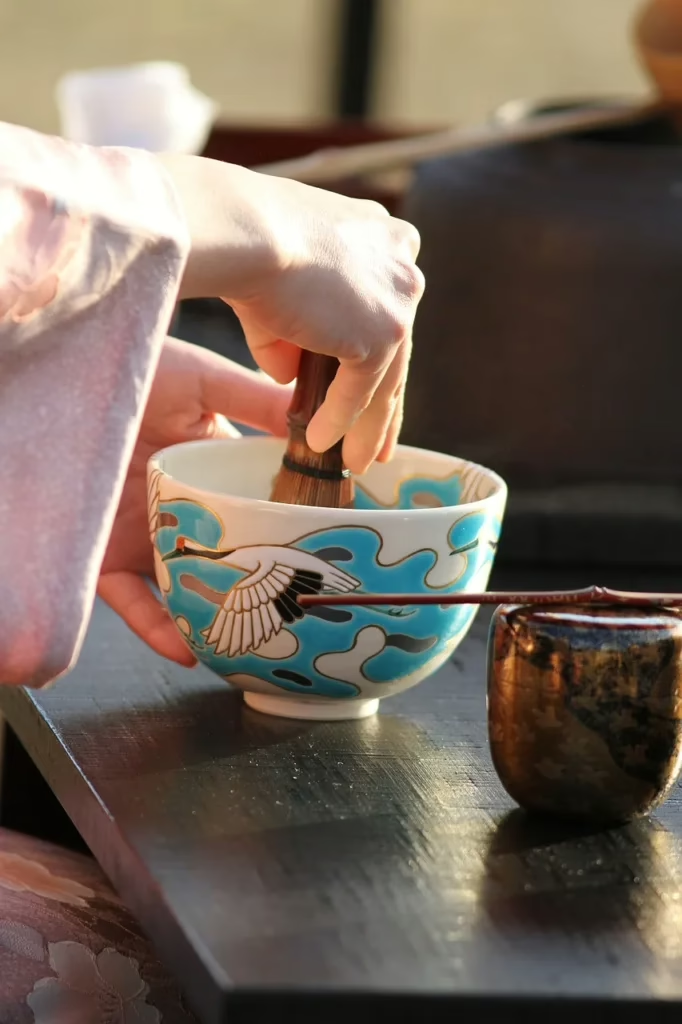
One last habit ties everything together, and that is writing. A single line each evening can capture the day’s small moment, whether a shared laugh or a cup that felt good in the hand. Then, over weeks, those lines form a record of what you noticed. Reading them back later is its own gentle pleasure. Choose a notebook you enjoy holding, and keep it where you end the day.
You see the seasons turn on the page. You also see your attention sharpen, since the entries grow more specific with time. That is the practice at its simplest: notice, name, and keep.
Questions Worth Asking
Is mono no aware the same as wabi-sabi?
No. They are related but distinct. Mono no aware describes an inner response, the tender sense of being moved by passing moments. Wabi-sabi describes an outer quality of objects and places that are simple, weathered or irregular. People often confuse them because both draw on the old Japanese idea that nothing stays the same.
What is the English translation of mono no aware?
The most common rendering is "the pathos of things." Britannica also glosses it as "sensitiveness to beauty." No single English phrase captures it fully, which is why most writers keep the Japanese term and explain it through examples like falling blossoms or the last evening of a visit.
What does wabi-sabi mean in simple terms?
Wabi-sabi means finding beauty in things that are simple, modest, aged or a little imperfect. Think of a hand-thrown cup with an uneven glaze, a linen cloth softened by years of washing, or a wooden floor polished by footsteps. It values character and honest wear over polish and uniformity.
Is kintsugi an example of wabi-sabi or mono no aware?
It can express both. The visible gold seam, which celebrates a flaw instead of hiding it, reflects wabi-sabi. The affection that makes someone repair a favorite bowl rather than replace it reflects mono no aware. That double meaning is one reason the craft appeals to so many people outside Japan.
How do you pronounce mono no aware?
Say it as four short parts: MOH-noh noh ah-WAH-reh. The final "e" sounds like the "e" in "bed," not silent as in English. Japanese stresses syllables fairly evenly, so avoid leaning hard on any single one. Wabi-sabi is simpler: WAH-bee SAH-bee.
Is mono no aware a sad feeling?
Not in the way English "sad" suggests. It holds an awareness that moments end, but its effect is to make them feel more precious. Many people describe it as tenderness or gratitude. Watching friends laugh at dinner and wishing the evening could stretch a little longer is a good everyday example.
Two Ways of Seeing, One Attentive Life
In the end, the question of mono no aware vs wabi sabi has a happy answer. You do not have to choose. Mono no aware teaches you to feel the moment. Wabi-sabi teaches you to love the marks that moments leave behind. Together, they turn an ordinary day into something worth savoring. Both ask only for attention, and attention grows with use. So start small, with one bowl and one moment.
If you would like a daily structure for the first of these, The Mono no Aware Journal offers 90 days of guided prompts in tenderness. For the second, a companion journal on wabi-sabi follows below.
A ninety-day guided practice in the beauty of the imperfect and the unfinished, a good companion to a daily journaling habit.
View the Journal →Whichever door you enter by, the practice is the same. Slow down, look closely, and let the ordinary move you. Keep a bowl you love within reach. Keep a page open for the day’s small moments. Over time, both habits make life feel fuller.
The Editors, Magnificent Japan
We design routes that hold both ideas: a Kyoto moss garden, a potter’s studio in Mino, and a riverside walk timed to the blossoms or the maples.
Plan Your Custom Japan Itinerary