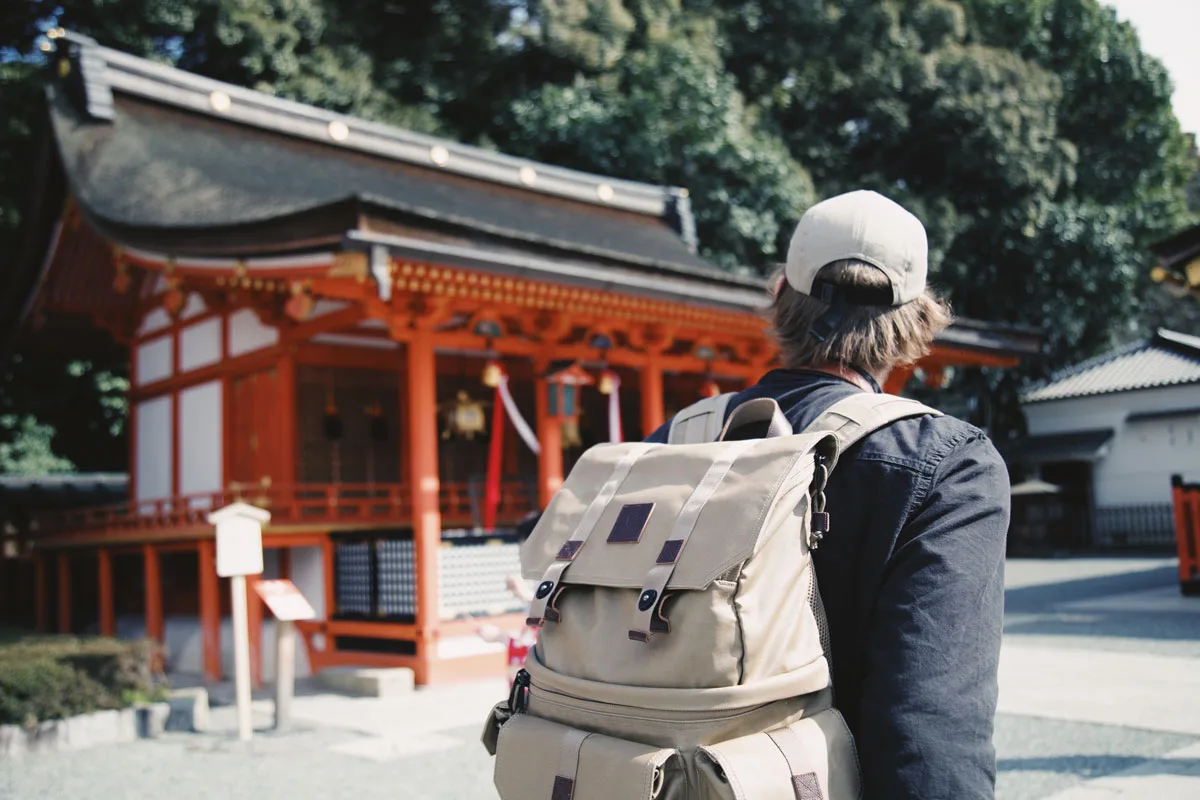
Solo travel in Japan is unusually rewarding. Civic safety is high, the rail network is dense and intuitive, and dining-for-one is culturally normal — the country tolerates, even rewards, the kind of unhurried attention that solo travel makes possible. The trick is planning the trip the country deserves, rather than the one a checklist would produce.
Solo travel in Japan suits a particular kind of traveler. Group-trip logistics tire them. They would rather spend a slow Tuesday at a temple in Yanaka than tick another headline sight. The country is built, almost accidentally, for that disposition. Trains run on time to the second. Public order is genuine rather than performed. A single-cover place setting at a long cypress counter is a quiet feature of the dining culture, not an apologetic exception. The conditions are unusually generous. The harder question is what to do with them.
The most common mistake the first-time solo traveler makes is to plan Japan as if it were Europe. A city circuit knit together by rail. Two nights here, three nights there. The headline sights collected in sequence. That itinerary works mechanically but leaves no room for the country’s quieter rewards. The better approach treats one or two cities as anchors. The days breathe between them. Small daily rituals turn a trip into a memory rather than a logistics exercise. The site’s broader primer on Japanese etiquette is the right place to start before any of this. The conventions around shoes, queueing, voice level, and bathing thread through every section that follows.
Why Japan rewards the solo traveler
Four conditions sit beneath Japan’s reputation as a strong solo destination. Understanding them in advance shapes the trip you actually plan.
The first is civic safety. Crime rates are low across categories. The cultural register around personal space and public conduct is unusually disciplined. A traveler can sit alone with a coffee at a quiet bar in Shimokitazawa at eleven at night without the ambient watchfulness some cities demand. This is not the same as saying nothing ever goes wrong. Late-night entertainment districts like Kabukicho and parts of Roppongi have documented bar scams and touts. But the baseline is genuinely different from most major capitals.
The second is infrastructure built for one. Conveyor-belt sushi counters. Ramen shops with single-row stools. Business-district tachinomi standing bars. Chain coffee houses with quiet single-seat tables. These are part of the everyday architecture of urban Japan. The country has spent decades quietly designing for the solo eater, the solo commuter, and the solo evening. None of it needs to be sought out. It is simply the default.
The third is the rail and metro network. It removes most of the friction that drives group travel decisions in the first place. With a transit IC card and a working data plan, a competent solo traveler can move between Tokyo, Kyoto, Osaka, Kanazawa, and Hakone without ever speaking to anyone who is not selling food. The network is dense. It is signed in English on all major lines. It is reliable to a degree that most visitors find surprising. The full JR Pass guide covers when the pass earns its keep and when point-to-point tickets work better.
The fourth, and the one that matters most, is the country’s tolerance for unhurried attention. Japan rewards the traveler who is willing to sit in a single tea house for forty minutes. The traditional tea ceremony is the formal version of this register. Walk an entire block looking at a wooden gate before entering it. Linger over a bowl of soba rather than photograph it. Solo travel grants that posture more easily than group travel does. It is the deeper reason the trip works.
Where to go: a register, not a checklist
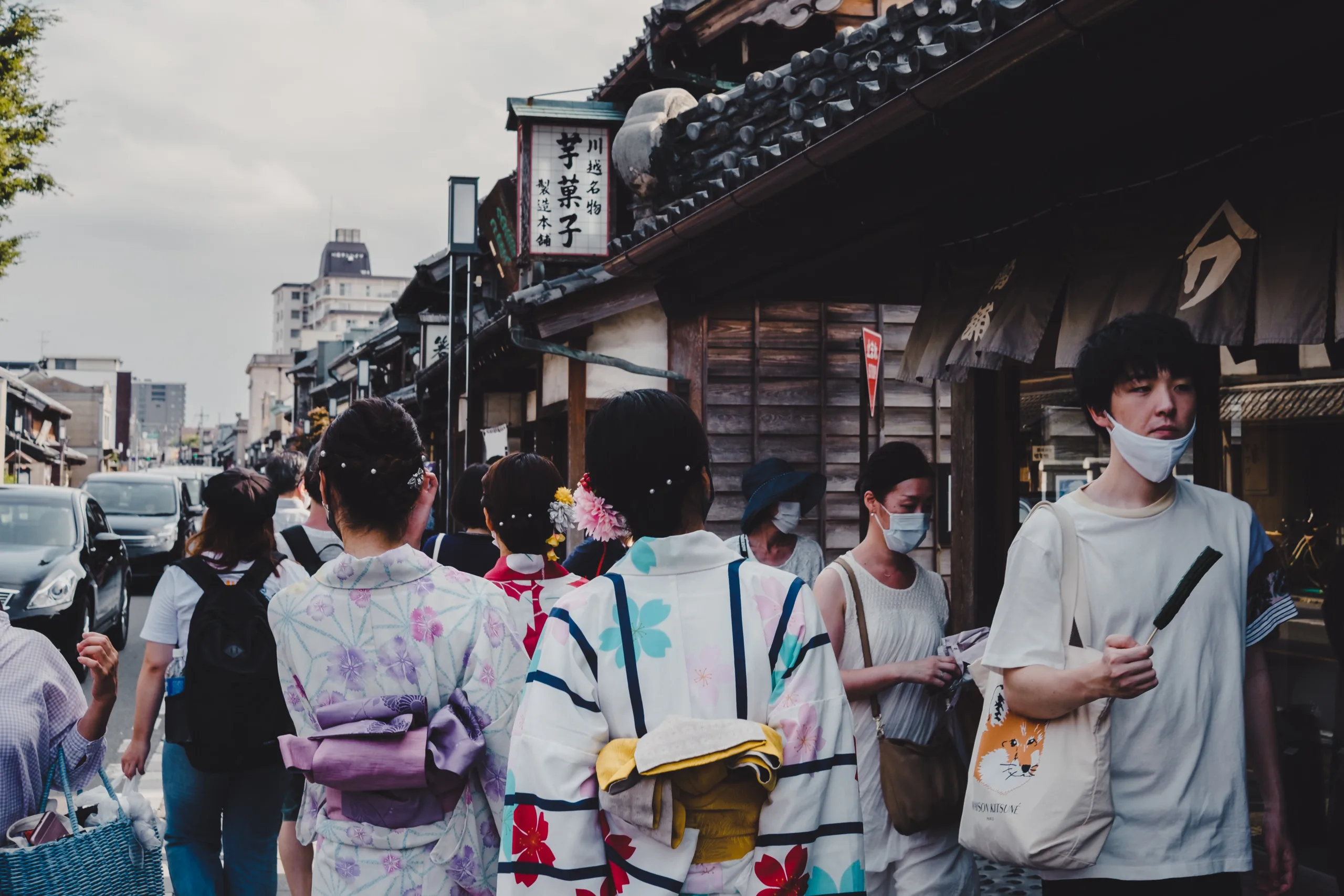
The strongest itineraries for solo travel in Japan are built around two principles. First: choose a register, not a list of cities. Second: leave one full day in every five completely unstructured. What follows is a register, not a recipe.
Tokyo
Tokyo is the obvious starting point. It works best as a base for four to six nights, with day trips out as needed. The city rewards the solo traveler precisely because its scale absorbs you. You are never the only person eating alone, walking alone, browsing alone. The neighborhood logic matters more than the headline sights. Yanaka and Nezu in the old shitamachi. Shimokitazawa for vintage shopping and slow afternoons. Daikanyama and Nakameguro for the evening. Kichijoji for the parks and the western Tokyo register. The full Tokyo cultural guide covers the connective tissue.
Kyoto
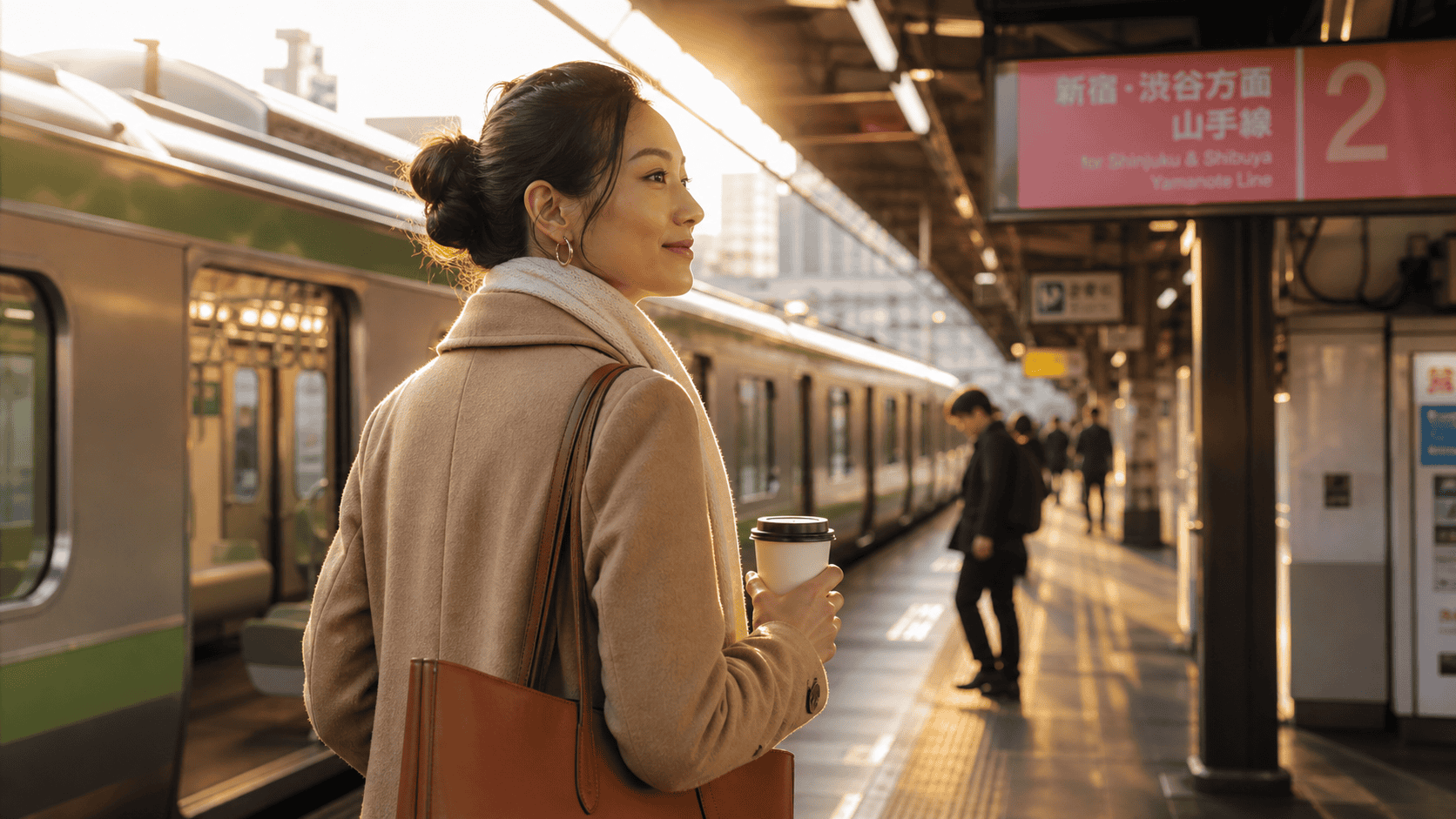
Kyoto sits at the opposite end of the register. Slower. More compressed. More demanding of the kind of attention solo travel grants. Three nights is a workable minimum for a first trip; five rewards better. The error most first-timers make is to chase the headline temples on a tight cycle. Kyoto’s quieter precincts reward a solo traveler at any time of year that is not peak cherry blossom or peak autumn — northern Higashiyama, the Murin-an gardens, the slope up to Honen-in. The two-day Kyoto itinerary is the practical companion for a first visit.
Kanazawa
Kanazawa is the secondary destination most often missed and most frequently regretted afterward. A small, walkable city with intact samurai and geisha districts. An extraordinary garden in Kenroku-en. A contemporary art museum that ranks among the country’s best. Two nights is enough for a first stay. The city is a natural complement to a Tokyo–Kyoto axis. The Kanazawa guide covers the practical details.
Hakone, Yanaka, and the day-trip register
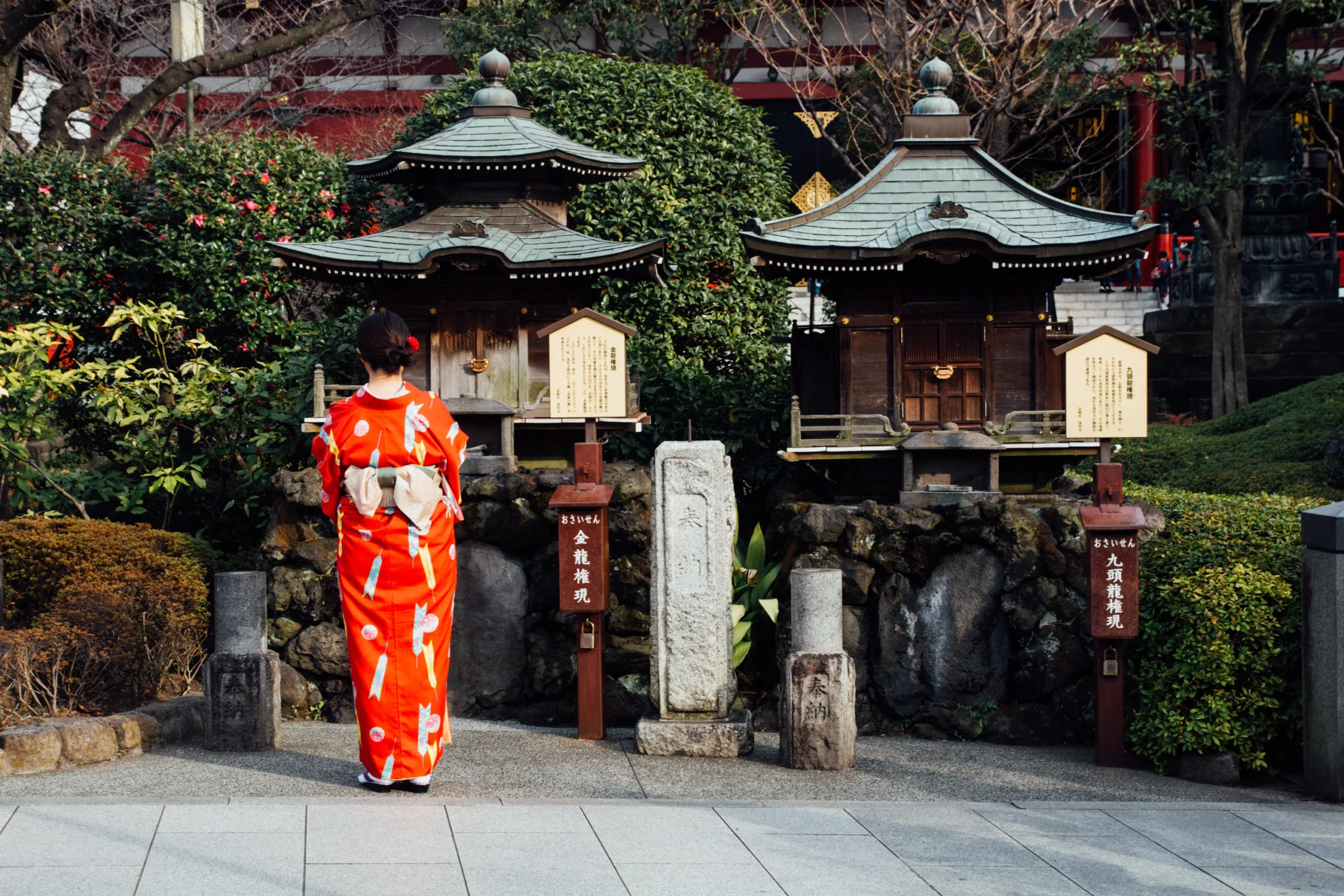
One full day at a forested onsen town changes the tempo of a Japan trip more than another city stop would. Hakone, Kinosaki, Kurokawa. Each works for a single mid-trip night. The full onsen and ryokan primer covers the bathing conventions a first-timer should read in advance. For the urban version of the same instinct, the old shitamachi neighborhood of Yanaka in northern Tokyo is among the strongest solo afternoons available anywhere in the country.
The art of solo dining in Japan
Solo dining is the part most Western travelers worry about. It is also the part that resolves itself most quickly on the ground. Japan’s dining culture treats eating alone as a normal civic act. An enormous part of the country’s restaurant infrastructure is designed around it.
The single best piece of advice is to lean into counter seating. A counter spot at a small ramen shop, a soba bar, a sushi counter, or an izakaya places you in front of the cook. The conversational pressure that table-for-one creates in Western restaurants disappears. The small theater of watching the food made replaces it. Conveyor-belt sushi chains like Sushiro and Kura Sushi work for the lower end of the spectrum. Counter sushi at a neighborhood sushi-ya is the version worth the splurge.
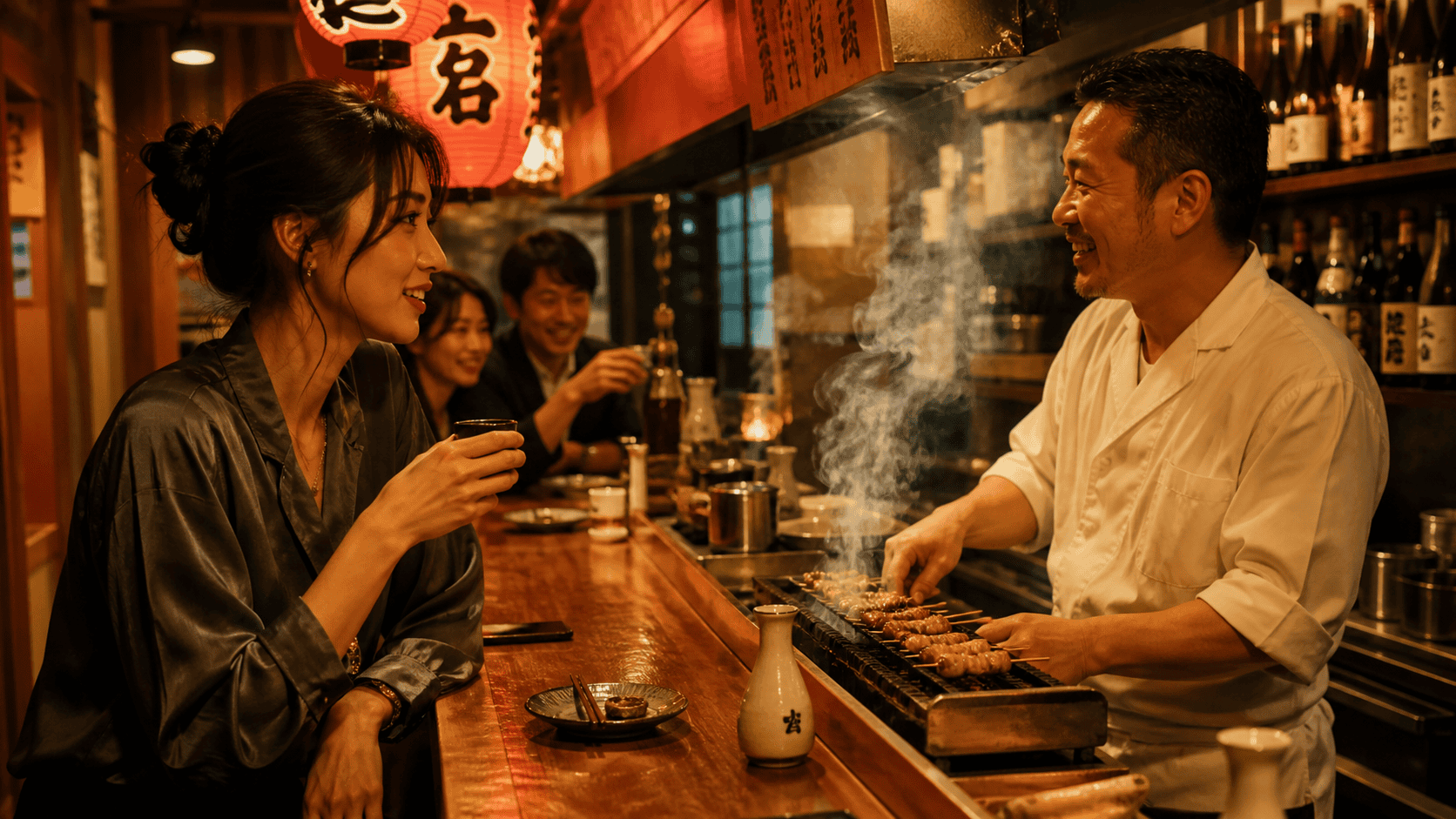
For the early evening, the standing-bar tachinomi tradition is built around solo drinkers. Yurakucho, Shimbashi, and Kanda are the strongest stations for it. The format is among the most efficient ways to taste local sake while exchanging a few quiet words with whoever you happen to stand next to. Izakayas are slightly more sociable but still entirely workable alone. The full izakaya primer covers ordering conventions and the small etiquette around shared dishes.
The one register where solo dining genuinely works less well is high-end kaiseki. The format is built around shared rhythm and pacing. A kaiseki dinner alone tends to feel ceremonious rather than convivial. A workable substitute is a counter kappo restaurant — same craft, less formality, designed for solo seating.
A printable one-page folio of ten Japanese proverbs, each with a sentence of editorial context. Worth a slow read on the plane, or a quiet hour on a ryokan veranda. Sent in one email. No newsletter follow-ups unless you opt in.
One email. No spam. Unsubscribe anytime.
Where to stay alone
Where you sleep shapes the rhythm of solo travel in Japan more than any other single decision. Three registers are worth considering. Most strong itineraries combine two of them.
The first is the well-located city hotel. In Tokyo, the strongest solo bases are not the headline luxury towers. Smaller boutique hotels work better — the Hoshinoya Tokyo, the Aman Tokyo, the Trunk Hotel Yoyogi Park. At the design-led mid-tier, the Hamacho or the K5 in Nihonbashi. In Kyoto, neighborhood ryokans like Yoshikawa and Hiiragiya, or the contemporary Aman Kyoto and Park Hyatt Kyoto, work well for a single traveler who wants both privacy and the option of dinner downstairs.
The second is the ryokan. A single night at a forested ryokan, mid-trip, is the move that most often turns a good Japan trip into a memorable one. The full luxury ryokan list covers the upper end of the segment. Hakone, Hakone-Yumoto, Kinosaki, Kurokawa, and the Izu Peninsula are the closest forested onsen regions to Tokyo and Kyoto. The single-occupancy supplement at most ryokans is real — usually thirty to fifty percent above the per-person rate. It is worth paying.
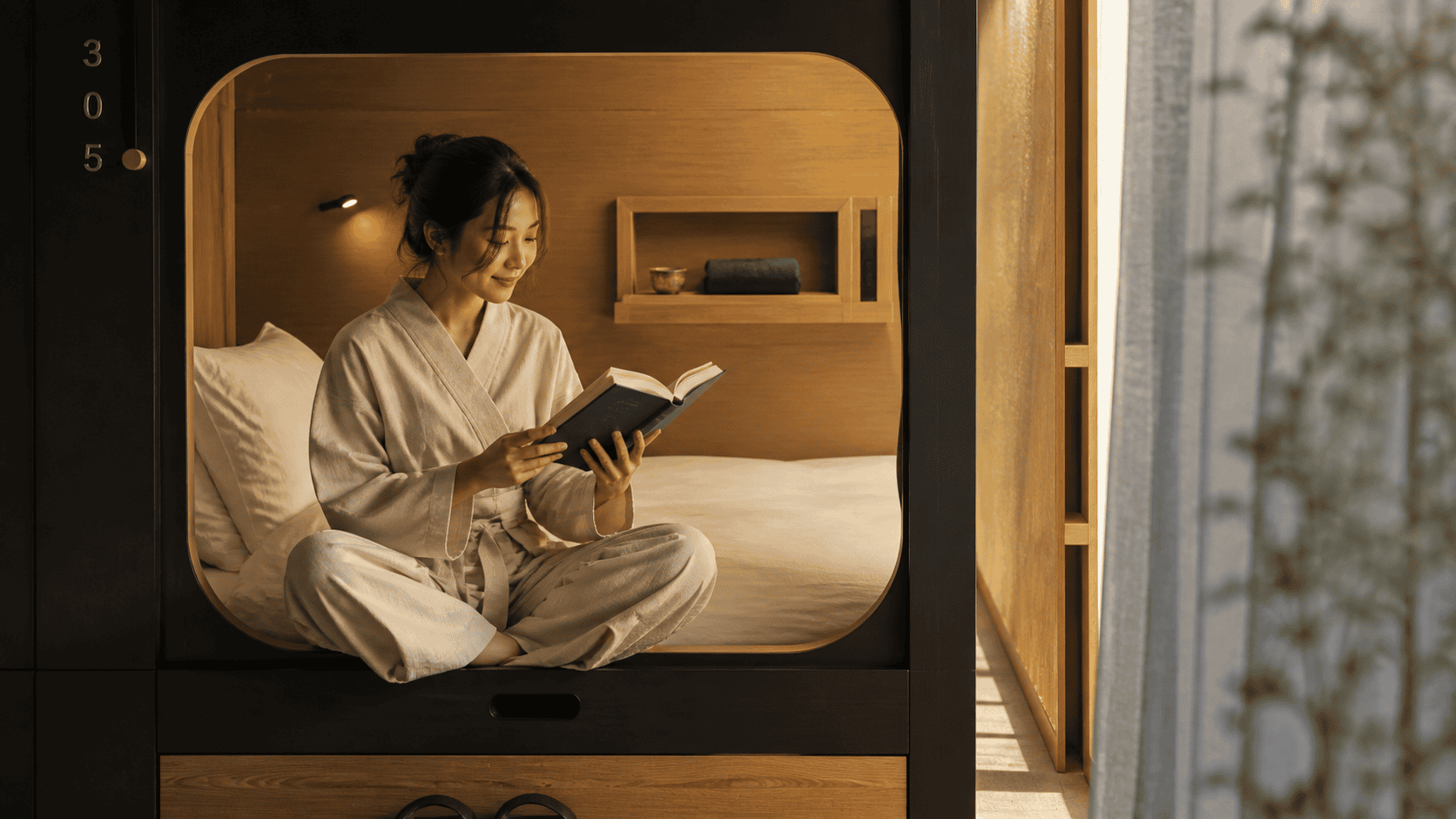
The third is the capsule hotel, which has evolved well beyond its 1980s reputation. The Nine Hours chain, First Cabin, and the upmarket Millennials Shibuya all work as a one-night solo experiment for travelers who want the format. The capsule is best treated as a deliberate experience, not as the lowest-cost default. A single night between hotel stays — near a major station, after a late arrival — is the right way to use it.
Practicalities: arrival, transit, connectivity
Five practical decisions hold solo travel in Japan together. None of them is hard. All of them are easier to make at home than at Narita arrivals at eleven in the evening.
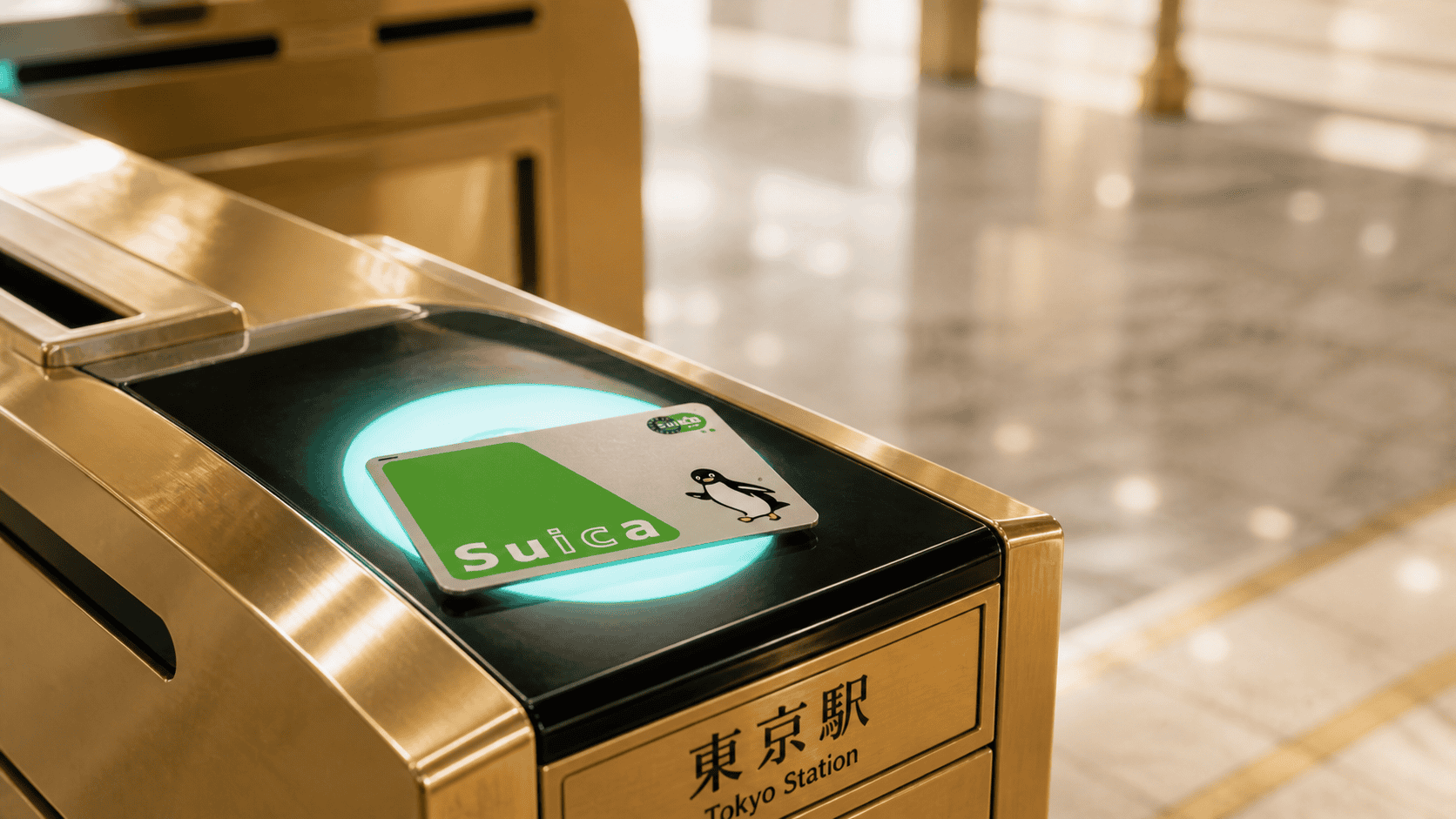
The transit IC card. A Suica or Pasmo card replaces ticket-buying for almost all rail and metro travel. It also works in convenience stores. Load it on Apple Wallet or pick up a physical card from any major station. This is the highest-leverage practical decision a solo traveler can make. Set it up on day one.
What to read
The four books worth carrying for a solo Japan trip. The full guide for orientation, the lighter companion for shorter stays, an essayist for the plane, and a pocket phrasebook for the moments translation apps will not cover.


The JR Pass question. Since the 2023 price increase, the JR Pass no longer pays back automatically for short or single-region trips. A two-week Tokyo–Kyoto–Osaka trip with one Hokkaido or Kyushu excursion is roughly the threshold above which the pass earns its keep. Below that, point-to-point Shinkansen tickets are usually the better economics. The full JR Pass analysis walks through the math.
Connectivity. An eSIM purchased before departure is the cleanest solution for a solo traveler. Airalo, Ubigi, or Sakura Mobile for longer stays. Pocket Wi-Fi units rented at the airport remain a workable alternative. They are also one extra device to charge and lose. Do not arrive without a working data plan. Japan’s open public Wi-Fi is uneven outside of stations and major chains.
Cash. Japan has digitized faster than its reputation suggests. Cash still remains essential for small restaurants, temples, ryokans, and rural areas. Withdraw yen from a 7-Eleven ATM on arrival. The network accepts most foreign cards and does not charge predatory fees. Carry roughly twenty thousand yen on the first day. Replenish as needed.
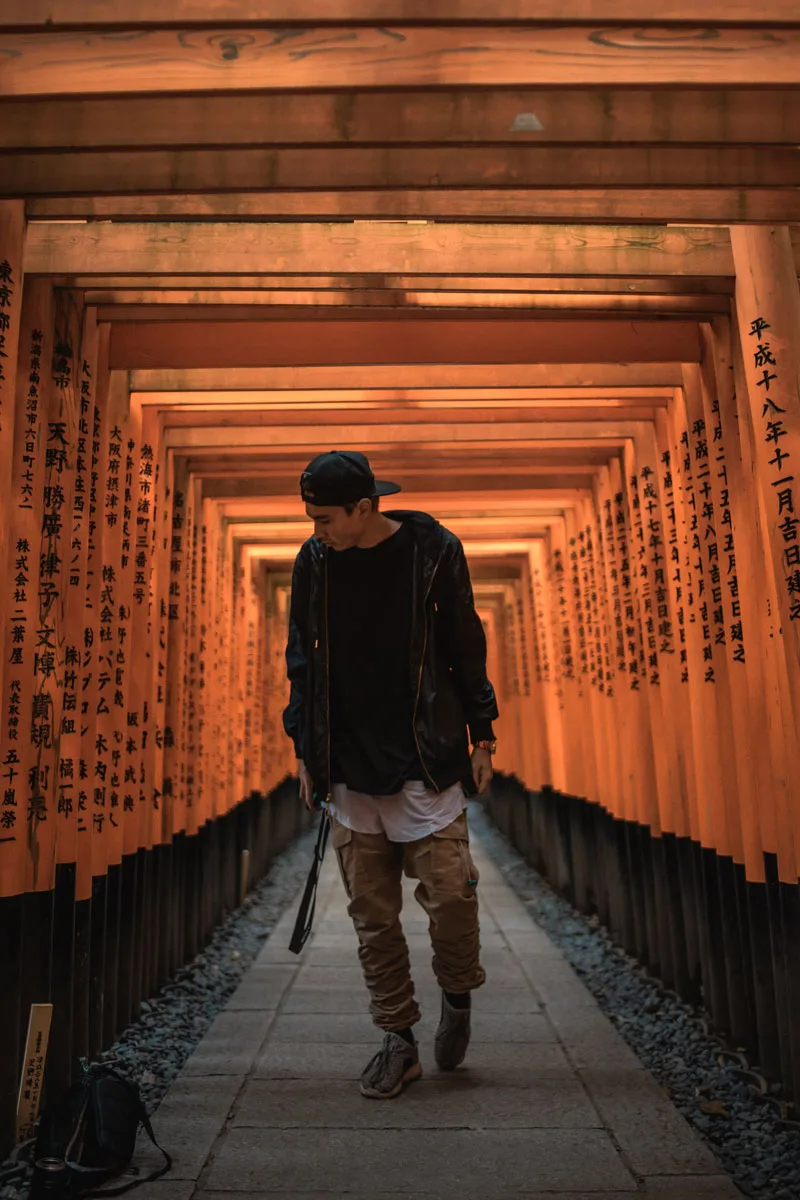
Safety, honestly. Japan is unusually safe by international standards. That does not mean ambient awareness can be entirely retired. The genuine risk vectors are documented: late-night bar scams in Kabukicho and Roppongi, occasional groping incidents on rush-hour trains, and the standard urban risk of leaving belongings unattended in tourist-heavy temple precincts. Women-only carriages exist on many rush-hour lines specifically for this. The US Embassy Tokyo consular page lists current advisories. Trust your instinct. That part of solo travel does not change between countries.
Studying Japanese, or moving for work
A particular kind of reader plans a solo Japan trip not as tourism, but as research. The Japanese-language student who wants two weeks of unmediated input. The professional weighing a Tokyo posting and trying to read a neighborhood honestly before signing the lease. The career-changer assessing whether life in Japan would actually suit them. Solo travel is the right format for that question. A group amplifies tourism. A solo trip lets the country answer.
For the language learner, the rhythm of a solo trip already does most of the work. Two weeks of ordering food at counters, asking directions, reading station signage, and listening to ambient Japanese gives more usable input than a year of textbook study. Build the trip around language exposure rather than around it. A morning at the Magnificent Japan Calligraphy Practice tool sets the day’s attention. The companion Calligraphy Practice Workbook is what travels in the carry-on. The site’s Daily Kanji Flashcards handle the reading-fluency side. The deeper essay on Shodō is the right context-setter for someone who wants the practice to mean something rather than merely produce strokes.
What to carry and pack
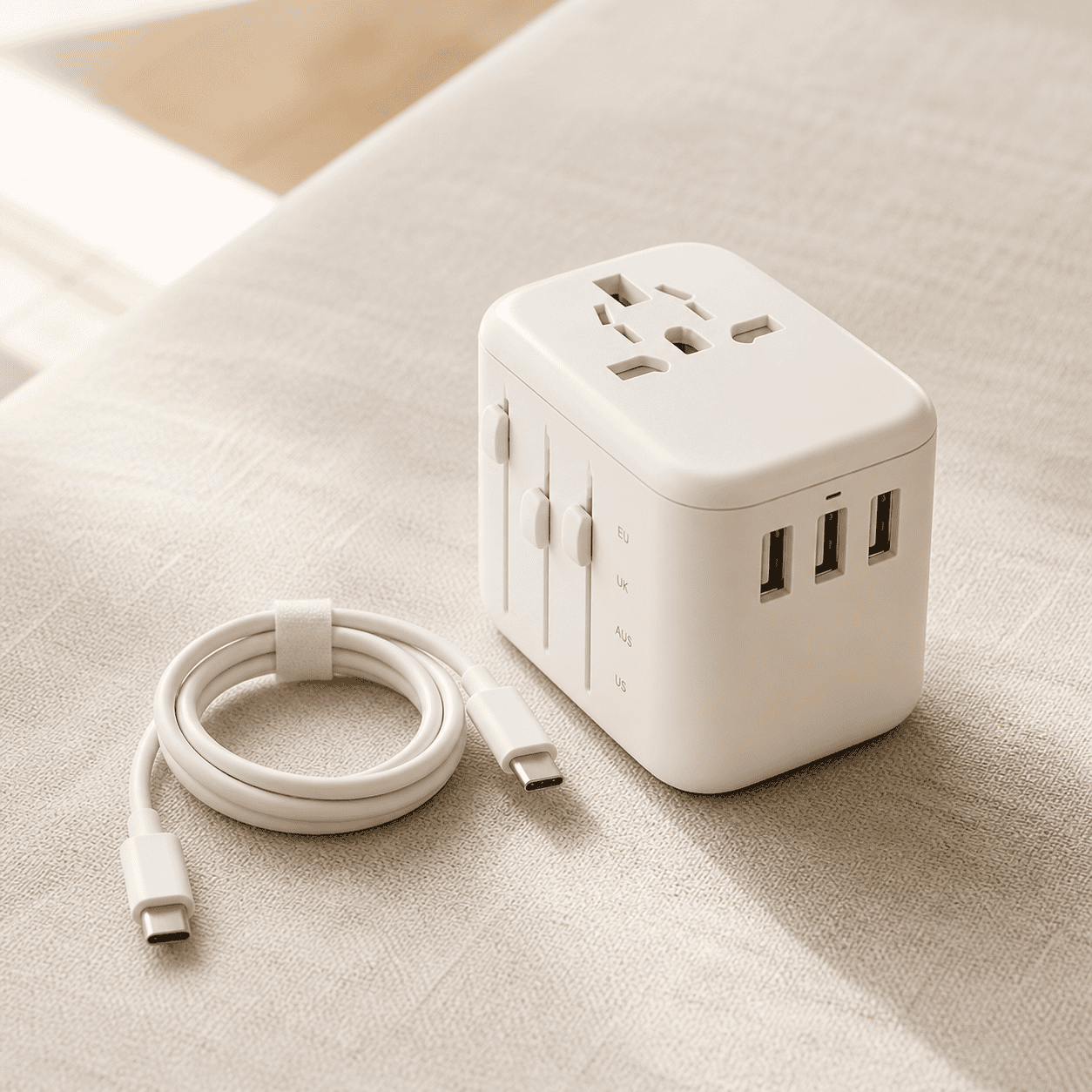
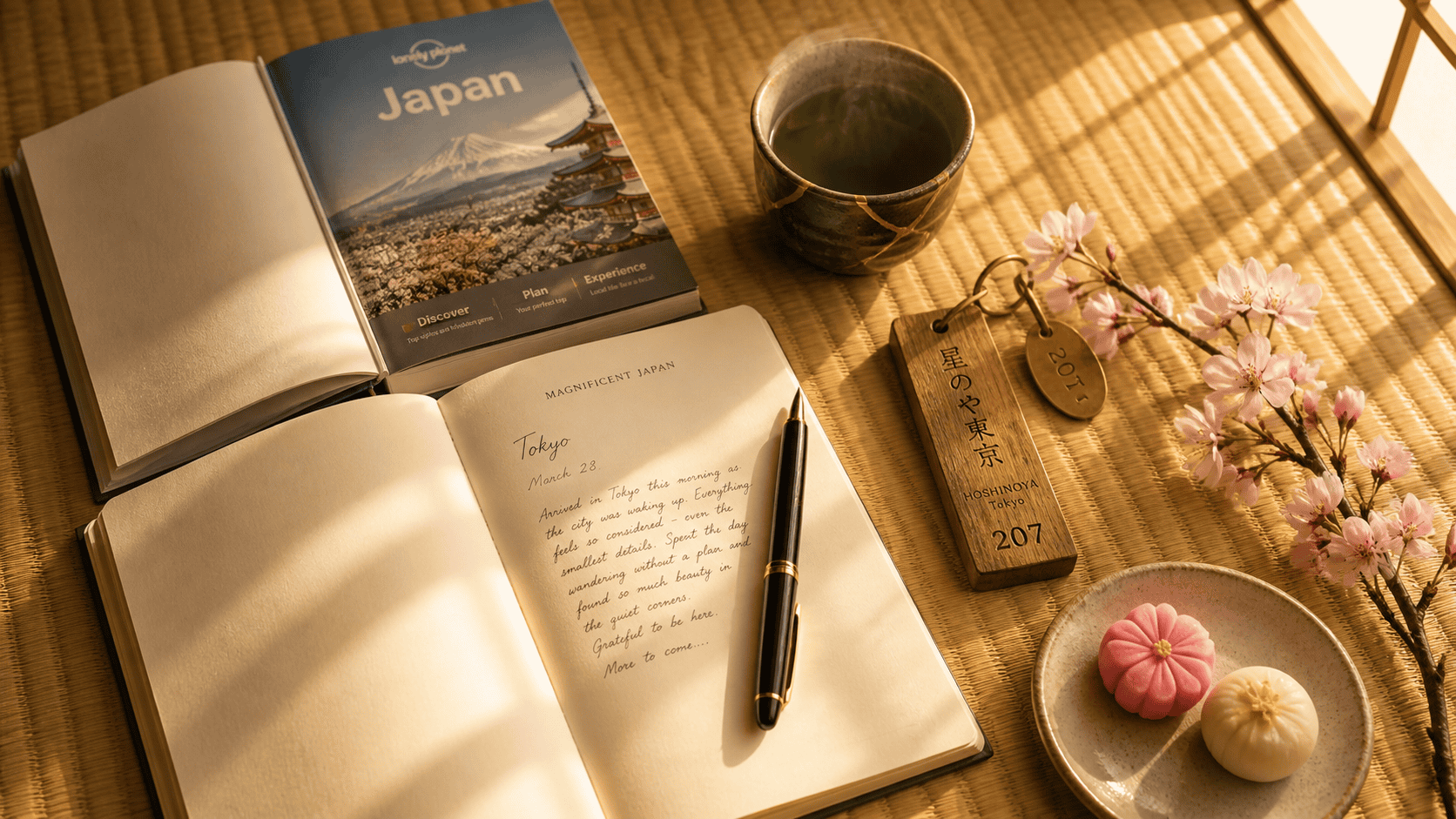
The small kit that earns its place in a solo carry-on for Japan: power for the long days, packing discipline for the multi-stop nights, and the journal for everything the trip surfaces that text alone cannot hold.


For the prospective resident, the trip’s purpose shifts. The question is not what you can see, but how you would actually live. Walk the neighborhoods you would consider — Setagaya, Bunkyo, Meguro for Tokyo; the northern wards of Kyoto if Kyoto is on the list. Take the trains at commute hours, not at noon. Eat lunch at the kind of small shop you would visit twice a week. The Magnificent Japan Japan Residency Assessment is a useful pre-trip exercise. It forces a sharper read on what specifically draws you, and what would test you, before the romance of the trip overlays the logistics.
The work-and-business angle has its own track. The detailed essay on Starting a Business in Japan as a Foreigner covers the visa categories, the actual approval rates, and the industries that absorb foreign founders most easily. The longer-form piece on Japanese citizenship by investment covers the rare-but-real pathway for those weighing a longer commitment. Both reward reading on the plane.
What anchors a solo Japan trip is rarely the headline sights. It is the small ritual that repeats. The morning at a temple. The afternoon at a tea counter. The evening at the same izakaya twice in a week. The pages below speak to that register: the planning that holds the trip together, the conversation that lets it begin.
Questions Worth Asking
Few countries are better suited to traveling alone. Civic safety is unusually high. The rail and metro networks are dense and intuitive. Dining-for-one is culturally normal across most price tiers. The language barrier is manageable in any major city. The deeper reward is the country’s tolerance for unhurried attention. Solo travel grants that posture more easily than group travel does.
Japan ranks among the safest countries in the world for solo visitors of any gender. Street crime rates are extremely low and public order is genuine. Standard urban precautions still apply, particularly in late-night entertainment districts like Kabukicho and Roppongi where touts and bar scams are documented. Trust your instinct. Keep your accommodation address saved offline. The rest tends to handle itself.
Ten to fourteen nights is the realistic floor for a first solo trip that includes Tokyo, Kyoto, and one secondary destination. Anything shorter forces a checklist mentality the country actively resists. Travelers with limited time are better served by a focused single-region trip — five nights in Tokyo, four in Kyoto — than by a sprint between cities.
Far less than in most Western countries. Counter seating at ramen shops, soba bars, sushi counters, and izakayas is designed for the solo diner. Many small restaurants in business districts cater almost exclusively to people eating alone. The cultural register is matter-of-fact: no lingering glances, no awkwardness, no upselling. The one exception is high-end kaiseki, which is built around shared rhythm and works best with a companion.
Yes — perhaps the strongest case for a solo trip. A two-week stay gives a learner more usable language input than a year of textbook study. It gives a prospective resident an honest read on neighborhoods, commute realities, and daily-life cost. Build the trip around language exposure: a brief language exchange, a calligraphy or kanji session, an evening in an izakaya where the staff do not speak English. The Magnificent Japan Calligraphy Practice tool, the Kanji Flashcard Method, and the Japan Residency Assessment are useful before, during, and after the trip.
Three things hold a solo Japan trip together. First, a transit plan that does not assume the JR Pass solves everything. Second, an offline navigation backup for when a Japanese-only signage moment lands. Third, a small ritual that anchors each day — a morning at a temple, an afternoon coffee, a quiet bath. Without the third, solo travel can drift toward the merely transactional.
The Trip Worth Building
Solo travel in Japan is, at its best, a trip in which the traveler arrives slightly different from the one who left. The country grants the conditions. The planning grants the time and space to use them. A good itinerary is not a list of cities but a register. When the days are quiet. Where the meals are unhurried. Which mornings are kept open. Which night is the one in the ryokan. The rest tends to organise itself.
For travelers who would rather have the planning handled, the Luxury Adventure Starter covers the first three to five days professionally. The full luxury ryokan list is the companion piece for the night that anchors the trip. The Magnificent Japan Journals are the slow-attention object that travels in the carry-on.
A bespoke Japan itinerary, designed around the way you actually want to travel. Not a packaged route — a plan built from a single conversation about what would make the trip yours. Quote within 24 hours, no commitment.
Begin a Custom Itinerary