The ikigai kanji are three characters and one small kana: 生き甲斐. Together they spell a word Japanese speakers use every day, and each piece carries a meaning of its own. Once you can read them, ikigai feels less like a slogan and more like a sentence you could write.
Below, we read the word slowly. First comes 生, the character for life. Next comes 甲斐, a pair that means worth or reward. Then we turn to the hiragana spelling, to pronunciation and to stroke order. For the wider idea, begin with our introduction to what ikigai means.
By the end, you should be able to write the word with a brush or a pen. You may even want to keep it close, as we do in The Return, our 90-day ikigai journal.
What Is the Ikigai Kanji?
In Japanese, ikigai takes the form 生き甲斐, read i-ki-ga-i. The kanji 生 means life or to live, and the kana き completes the verb. Then 甲斐 means worth, effect or reward, and its sound softens from kai to gai inside the word. Everyday writing often uses 生きがい instead, because 斐 sits outside Japan’s list of common-use kanji.
Ikigai in Japanese: The Word Written Out
Ikigai joins two plain parts. 生き means living, and 甲斐 means worth. So the whole word names the worth of being alive. The Digital Daijisen dictionary defines 生き甲斐 as something worth living for, and as the drive and joy of going on living (Kotobank, 生き甲斐). Notice how modest that is. It speaks of energy and pleasure, not a grand mission.
生 and き: life, and the kana that finishes it
The first character is 生. It has five strokes, and Japanese children learn it in their first year of school. Its core meanings are to live, to be born and to grow. The character dictionary Jitsū describes it as a picture of a plant pushing up from the ground. You can still see it. A slanted stroke leans like a leaf, a stem rises through the middle, and a long line of soil runs along the base.
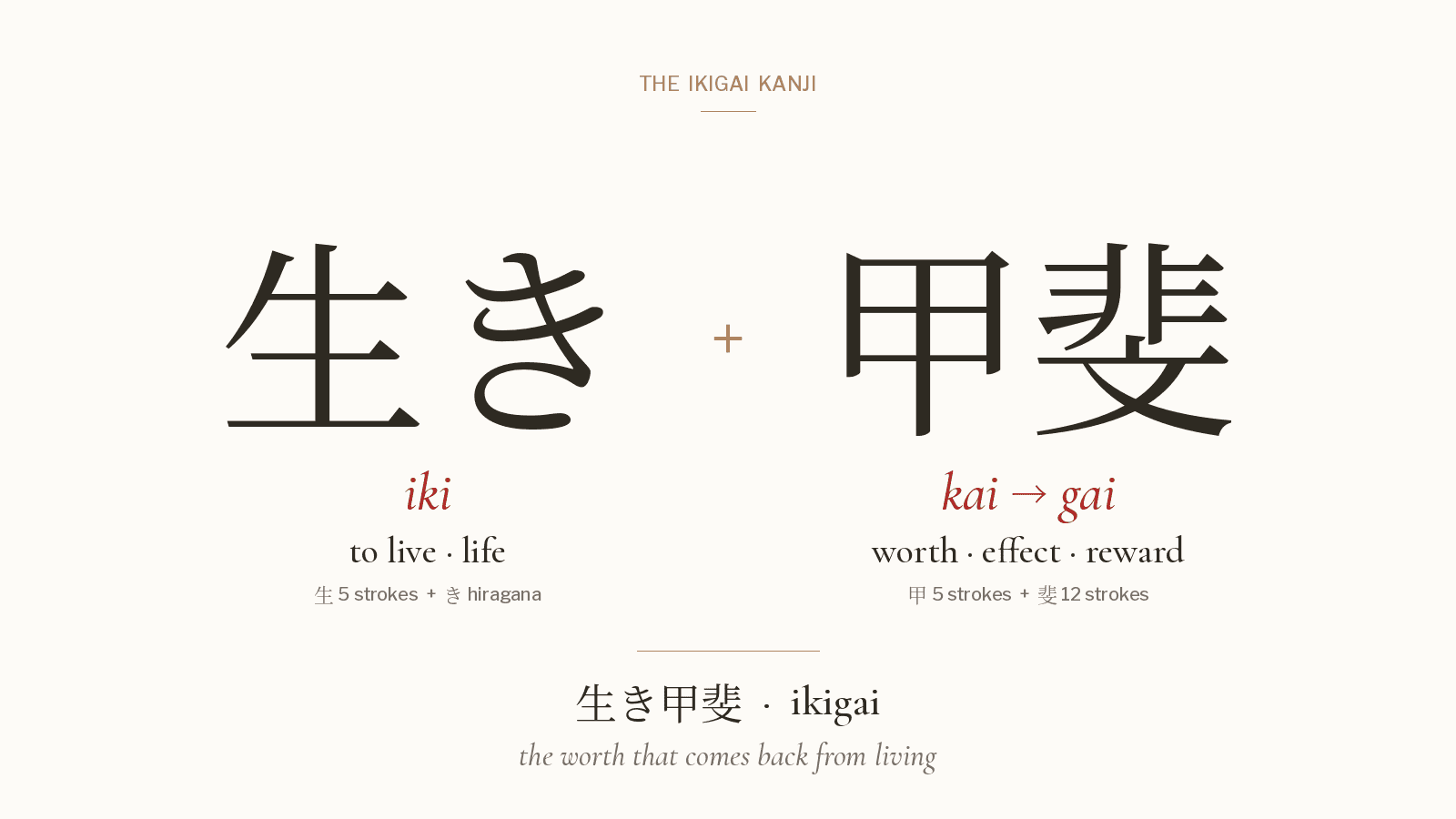
So the first mark of ikigai is growth, not effort. That is a hopeful place for any word to begin. Because 生 is so common, it also carries many readings, such as sei, shō and nama. In ikigai, though, it takes the native verb reading, i. You hear the same sound in 生きる, ikiru, to live, and in 生き物, ikimono, a living thing.
Between the kanji sits a single hiragana, き. Japanese calls this kind of trailing kana okurigana, and it shows how the verb bends. Here 生き is the stem form of 生きる, which can also work as a noun. Without the き, a reader might take 生 as sei or nama. With it, the reading snaps into place as iki. So keep it, and write it a little smaller than the kanji around it.
甲斐: worth, effect and a softened sound
The second half, 甲斐, is the heart of the word. On its own it reads kai. Dictionaries define it as the visible result of an action, the effect of an effort, or worth you can expect (Kotobank, 甲斐). The Nihon Kokugo Daijiten traces it to an old verb, kau, meaning to exchange. In other words, 甲斐 is what you get back for what you give.
Japanese attaches it to many verbs. 働き甲斐 is the worth of working, and 生き甲斐 is the worth of living. Inside these compounds, kai becomes gai. This softening, called rendaku, often happens when two Japanese words fuse into one. So the full word reads i-ki-ga-i, four even beats.
To feel how these parts fit, write them. A brush pen is the gentlest way to begin, because it behaves like a brush without the inkstone and water. The tip swells under pressure and tapers as you lift. As a result, each stroke of 生 shows its start and finish. Japanese makers design these pens for exactly this work.
Ikigai Hiragana: いきがい, 生きがい and 生き甲斐
You will see ikigai written three ways. The full kanji form is 生き甲斐. A mixed form uses one kanji and three kana, 生きがい. An all-hiragana form reads いきがい. All three say the same word, yet each feels a little different on the page.
Why 生きがい is the everyday spelling
Japan keeps an official list of common-use kanji, the jōyō kanji. 生 and 甲 both appear on it, but 斐 does not. The Japan Kanji Aptitude Testing Foundation’s dictionary lists 斐 as a twelve-stroke character outside that list, assigned to the advanced pre-first level of its test (Kanjipedia, 斐). On its own, it means a beautiful pattern. That is one reason 生きがい is so common in everyday print.
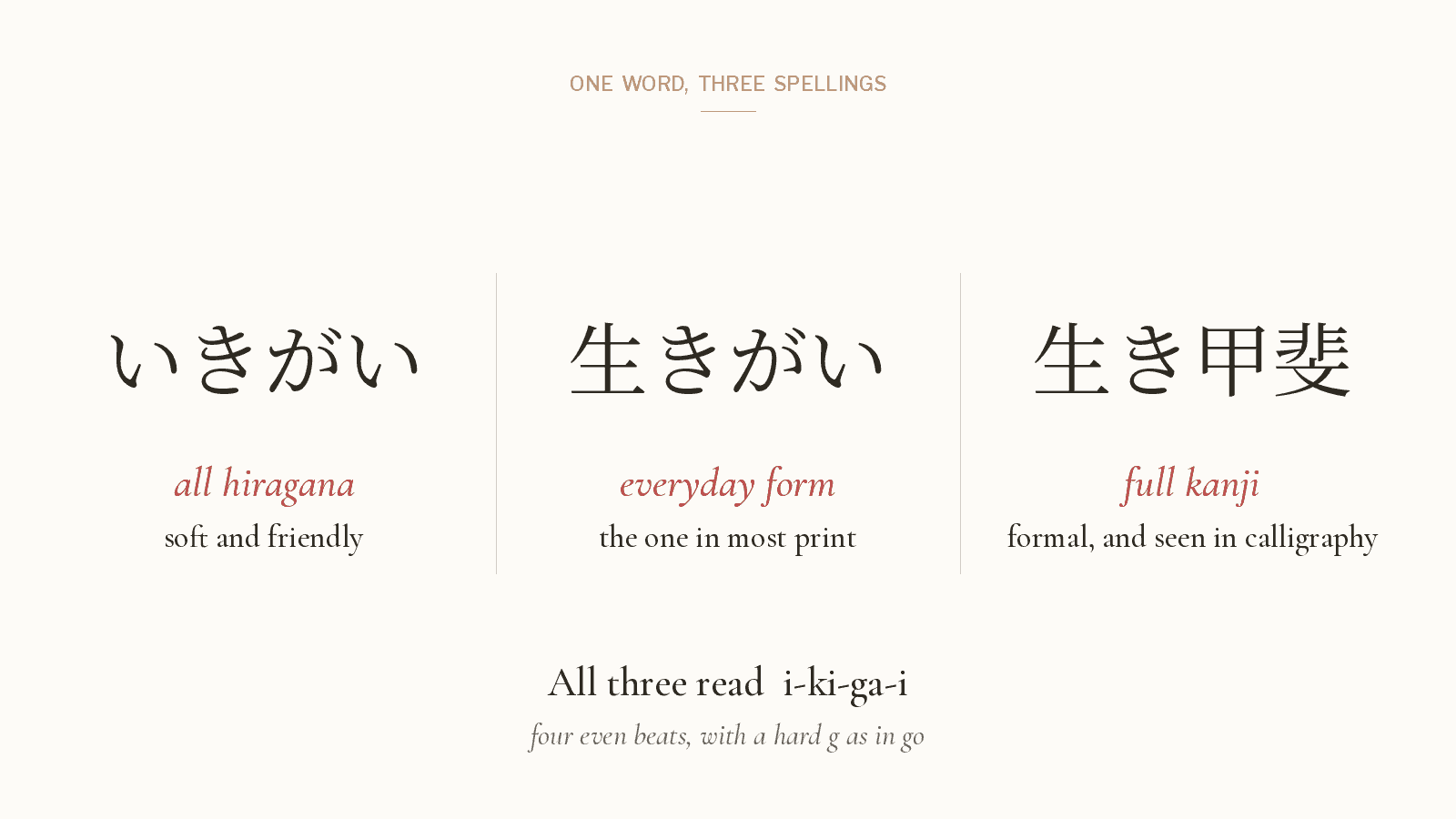
The best-known Japanese book on the subject shows the habit well. In 1966, the psychiatrist Mieko Kamiya published 生きがいについて, On Ikigai (Misuzu Shobo, Mieko Kamiya). She worked in psychiatry at Nagashima Aiseien from 1957 to 1972, and her book asks what makes a life feel worth living. Look at its title. Even there, the word appears as 生きがい.
How to pronounce ikigai
Say it as four short, even beats: ee-kee-gah-ee. Each vowel is clean and brief, as in Italian. The g stays hard, as in “go.” Also, try not to stress one syllable, because Japanese spreads the weight evenly.
A good habit is to write the word as you say it. That links sound, shape and meaning on a blank page. A travel notebook suits the ritual, especially one whose cover carries a hopeful phrase. 七転八起, nana korobi ya oki, means fall seven times and rise eight. It sits beautifully beside 生きがい.
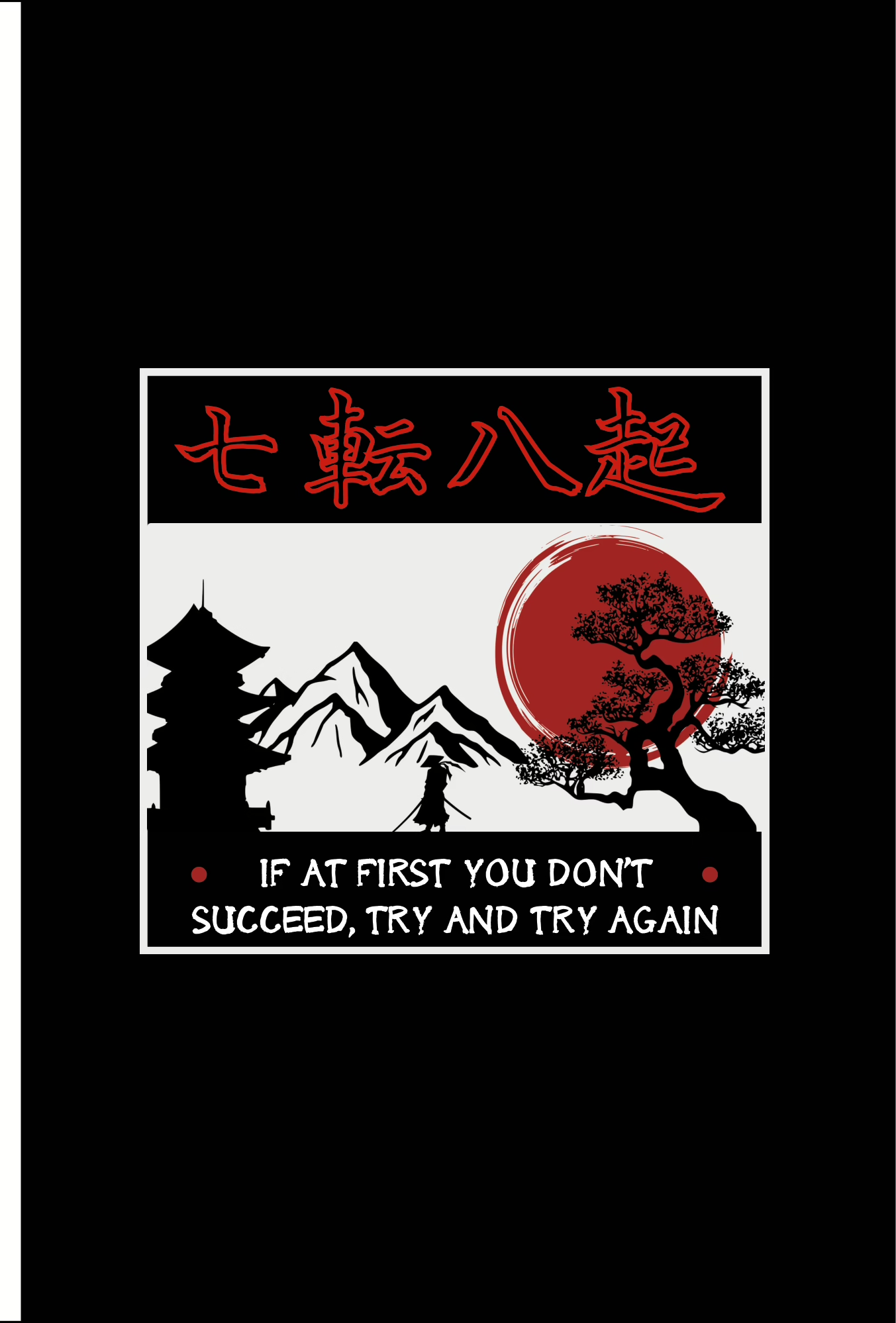
Fall seven times, rise eight: open pages for practice by hand.
Unlined · 120 pages · Original cover art
Shop This Journal →Travel gives you a natural reason to write the word often. Each evening, note one small thing that felt worth the day, however modest. A bowl of noodles counts, and so does a kind stranger. The note takes only a minute, yet it shapes the whole trip. Over a week, those notes sketch your own 甲斐, the steady return your days are giving you back. Writing by hand also slows you down in a helpful way. The pen makes you choose each stroke, and that choice keeps the meaning present. Back home, the notebook becomes a keepsake in your own hand, with the ikigai kanji at the top of every page.
How to Write Ikigai in Japanese, Stroke by Stroke
Stroke order follows a few steady habits. Top comes before bottom, and left before right. Horizontals usually come before the verticals that cross them. Also, a stroke that runs through a whole character often comes last. Once these habits feel natural, the ikigai kanji almost write themselves.
Writing 生 and 甲, five strokes each
First, draw the short slanting stroke at the upper left, falling from right to left. Next, draw the short horizontal just below it. Third, drop the tall vertical down the center. Fourth, add the middle horizontal across that stem. Finally, lay the long bottom line from left to right. If you want a guide, our browser tracing tool for kanji practice shows each stroke as you draw.
甲 looks like a box with a tail. First, draw the left vertical. Second, draw the top line and turn down the right side in one stroke. Third, add the inner horizontal. Fourth, close the box with the bottom line. Then drop the center vertical through the box and let it run below. Because it passes through everything, it comes last.
Four marks carry the whole word, and only one of them sits outside everyday Japanese.
| Character | Reading on its own | Core meaning | Strokes |
|---|---|---|---|
| 生 | sei, shō, iki(ru) | life, to live, to grow | 5 |
| 甲 | kō | shell, armor, first in rank | 5 |
| 斐 | hi | beautiful pattern | 12 |
| 甲斐 (together) | kai, gai in compounds | worth, effect, reward | 17 |
The table shows why 甲斐 reads as a unit. Alone, 甲 and 斐 say kō and hi. Together they say kai, a reading that belongs to the pair. That is also why dictionaries list 甲斐 as a word of its own.
Writing 斐 in twelve strokes
斐 has two stacked parts. The top is 非, and the bottom is 文, the character for writing. Start with the left half of 非, a vertical and three short horizontals. Next, draw its right half the same way. Then move down to 文. Place the small dot at the top, then the horizontal, then the stroke that falls left, and finally the long sweep right. Keep the top half narrow, so 文 can spread beneath it.

Practice follows a simple rhythm. Trace each character three times over a model. Then copy it three times beside the model. Finally, cover the model and write it from memory. Short sessions work best, so ten minutes a day beats an hour on Sunday. Our printed calligraphy workbooks follow this same trace, copy and recall pattern.
A written word also changes when it has a daily place. Many people write it at the top of a morning page, then answer one question beneath. The short film below shows that habit. A hand answers a morning prompt in The Return, in its digital edition on a tablet.
Twenty seconds inside the journal
The digital edition in use — a morning prompt, answered by hand while the coffee is still warm. Tap to play, with sound.
One page, one intention, one single quiet moment.
Notice how little the page asks. One prompt, one answer, and the day begins. That scale matches the word itself, because 甲斐 is a return, not a trophy.
Ikigai Calligraphy: The Word Under a Brush
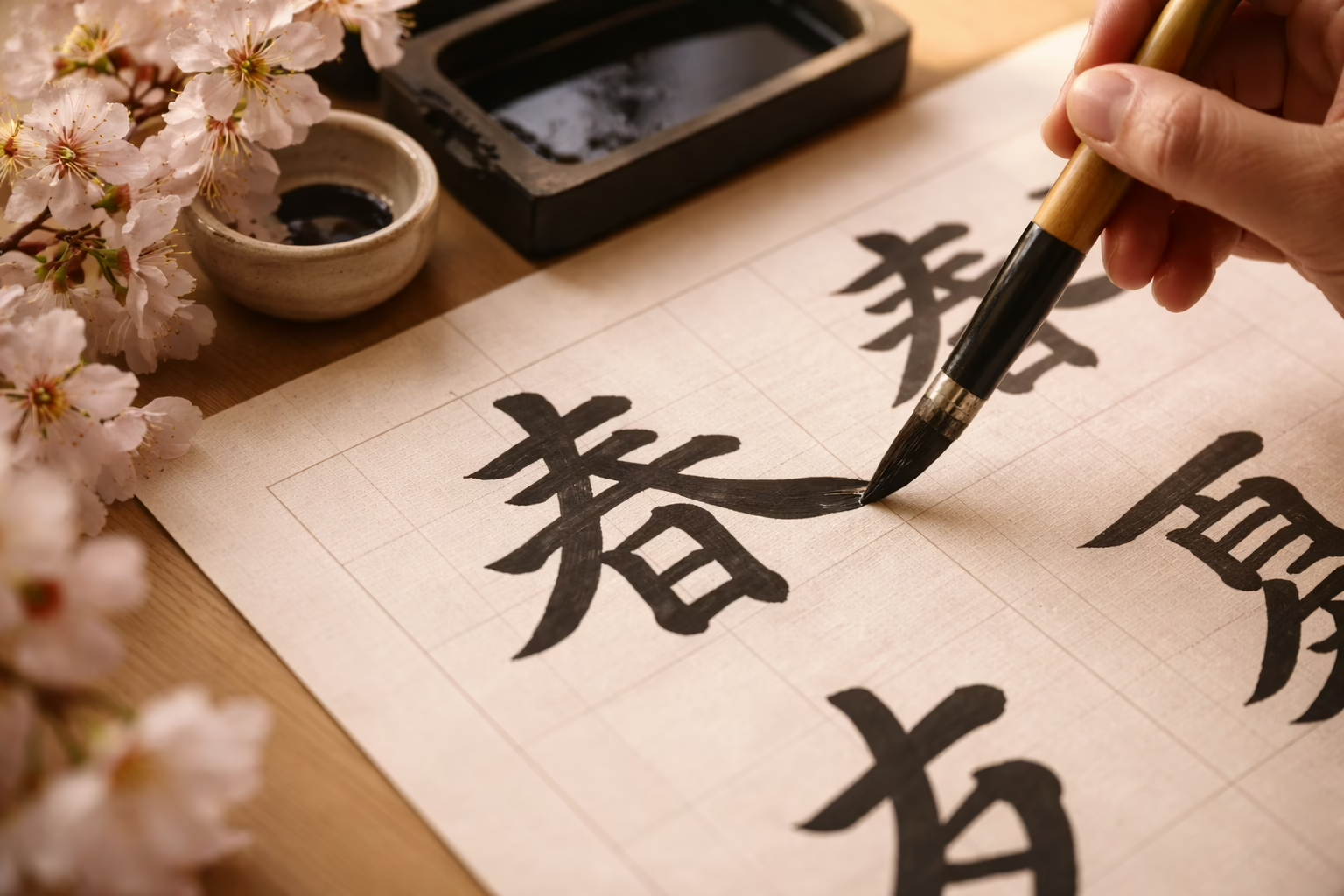
In shodō, Japanese calligraphy, 生き甲斐 is a rewarding piece to write. It opens with a simple character, pauses on a soft kana and ends on a dense pair. That mix of light and heavy gives the brush something to do.
Three scripts, three moods
Kaisho, the standard script, writes every stroke separately, so it looks calm and clear. Gyōsho, the semi-cursive script, lets strokes join, and 甲斐 begins to breathe. Sōsho, the cursive script, compresses whole characters into a few sweeps. Hiragana itself grew from highly cursive forms of kanji. So the soft がい at the end of 生きがい already carries a trace of the brush.

Before you write the full word, test your tool with a single line. Press, pull and lift, and watch the stroke thicken and thin. Then write 生 alone until the base feels steady. Only then add the heavier pair. Patience here pays off, because a steady 生 sets the rhythm for everything after it. For the wider story of the art, see our guide to the history and practice of Japanese calligraphy.
If you would rather learn from a calligrapher in person, a brush lesson can anchor a whole day, and we can fold one into a Japan itinerary built around calligraphy and craft.
Occasional letters on ikigai and the Japanese ideas behind a good day, with news of the Cultural Reflection Collection.
Occasional letters. Unsubscribe anytime.
Spacing, size and a signature seal
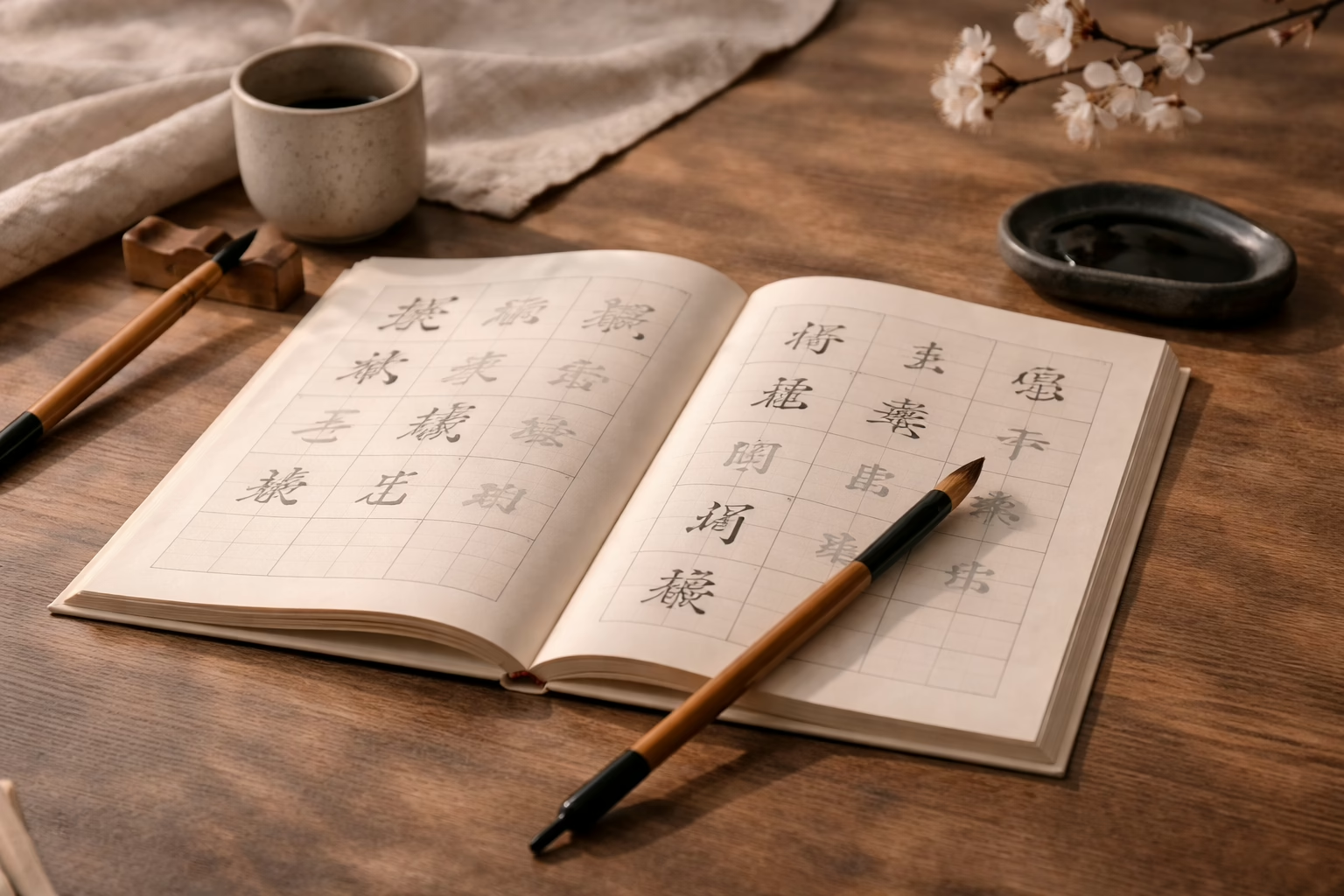
Good calligraphy is as much about space as ink. When you write 生き甲斐 vertically, center each character on an invisible line. Give 生 and 甲斐 similar weight, and let き sit smaller between them. Leave generous margins, because white paper frames the word the way a mat frames a print. Many finished pieces also carry a small red seal, which balances the black ink. At home, a pencil date works just as well. It lets you compare this month’s 生 with last month’s. Also, keep your early sheets. The first clumsy attempts often become the pages you treasure most, since they show how far your hand has come.
Why the Ikigai Kanji Point to Everyday Meaning
Read the characters again and a pattern appears. 生 is life as growth, while 甲斐 is worth as a return on effort. Neither speaks of destiny or a single calling. Instead, the word describes an ordinary exchange. You live, you act, and life gives something back.
From small pleasures to deep questions
Japanese reference works reflect this range. The Heibonsha World Encyclopedia describes ikigai as whatever encourages a person’s life and gives it grounding. That span runs from a simple sense of drive in daily life to an answer about how to live. Both ends count. A good cup of tea belongs to the word as surely as a life’s work.
Research shows the same breadth. The Ohsaki Study followed 43,391 Japanese people for seven years. It asked one plain question: do you have ikigai in your life? Those who said no had a higher risk of death, mainly from cardiovascular disease (Sone and colleagues, Psychosomatic Medicine, 2008).
Recommended
That finding is an association, not proof of cause. Still, one detail stands out. The researchers did not need to define ikigai for anyone. Tens of thousands of people understood the word at once, because it belongs to everyday speech.
That is the lesson inside the ikigai kanji. The word does not ask you to find one great purpose. Rather, it asks you to notice what returns your effort with energy or joy. Some days that is family. On other days, it is a garden, a craft or a morning walk. Each one is a small 甲斐, and together they make a life that feels worth living.
甲斐 Beyond the Word: From Kai Province to Your Table
The pair 甲斐 has a second life as a place name. Kai was an old mountain province, and after the Meiji reforms it became Yamanashi Prefecture. The Kotobank entry for 甲斐 records both uses side by side. The single character 甲 still stands for the region in words such as 甲州, Kōshū.
It is tempting to link the two meanings, but the dictionaries do not. The word kai, worth, comes from an old verb for exchange. The province simply shares the written characters. So enjoy the coincidence, and leave it there. When you write 生き甲斐, you are writing about the worth of living, not about Yamanashi.
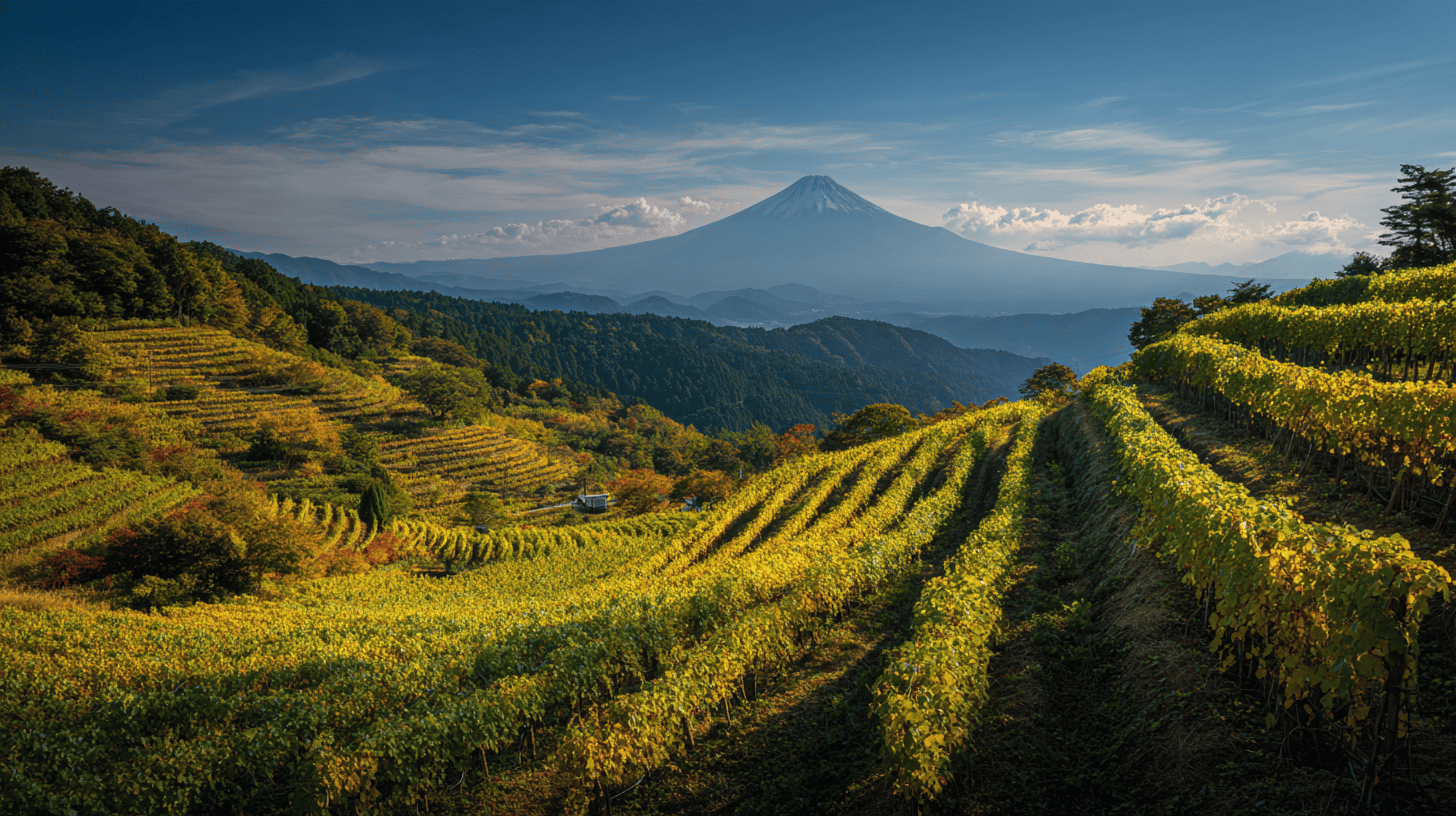
Yamanashi rewards a visit all the same. Its steep land suited wheat better than rice, so the region built its cooking around flour. The best-known result is hōtō, a flat noodle stew that the prefecture’s tourism office calls the soul food of Yamanashi. Local tradition also says the warlord Takeda Shingen fed it to his troops.
Why hōtō belongs in this story
Hōtō differs from udon in one key way. Cooks drop the raw, unsalted noodles straight into the miso broth instead of boiling them apart. As a result, their starch thickens the soup, and the kabocha squash melts into it. The recipe below follows that classic Yamanashi pattern.
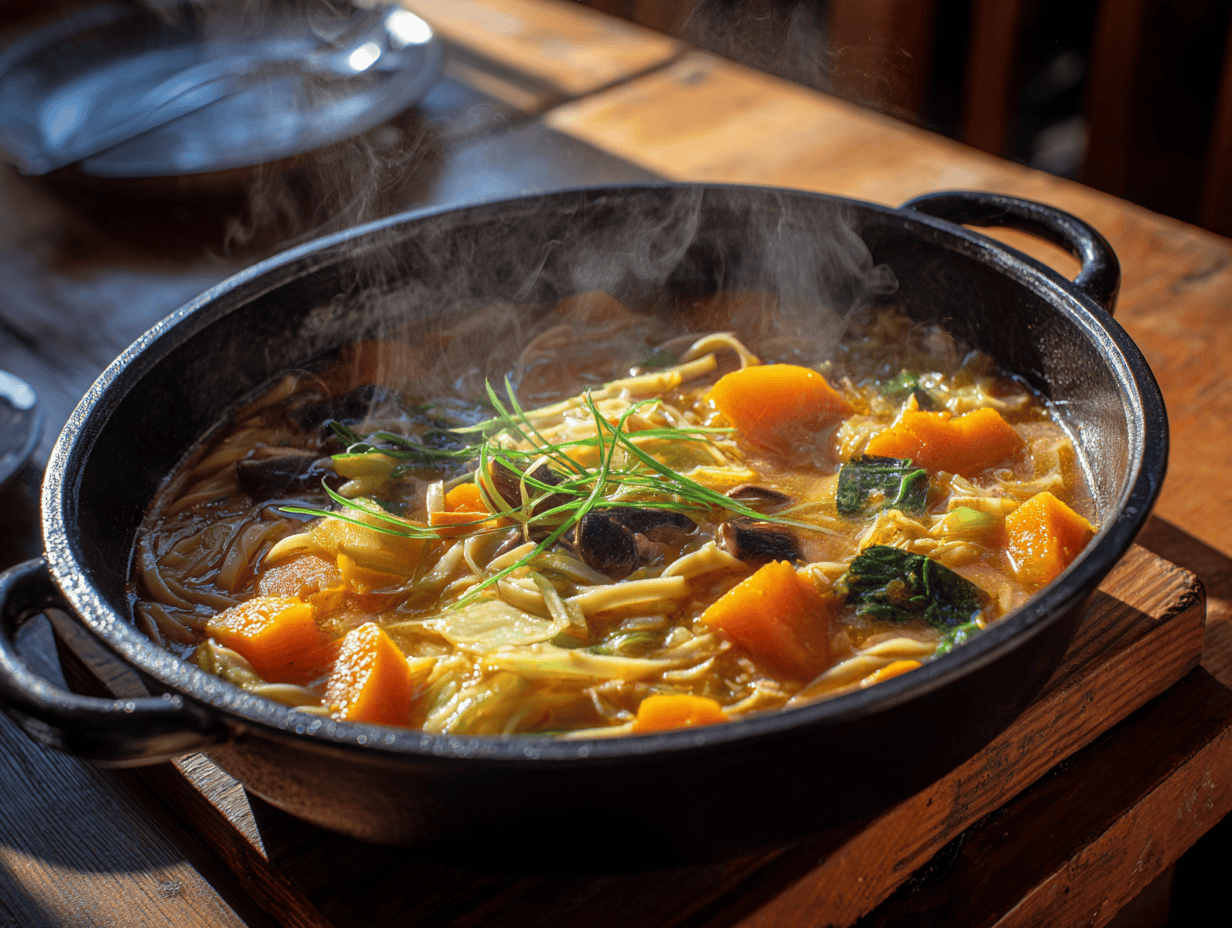
Hōtō comes from Yamanashi, the old province of Kai, where mountain farms grew wheat rather than rice. Families simmer the flat noodles straight in miso broth with whatever vegetables the season brings.
- 4 cups (950 ml) dashi made with kombu and niboshi (dried sardines)
- 7 oz (200 g) kabocha squash, seeded and cut into 1¼-inch (3 cm) pieces
- 1 small carrot, cut into half-moons
- 2-inch (5 cm) piece daikon, cut into quarter-moons
- 1 small potato, peeled and cut into chunks
- 2 napa cabbage leaves, cut into bite-size pieces
- 4 shiitake mushrooms, stems removed, sliced
- 1 sheet aburaage (fried tofu), sliced into strips
- 7 oz (200 g) uncooked hōtō noodles, or wide flat wheat noodles
- 4 tbsp miso, divided
- 1 negi (Japanese long onion), sliced on the diagonal
- Bring the dashi to a simmer in a heavy pot or donabe. Add the kabocha, carrot, daikon and potato, and simmer for 10 minutes until they begin to soften.
- Add the napa cabbage, shiitake and aburaage. Dissolve half the miso in a ladle of broth and stir it into the pot.
- Add the uncooked noodles directly to the pot without boiling them first. Simmer for 10 to 12 minutes, stirring now and then, until the noodles turn tender and slightly translucent and the broth thickens.
- Dissolve the remaining miso in a little broth and stir it in. Scatter the negi over the top.
- Turn off the heat, cover the pot and let it stand for 2 to 3 minutes. Serve hot, straight from the pot, with some of the softened kabocha in every bowl.
Hōtō is forgiving. If a piece of kabocha breaks down, the broth only gets richer. If the noodles run long, they simply soak up more miso. Serve it in the pot at the table, and let everyone ladle their own. It feels like 甲斐 in edible form, a steady return for a little patience.
The same patience helps at the writing desk, and good materials reward it. Washi, traditional Japanese paper, takes ink softly and holds each stroke. Sumi ink gives a deep black that turns to warm gray where the brush runs dry. Together, they turn a practice sheet into something worth keeping. For shodō, look for paper with one smooth side for writing.
Writing 生き甲斐 with someone else
Calligraphy can be a solitary art, yet ikigai invites company. Many of the returns that make life worthwhile involve other people. So try writing the word beside a friend, a partner or a child. Share one inkstone, take a sheet each, and then compare your versions of 生. One may lean forward, while another sits square. Neither is wrong, because each hand leaves its own mark on the paper. Over a few sessions, you may even learn to recognize each other’s strokes from across the table. That small shared skill becomes a reward of its own. Talk about what each version gets right.

Keeping the habit alive
A shared practice also keeps the habit alive. Skipping a session alone is easy, but a friend waiting at the table changes that. Agree on one regular evening a week. Choose a new word each time, perhaps a season or a feeling, then return to 生き甲斐 once a month. That way, the word becomes a shared record of how both your hands have grown. Keep the sheets together in one folder, each one dated. After a year, the stack tells a story that no single page can. You will see strokes grow steadier and spacing grow calmer, often without noticing the change as it came.
If you prefer to practice alone, you can still borrow that spirit. Write the word, then add one sentence about a person who gave your day some worth. It might be a colleague who helped, a neighbor or a friend who called. That line turns a drill into a small note of thanks. Whichever way you practice, keep it light. A relaxed hand makes the best strokes, so breathe out before you begin. Some people keep these notes in the same folder as their practice sheets. Then the ikigai kanji on each page sit above a real name and a real moment, which is exactly where the word belongs.
Questions Worth Asking
Is ikigai a Chinese word or a Japanese one?
It is Japanese through and through. Iki comes from the native verb ikiru, to live, and kai from an old native verb meaning to exchange. The characters come from Chinese writing, but the word itself formed in Japanese and has no single Chinese equivalent.
How many strokes does it take to write 生き甲斐?
The three kanji need twenty-two strokes in total: five for 生, five for 甲 and twelve for 斐. Add the hiragana き and the full word takes a few more. Most of the effort sits in 斐, the densest character of the four, so give it extra room.
Should an ikigai tattoo use kanji or hiragana?
Either works, but check the design with a fluent reader before you commit. The full kanji form looks formal and dense, while 生きがい looks softer and more modern. Keep the small き between the characters, since leaving it out changes how a Japanese reader will pronounce the design.
Can ikigai be written in katakana?
You can write イキガイ, but Japanese readers would find it odd. Katakana usually marks foreign loanwords, sound effects or emphasis. For a native word like ikigai, katakana can look like a label or a brand name. Hiragana or the mixed kanji form reads far more naturally.
What does 甲斐 mean on its own in modern Japanese?
As a standalone word, kai means the payoff for an effort. People say 努力した甲斐があった when hard work pays off, or 甲斐がない when it does not. It also names the old province that became Yamanashi, a separate use that simply shares the characters.
Is there a single kanji symbol for ikigai?
No. Ikigai needs at least one kanji and some kana, and no one-character symbol exists for it. Designs that show a single character usually show 生, life, which covers only half the idea. For the full meaning, write 生きがい or 生き甲斐 as one unit.
Carrying 生き甲斐 Into Your Day
You now know the word from the inside. 生 is a plant rising from the soil, and き turns it into living. 甲斐 is the worth that living returns, softened to gai as the parts join. Meanwhile, 生きがい, the everyday spelling, keeps all of that in a lighter form.
The next step is to use the word, not just read it. Write it each morning, and add one line about what might make the day worthwhile. That is the practice at the center of our guided journal for finding your ikigai, with a prompt for each of ninety mornings. If you love the mending spirit of Japanese craft, the Kintsugi Journal brings the same daily rhythm to renewal.
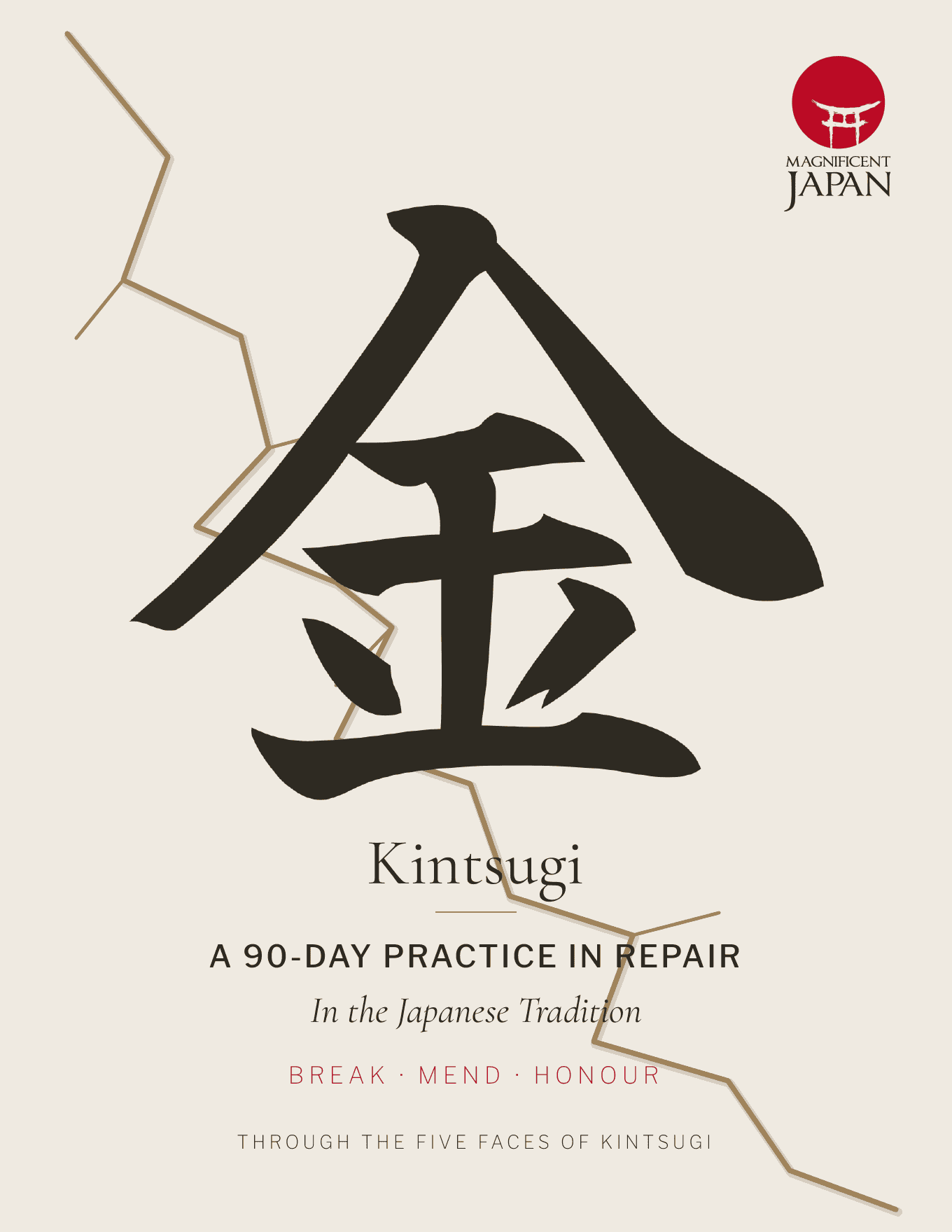
A ninety-day guided practice in repair, drawn from the gold-seamed craft that shares ikigai’s respect for patient, handmade work.
View the Journal →Whichever page you choose, begin with the same five strokes of 生. Each morning you write them, the word grows a little more familiar, and a little more yours. That steady return is ikigai itself. So keep the brush, the pen and the page within easy reach.
The Editors, Magnificent Japan
We design routes that bring the characters to life: a calligraphy lesson with a local teacher, a day in Yamanashi's vineyards, and station signs you can finally read.
Plan Your Custom Japan Itinerary