The Japan luxury travel market is smaller in headcount than most people assume, and larger in money. A narrow slice of visitors now accounts for a big share of what foreigners spend in the country. This report sets out what the official data says, where the money goes and what that means for a high-end booking. The figures come mainly from the Japan National Tourism Organization, the Japan Tourism Agency and hotel analysts at JLL.
Commercial estimates appear too, but they measure something narrower. Read together, the sources describe a segment growing faster in value than in volume. The best rooms, meanwhile, stay in short supply. For the traveler’s side of the story, start with our guide to planning luxury travel in Japan.
How big is the Japan luxury travel market?
Japan’s national tourism organization counts visitors who pass a high spending threshold on the ground as luxury travelers. In 2023, about 590,000 such visitors came. They were only 2.4% of arrivals, yet they produced 19.1% of all inbound spending. That is close to one yen in every five.
What Is the Japan Luxury Travel Market?
The Japan luxury travel market is the small group of visitors who spend heavily once they land, and the hotels, inns, restaurants and shops they pay. The Japan National Tourism Organization’s luxury-market release of June 2025 sets the line at a high spending threshold per person. It uses credit card data and other sources, so it measures real spending.
On that basis, Japan received about 590,000 luxury travelers in 2023. That was 2.4% of all international visitors, up from 1.0% in 2019. Above all, they produced 19.1% of total inbound spending, compared with 14.0% four years earlier. Put simply, about one visitor in forty now sits in this group.
Growth is the second headline. Against 2019, luxury spending rose 50.6% and the number of luxury travelers rose 83.2%. Over the same years, the global luxury travel market grew 17.6% in spending and 32.5% in travelers. In other words, Japan took share. By luxury spending, China led at 23%. The United States followed at 16.3%, then Taiwan at 13.1%.
Why the published estimates disagree
Search for market size and you will find figures that seem to describe different countries. One commercial research firm, IMARC Group, sizes the market at a tiny fraction of the official estimate. In fact, the JNTO figure is more than a hundred times larger. Yet both can hold up, because they measure different things. The gap is a useful warning.
Commercial reports usually count packaged luxury tours sold by operators. IMARC, for example, splits its market into private vacations, cruises, small group journeys and similar products. JNTO, by contrast, counts everything high-spending visitors pay for on the ground. That includes hotels, dining and shopping. For anyone planning a trip or a business, the JNTO definition is the useful one, since it captures where the money lands. Therefore this report uses official data wherever it exists. On that view, the Japan luxury travel market covers every hotel night, dinner and purchase, not just tours.
An ethnography of a working inn in Kurokawa Onsen. It shows why ryokan supply grows so slowly.
Read Ryokan by Chris McMorran →A guide to the inns and hot springs at the top of the market. Useful when choosing where the scarce nights go.
View Japanese Inns and Hot Springs →The architect's own account of his low timber style. It explains the look of the new luxury openings.
See the Kengo Kuma Memoir →The Wider Inbound Picture in 2025 and 2026
Luxury travel sits inside a much larger boom. Visitor spending reached a record in 2025, up 16.4% on 2024, according to the Japan Tourism Agency’s final 2025 spending survey. More than 40 million visitors arrived during the year. Lodging took 36.6% of the total and grew by about a quarter. Food and drink grew by almost a fifth, while shopping rose only slightly.
The United States ranked third by total spending, at 11.8% of the total, behind China and Taiwan. Germany led on spending per person, ahead of Britain and Australia. That ranking matters here. The longest and richest trips now come mostly from Europe, North America and Australia.
What 2026 looks like so far
So far, 2026 has been more uneven. The JNTO arrivals estimate for August 2026 shows 27.6 million visitors from January to August. That is down 2.7% year on year. August alone fell 9.6% to about 3.1 million. Arrivals from China fell 59.0% that month. Travel Voice links the drop to a Chinese government travel warning against Japan and to flight cuts from Southeast Asia. Even so, fourteen source markets set August records. Italy and Spain set records for any single month, and South Korea and Mexico also reached August highs.
Arrivals from the United States held up. About 197,400 Americans visited in August, up 1.5%. From January to August, American arrivals rose 6.1%. That matters for the luxury segment, because Americans were the second-largest source of luxury spending in 2023. If Chinese demand stays soft, the high end leans further toward North American, European and Australian travelers.
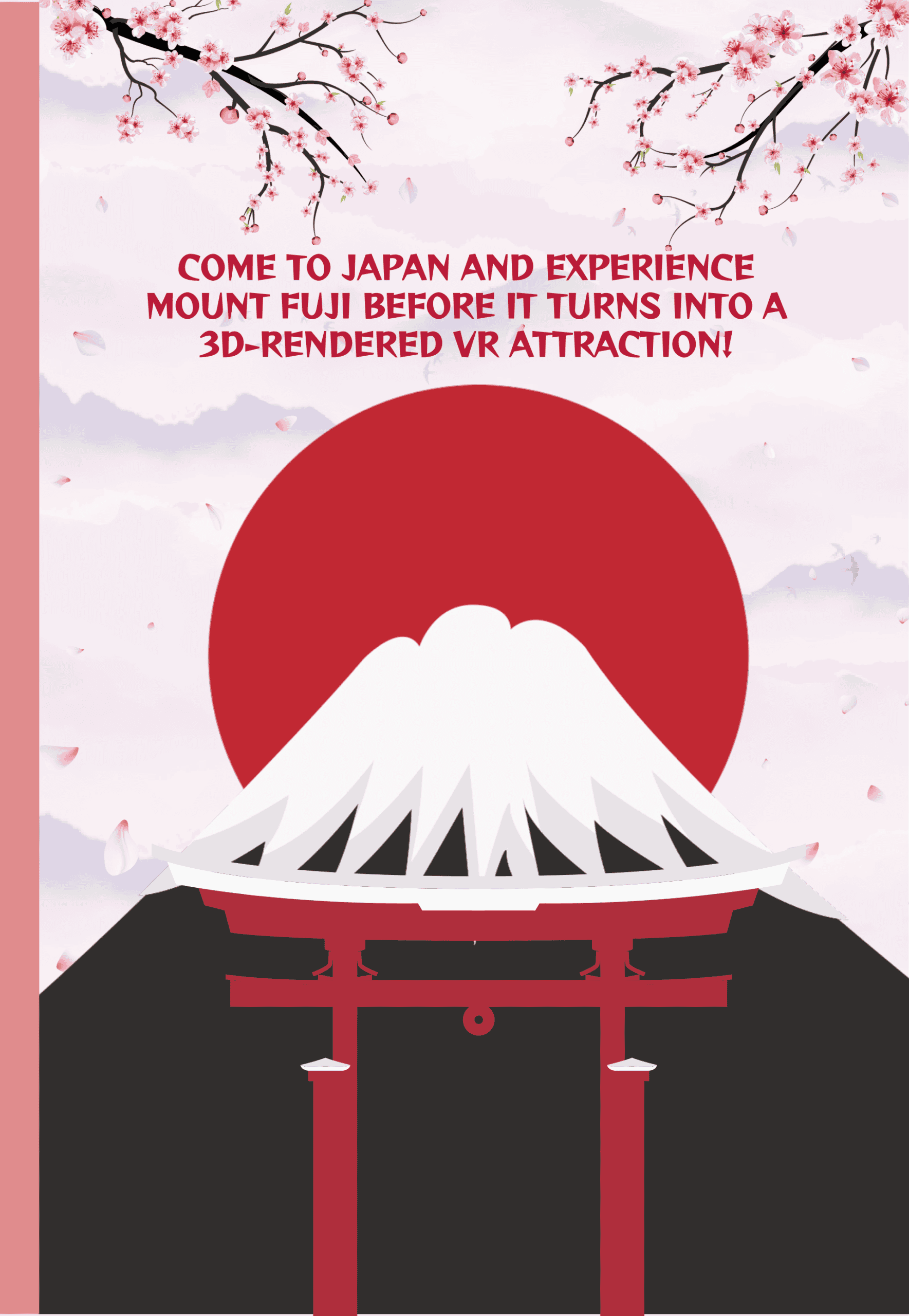
For the scarce nights worth remembering: the bath, the counter, the light at dawn.
6 × 9 in · 120 unlined pages · matte softcover
Shop This Journal →Where Money Goes in the Japan Luxury Travel Market
Accommodation comes first, because it now leads all visitor spending. Hotels in Japan remain good value by global standards, even after several years of rising rates. A JLL analysis reported in December 2025 put Tokyo’s average daily rate well below those of Singapore, London, New York and Paris.
Rates are climbing, however. In the first nine months of 2025, JLL found average daily rates up 10.8%. Occupancy rose 3.2 points, and revenue per available room rose by more than 15%. At the same time, new supply is thin. New hotels added only 1.7% to existing stock nationally, and around 2% in Tokyo, Osaka, Kyoto and Fukuoka.
JLL expects that constraint to last, because construction costs have risen sharply. That combination explains what high-end travelers notice on the ground. Demand is rising faster than rooms, so the best properties fill early and price to match. Our edit of the luxury hotels in Japan we rate tracks which properties justify their rates.
The ryokan side of the ledger
The ryokan sector behaves differently from the hotel towers. Many inns are small and family-run, and many sit in rural hot-spring towns rather than big cities. That makes them harder to scale and easier to sell out. For the reasons why, read Chris McMorran’s study of a working inn in Kurokawa Onsen. It looks at the labor that keeps an inn running, which is exactly what limits supply.
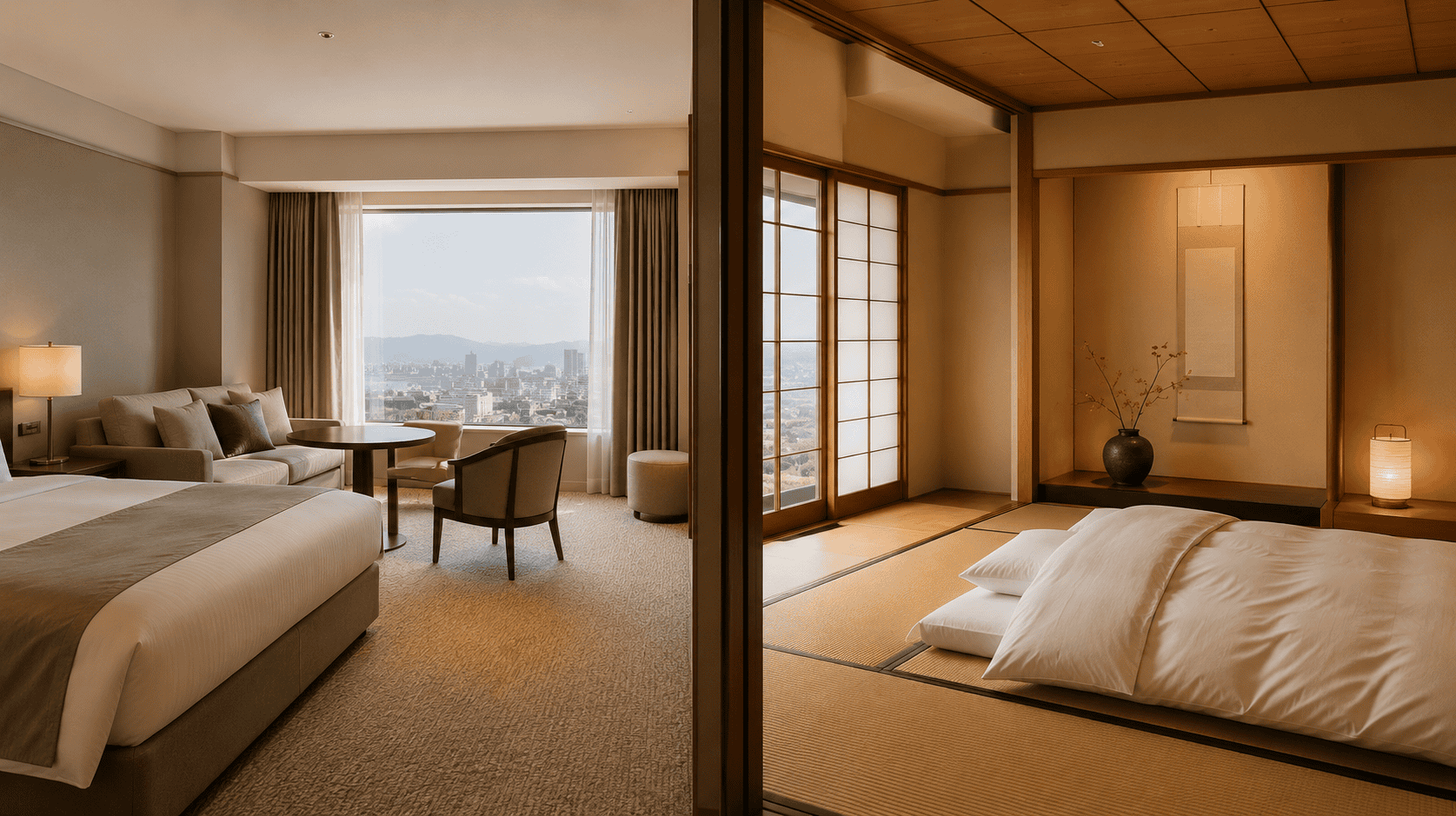
Ryokan rates also work differently from hotel rates. Most inns quote a rate per person that usually includes dinner and breakfast. So the rate already covers the two most elaborate meals of the day. For analysts, part of ryokan revenue sits in the food line. For travelers, the fair test is the whole evening, not the room alone. The comparison is closer than it first looks. A ryokan night often includes what a hotel guest pays for separately in town. Dinner, too, is often served in the room or a private dining room. Our ranking of Japan’s best luxury ryokan applies that lens to booking.
The high end is growing in value faster than in volume, and rooms are the constraint.
| Indicator | Latest figure | Direction | Source |
|---|---|---|---|
| Luxury travelers | About 590,000 in 2023 | Up 83.2% on 2019 | JNTO |
| Share of inbound spending | 19.1% in 2023 | Up from 14.0% in 2019 | JNTO |
| New hotel supply | 1.7% added to national stock | Thin, held back by construction costs | JLL |
| Hotel occupancy | Up 3.2 points in early 2025 | Rising with demand | JLL |
| 2030 visitor target | 60 million | Quality over volume | Basic Plan |
What the Government Wants: Quality Over Volume
Japan’s cabinet approved a new Tourism Nation Promotion Basic Plan on 27 March 2026, covering fiscal 2026 to 2030. It targets 60 million international visitors by 2030. Its spending goal is more than one and a half times the 2025 record.
Crucially, the plan stresses the quality of tourism rather than numbers alone. It aims for 130 million overnight stays in regional areas and 40 million repeat visitors. It also sets a goal of 100 regions working to balance visitors with residents’ daily lives. For the luxury segment, those goals point outward, away from the crowded core. Repeat visitors tend to venture further, and rural inns need exactly the low-volume, high-value guests the plan describes.
The Seto Inland Sea shows how this works. On Naoshima, the art island, museums, small inns and boat travel draw visitors who stay longer. Hokkaido, the hot-spring towns of central Japan and the Hokuriku coast offer the same thing: space, privacy and time. Getting there takes longer, which is partly the point. The journey becomes part of the stay, and that is what the top of the Japan luxury travel market now pays for. It is also why regional rooms go early: there are few of them, and the guests who want them plan ahead.
Prefer to have the scarce nights secured for you? Our custom Japan itinerary plans the route around them first.
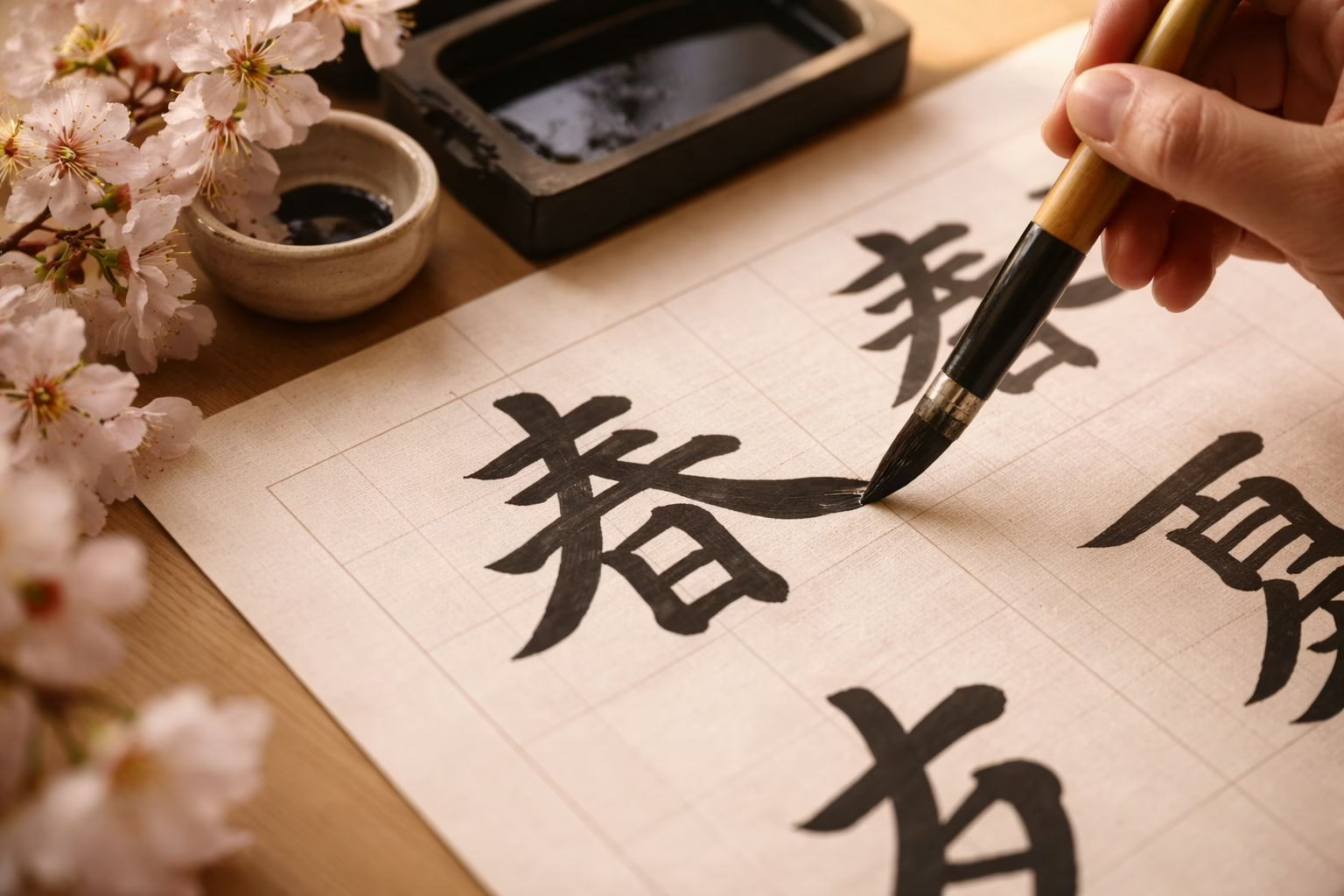
A typeset printable: ten Japanese proverbs with kanji, romaji and meaning. Signing up also brings occasional letters on Japan and word when a new journal reaches print.
One email with your printable. Occasional letters after that. Unsubscribe anytime.
New Openings in the Japan Luxury Travel Market
Scarcity attracts capital, and the hotel groups have noticed. The past two years brought a wave of international openings in Japan's main cities. Several borrow from the ryokan rather than compete with it. Tokyo and Osaka continue to add international brands, and resort groups are moving into the islands and the north. Still, one Kyoto opening this year shows the pattern more clearly than any statistic.
Capella Kyoto opened on 22 March 2026, the brand's first property in Japan. It sits in Miyagawa-cho, one of Kyoto's historic geisha districts. There are 89 rooms and suites across four stories, including six onsen suites with private hot-spring baths. Kengo Kuma and Associates designed it with Brewin Design Office.

Its dining program centers on a twelve-seat counter, SoNoMa by SingleThread. The counter, not the ballroom, is now the heart of a luxury hotel. That choice tells you where guests now want to spend their evenings. Kengo Kuma's name also recurs across the new wave. His memoir traces the ideas behind his low timber buildings. It also explains why Japan's newest luxury looks so unlike Dubai or Las Vegas. Investors are building fewer rooms at higher rates, with design and dining doing the work that size once did. As a result, new openings rarely ease prices, because each adds few rooms.
Recommended
Risks to the outlook
No market grows in a straight line, and Japan's high end carries real risks. Some are external, such as diplomatic tension and airline capacity. Others are structural, such as the shortage of staff and rooms. A clear view of them helps travelers book with fewer surprises.
The first risk is concentration. China was the largest source of luxury spending in 2023, and its travel warning has already cut arrivals in 2026. The second is capacity. Flight cuts from Southeast Asia show how quickly airline decisions can move the numbers. Neither affects American travelers directly. Still, both shape what hotels charge and when.
The third risk is labor. Ryokan in particular depend on staff who cook, serve and prepare rooms by hand. Rising construction costs add a fourth limit, because they slow the new supply that might relieve pressure. Rooms can be built in a few years, but trained inn staff take far longer. As a result, rates at the top are likely to keep rising faster than the market as a whole. Language is a smaller friction. Many luxury hotels work in English, but rural inns and counter restaurants often do not. For anything that matters, private tours in Japan remain the better answer.
Dining and Shopping: Where Luxury Spending Lands
Food and drink grew far faster than shopping in 2025, at 18.6% against 6.6%. Lodging aside, no category grew faster. Shopping, by contrast, grew slowly. That gap reflects a change in what visitors value. The meal has become the experience, and the counter seat has become the trophy. At the high end, dinner at a sought-after counter can now shape a whole itinerary. Our guide to unique dining experiences in Japan covers how to secure such seats. Capella's own SoNoMa counter, for instance, seats just twelve. Food and drink also took a larger share of the total, at 21.9%.
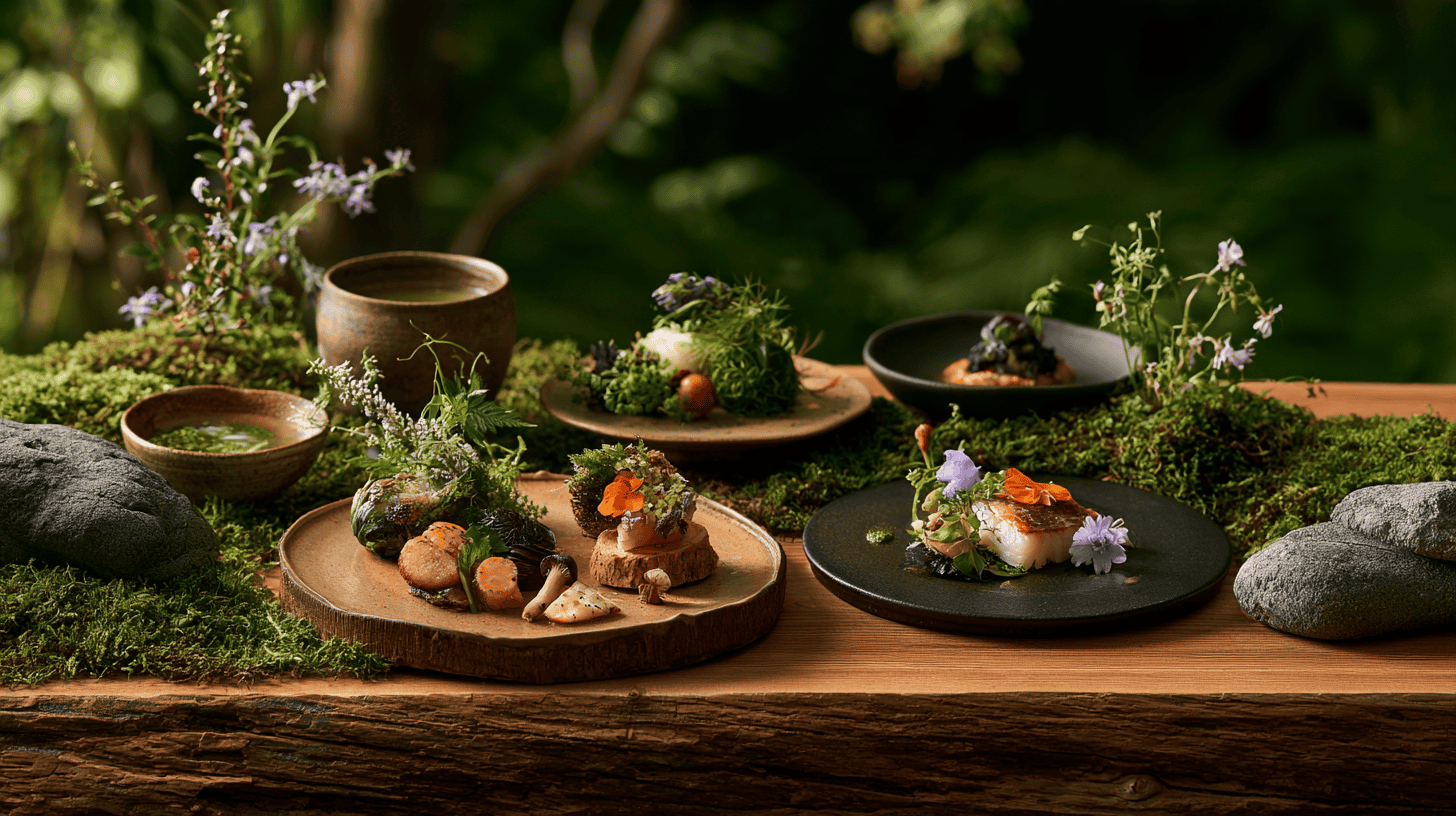
Wagyu at the table: sukiyaki
Beef shows that shift well. Wagyu is one of the foods many visitors now plan a dinner around, and sukiyaki is the classic way to share it. The cook sears thin slices in a shallow cast iron pot. Then they simmer with vegetables and tofu in a sweet soy broth. Diners often dip each slice in beaten egg. Because the cooking happens at the table, the meal becomes an event rather than a plate.
Wagyu also travels by region. Kobe, Matsusaka and Hida each lend their name to a beef, and each name carries weight on a menu. In that sense, sukiyaki is a fair symbol of the spending data above. It is shared, seasonal and slow, and it rewards a good counter or a good inn kitchen. The version below works at home with a shallow pot and a portable burner. Pasteurized eggs are the safe choice for dipping.
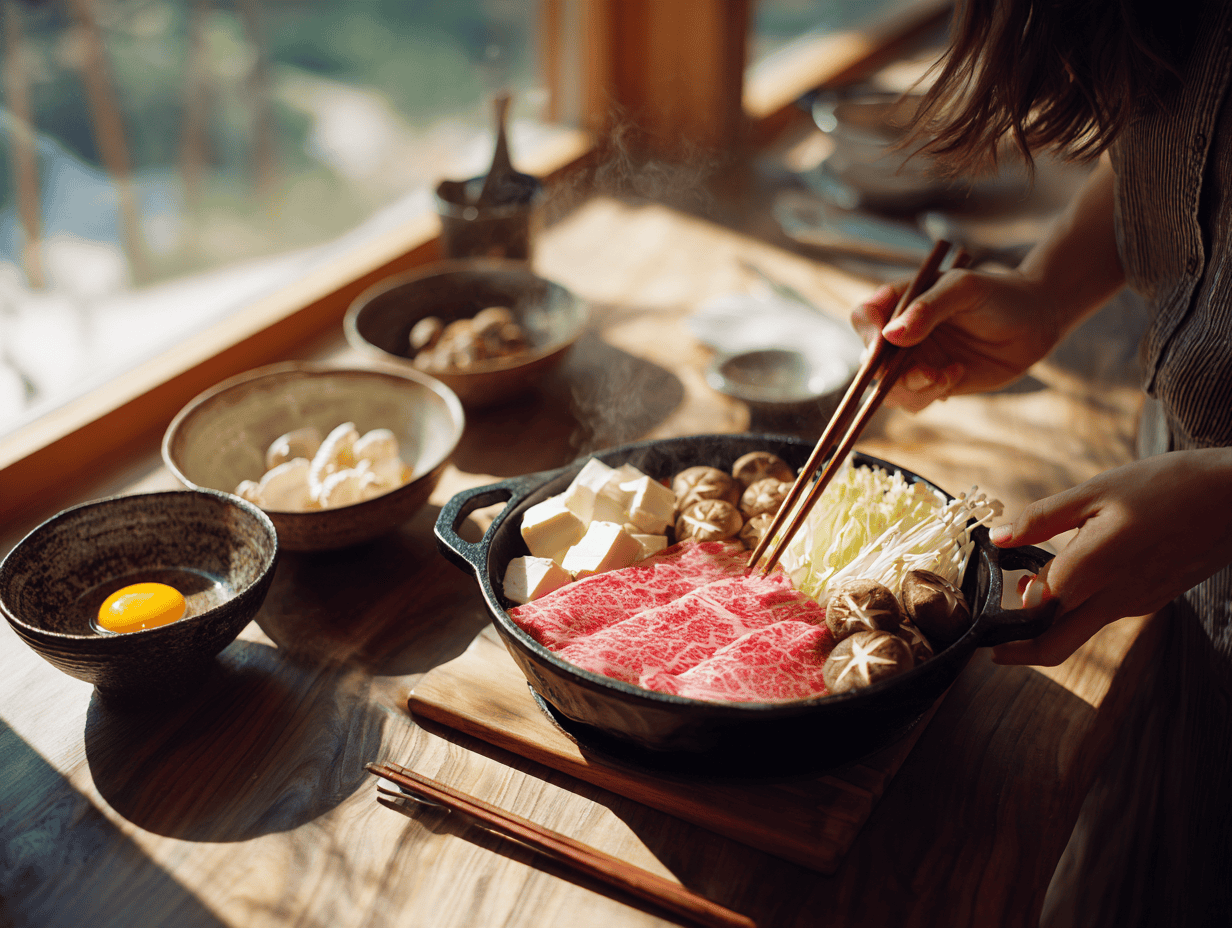
Sukiyaki took shape in the late nineteenth century, when beef eating spread in Japan. Today it is the classic hot pot for sharing wagyu at the table.
- 1 small square kombu
- 2 cups water
- 1/2 cup sake
- 1/2 cup mirin
- 3 tbsp sugar
- 1/2 cup soy sauce
- 1/2 lb thinly sliced wagyu
- 1/4 head napa cabbage
- 1 long green onion
- 1 bunch shungiku
- 1 cup mixed mushrooms
- 1 block grilled tofu
- 4 pasteurized eggs, beaten
- 1 tsp neutral oil
- Cooked udon, to finish
- Soak the kombu in the water for thirty minutes to make dashi.
- Simmer the sake and mirin for one minute, then stir in the sugar and soy sauce and bring to the boil.
- Cut the cabbage, green onion, shungiku, mushrooms and tofu into bite-size pieces.
- Heat the oiled pot at the table, add enough sauce to cover the base and sear the wagyu for two or three minutes.
- Eat the first slices at once, dipped in beaten egg, then add the vegetables and tofu with more sauce and simmer until tender.
- Thin the broth with dashi if it grows too strong, and finish by warming udon in the last of it.
Shopping, rethought
Shopping tells a different story. In the first quarter of 2026, its share of visitor spending fell to 25.2%, from 29.4% a year earlier. Accommodation took 36.7%, and total spending still rose 2.5%. Visitors are still buying, but they are buying differently. Craft, provenance and objects made by named workshops are replacing volume. The question is less how much, and more who made it.
Cast iron from Morioka is a good example. Iwachu has made Nambu ironware there since 1902, in a craft tradition of about four centuries. A hobnail teapot from a named house is the kind of object luxury visitors now seek out. It is useful, regional and built to last. Such objects also spread visitor spending beyond the department stores of Tokyo and Osaka. In short, shopping is shrinking as a share, while craft within it grows in weight. A single well-made tool or book can carry a trip home for years.
A Nambu ironware teapot in the hobnail pattern from a named Morioka house. It is the kind of regional craft visitors now seek out.
View the Iwachu Teapot →Kaiseki explained by the Kikunoi chef. A good companion to the counter dinners that now shape a trip.
Read Kaiseki by Yoshihiro Murata →The standard English-language Japanese cookbook. It covers sukiyaki and home versions of restaurant classics.
See Japanese Cooking: A Simple Art →Booking Into the Japan Luxury Travel Market
So the picture for 2026 is clear. The Japan luxury travel market has stopped growing in headcount but not in value. Fewer arrivals from some countries are offset by higher spending from others. For travelers, the practical effect is simple. The crowded end of the market may ease slightly, yet the rooms at the top remain scarce.
First, book the scarce nights early. Rooms are growing far more slowly than demand, especially in Kyoto and the ryokan towns. Second, expect rates to keep rising, so refundable early bookings carry real value. Third, look beyond Tokyo and Kyoto, where policy and supply both push high-end travel toward the regions.
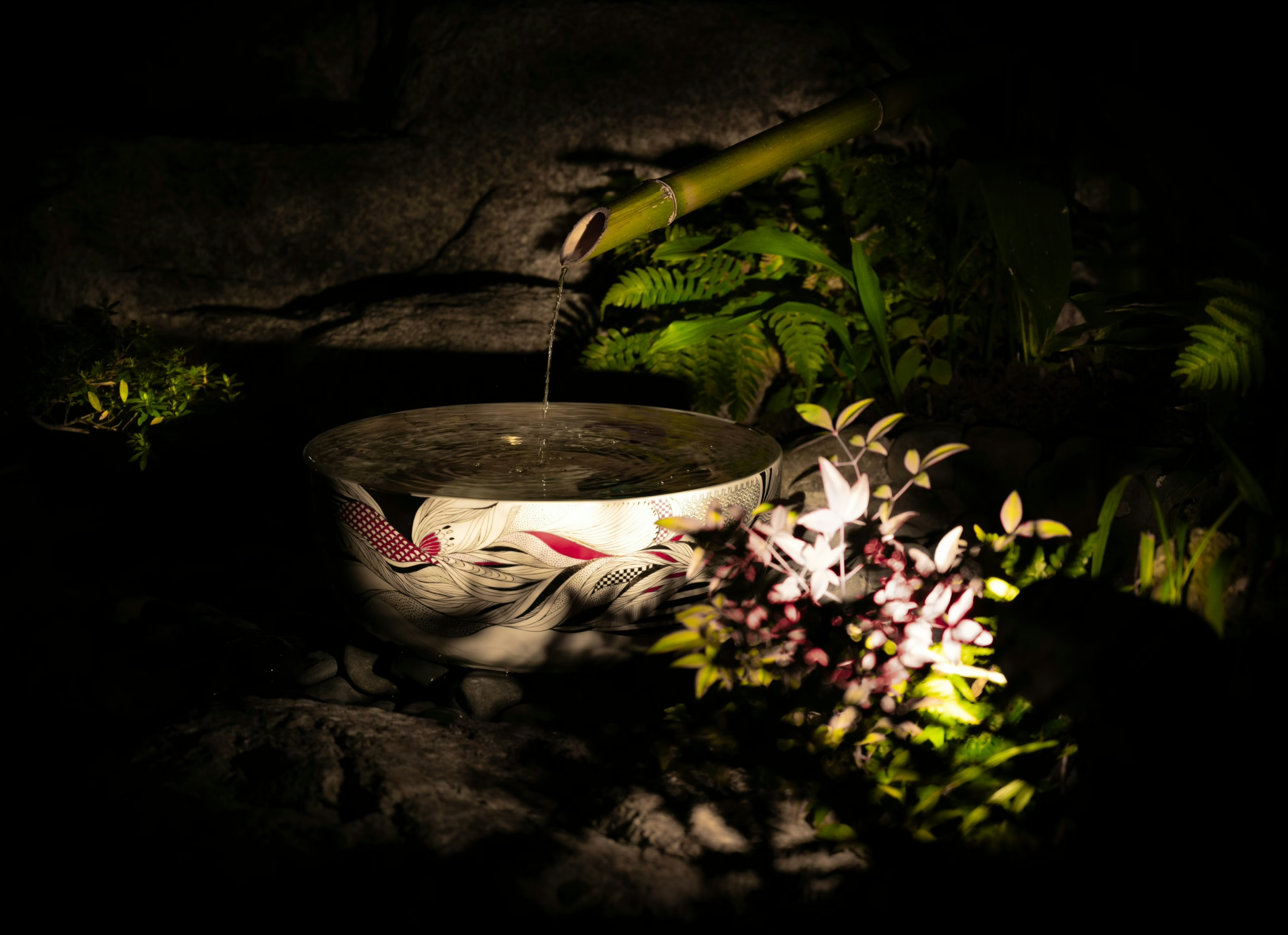
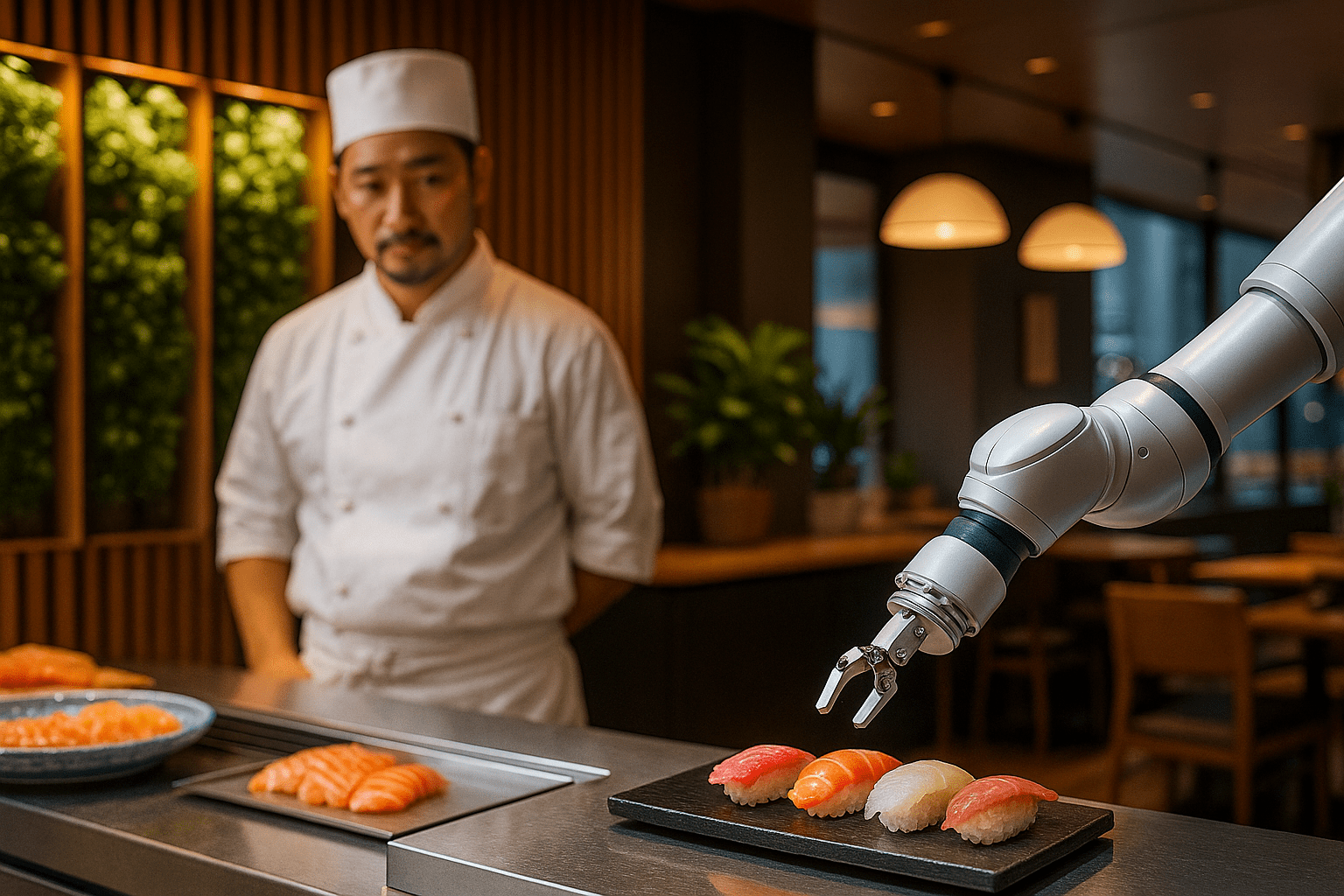
Those two guides cover the stays and tables at the center of this scarcity. The first ranks the inns themselves. The second looks at the slower, seasonal side of high-end dining in Japan. Read together, they show where the money in this report is spent. Both are written for travelers rather than analysts.
Currency adds a further layer. Official data is published in yen, so any conversion moves with the exchange rate. A weaker yen makes Japan better value for Americans, while a stronger one does the reverse. Yet the high end has grown through both. That suggests the demand is about the experience, not the discount.
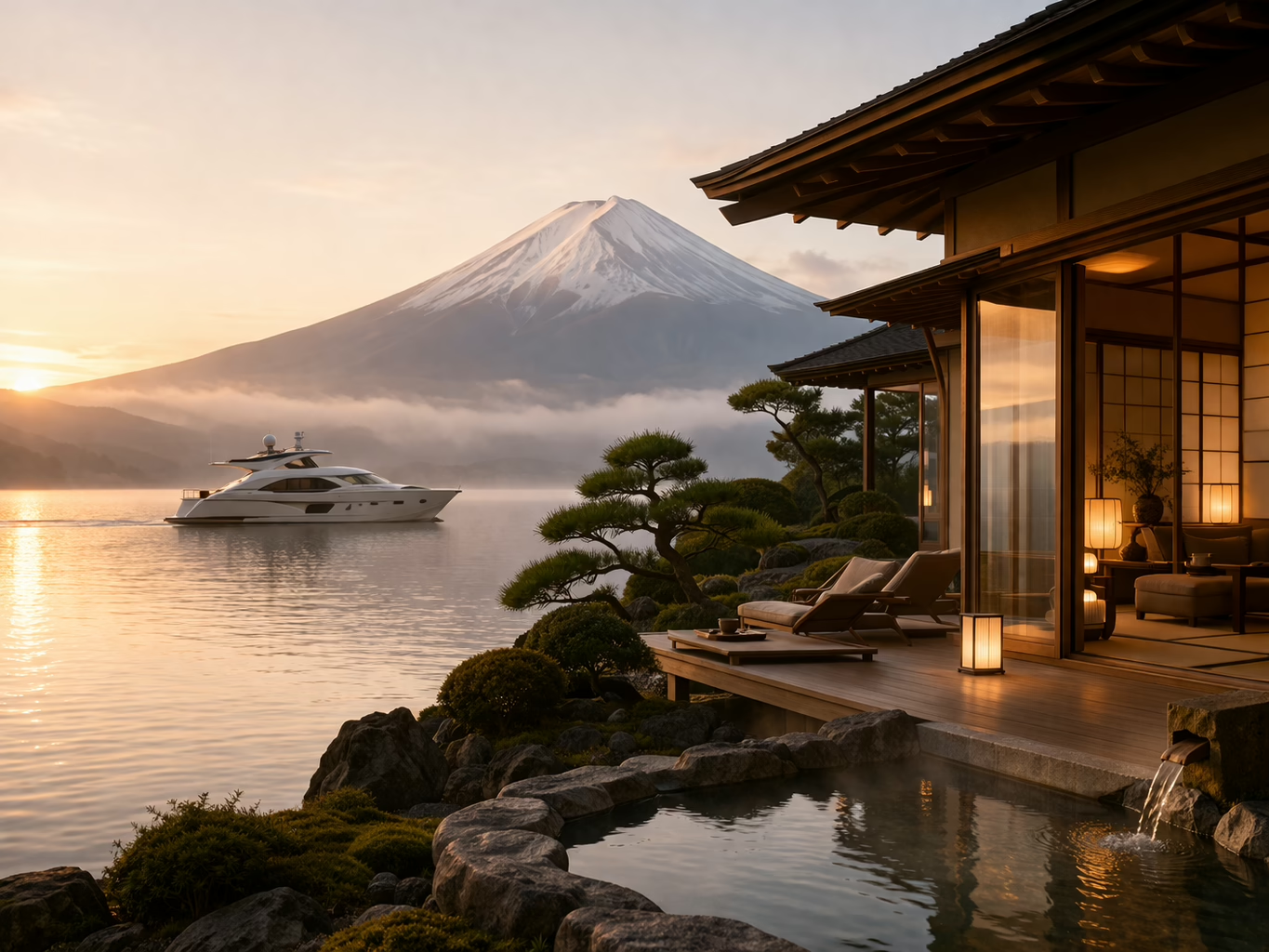
Where to start when you book
Finally, plan your time as carefully as your money. The richest trips succeed by choosing fewer places and staying longer. Visitors from Germany, Britain and Australia already lead on spending per person, and their trips show the habit. Regional inns are small, and transport takes longer, so the order of bookings matters. Every extra move costs hours of transit and packing. A week in two places usually beats a week in five. Two nights in one inn also means one full day without luggage. Secure the hardest nights first, then fill in the rail legs and city hotels around them.
Taken together, the numbers point one way. Japan rewards the planner who moves early and chooses carefully, and it rewards that planner more each year. The official data, the hotel analysts and the new openings agree. Demand at the top of the Japan luxury travel market keeps rising, while the supply of rooms grows slowly. Booking early is therefore the single most useful habit for any high-end trip. The questions below cover what readers ask most often, from definitions to the government's 2030 targets. Each answer draws on the official sources cited above. Where an estimate is commercial rather than official, the answer says so.
Questions Worth Asking
How big is the Japan luxury travel market?
JNTO counted about 590,000 luxury travelers in Japan in 2023. They were 2.4% of arrivals but produced 19.1% of all inbound spending, close to one yen in five. Commercial reports give far smaller figures, because they count packaged luxury tours only, not hotels, dining and shopping.
Who counts as a luxury traveler in Japan?
JNTO defines a luxury traveler as a visitor who passes a high spending threshold per person in Japan. The estimate uses credit card payment data and other sources. It counts spending on the ground, such as hotels, dining and shopping, rather than flights to Japan or packages bought at home.
Which countries spend the most on luxury travel in Japan?
In JNTO's 2023 estimate, China led luxury spending at 23%. The United States followed at 16.3%, then Taiwan at 13.1%. In 2026, a Chinese government travel warning has cut arrivals from China. American arrivals rose 6.1% from January to August 2026, so the American share at the top is likely to grow.
Are Japan's luxury hotels good value compared with other cities?
Yes, by global standards. A JLL analysis put Tokyo's average daily rate well below Singapore, London, New York and Paris. However, rates rose 10.8% in the first nine months of 2025, and new supply is thin. The newest openings, such as Capella Kyoto, sit at the very top of their markets.
What is Japan's 2030 tourism target?
The Tourism Nation Promotion Basic Plan, approved by the cabinet in March 2026, targets 60 million visitors by 2030. Its spending goal is more than one and a half times the 2025 record. The plan also aims for 130 million regional overnight stays and 40 million repeat visitors.
Is the Japan luxury travel market still growing in 2026?
In value, yes; in headcount, less so. Visitor spending hit a record in 2025, and first-quarter 2026 spending rose 2.5%. Arrivals from January to August 2026 fell 2.7%, mostly because of fewer Chinese visitors. Hotel rates keep rising while new supply stays thin, so the top end stays tight.
When should you book a luxury trip to Japan?
Book the scarce nights first and early. Hotel rooms are growing far more slowly than demand, especially in Kyoto and the ryokan towns. Rates are also rising, so refundable early bookings carry real value. Once those nights are secure, plan the rail legs and city hotels around them.
The Japan Luxury Travel Market in One Line
A small number of travelers spend a large and growing share of the money. Supply is tight, rates are rising and policy is pushing demand toward the regions. For analysts, that makes Japan one of the strongest high-end markets in travel. For travelers, it means one thing above all: book the scarce nights first.
Next quarter will move these figures again, and we will revise them as official data arrives. The direction, however, has held for several years. Value is rising faster than volume, and the properties at the top are few. For the stay at the center of that scarcity, see our guide to how an onsen and ryokan stay works.
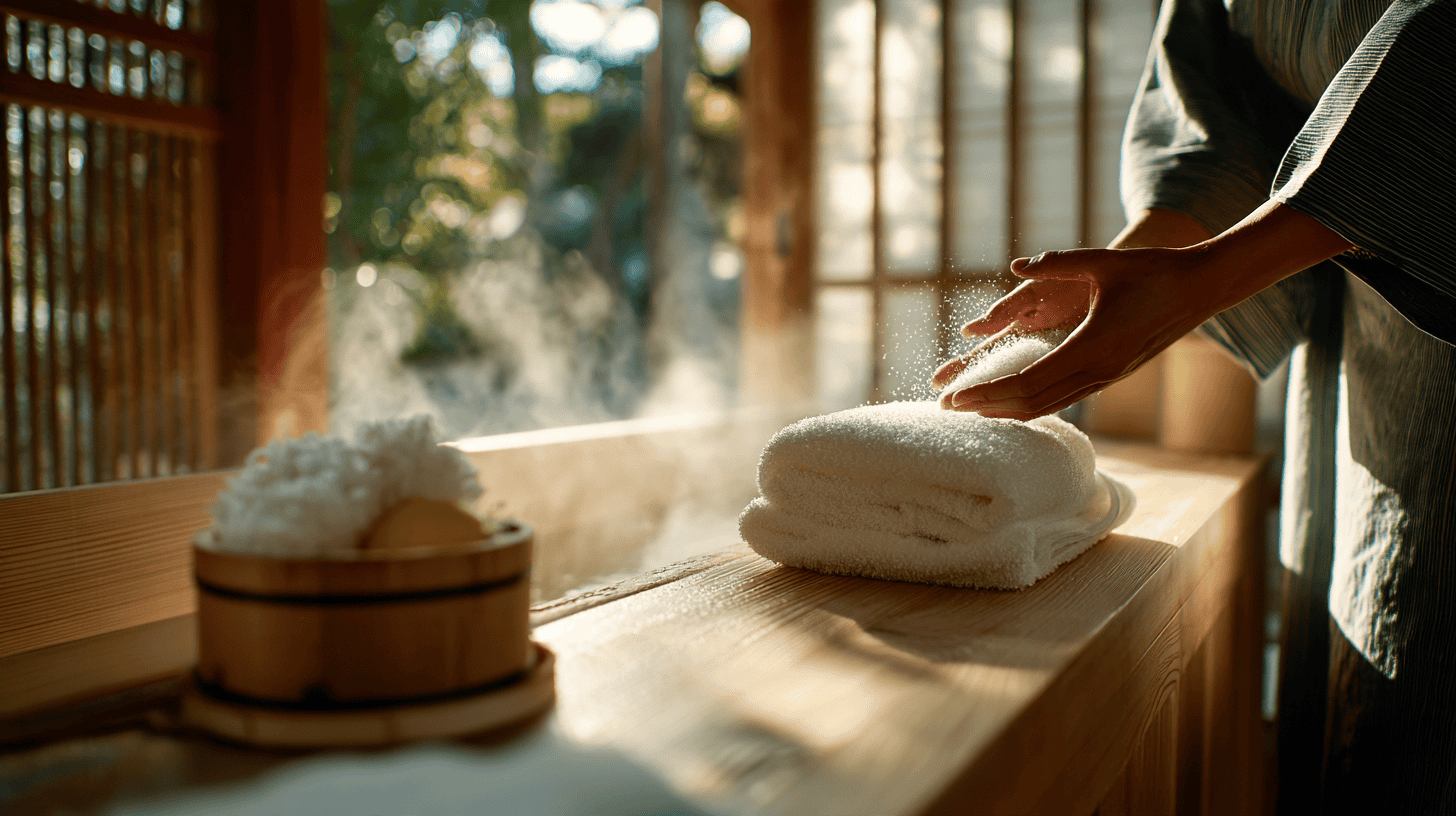
After a trip built on scarce rooms, ninety days of pages to notice what is already here.
View the Journal →A journal is the simplest record of a trip shaped by these numbers. The data explains why the room was hard to book. A journal keeps what happened inside it: the dawn bath, the counter courses, the light on the paper screens. Later, when you plan the next trip, start with the nights you wrote most about.
The ryokan nights and counter seats secured first, then the rail legs and city hotels laid around them. We plan the order, the guides and the access, so the scarce parts of a high-end trip are in place before anything else.
Plan Your Custom Japan Itinerary