Seven Japanese philosophy journals. One collection.
Ikigai, nagomi, wabi-sabi, kintsugi, mono no aware, shoshin, and ma — each made into a guided 90-day practice, in write-on digital and paperback print. This is the Cultural Reflection Collection.
Twenty seconds inside the practice — a morning prompt, answered by hand. Tap to play, with sound.
Meet the Seven PracticesJapanese philosophy journals, taken seriously.
Most Japanese philosophy journals lift a beautiful word, print it on a cover, and leave the rest to you. The Cultural Reflection Collection was built the other way around. Each of these seven Japanese philosophy journals begins inside its own tradition — the five pillars of ikigai, Motoori Norinaga’s reading of aware, Suzuki’s beginner’s mind — and only then becomes a practice.
The structure is the same across the collection. One prompt a day for ninety days, a synthesis at the close of each week, and three monthly reviews. A Day One assessment returns on Day Ninety, so the distance travelled is visible on the page. Every title is $27, in a write-on digital edition for iPad and tablet, and in a 6 by 9 paperback that ships worldwide.

Ikigai — the reason you rise
The sense that life is worth living, found in small recurring moments.
The Return
The four-circle diagram you have seen is not Japanese. It was assembled in the West in 2014, and Japanese scholars of ikigai call it a distortion. The Return sets it aside and works from the tradition instead. Its ninety days rest on the five pillars of ikigai — starting small, releasing yourself, harmony, the joy of little things, and being present. The full story of where the diagram came from is worth reading before you begin.
Decades before ikigai reached Western shelves, the psychiatrist Mieko Kamiya studied it in the people who kept it through hardship. She found it living in small, recurring moments far more than in achievement — the morning tea, the familiar walk. The prompts follow her finding. They do not ask you to solve a career. Instead, they ask you to notice the purpose already threaded through your days, and to give that reason for being a page of its own. There is a fuller account of what ikigai means, and the concept itself reaches well beyond any diagram.

Nagomi — the harmony that holds
Balance kept in the middle of things, not withdrawal from them.
Nagomi
Nagomi is the harmony a life keeps while it is still moving. The word describes tea reaching the right temperature, a room settling after conversation, two people finding an easy rhythm. It is not retreat, and it is not silence bought by leaving. Rather, nagomi is balance held in the middle of a full week, among the people and obligations already there.
The ninety prompts move through the places balance is made and lost. Stillness comes first, then relationships, blending, learning, and the spaces between commitments. Each week closes with a synthesis, and each month steps back further. Over three months, the practice teaches a hand lighter on the tiller — the ability to hold many things in relation without gripping any of them. For a culture that treats harmony as a daily craft rather than a mood, that skill is the whole point.

Wabi-Sabi — the beauty of the imperfect
Nothing lasts, nothing is finished, and nothing is perfect.
Wabi-Sabi
Wabi-sabi is a way of seeing before it is a style of anything. It formed in the tea room, where a bowl’s uneven glaze mattered more than its symmetry, and it rests on three plain observations. Things are impermanent. They are incomplete. And they are imperfect. Western shelves have turned the phrase into a decorating trend; the tradition asks for something harder and more useful — an eye trained to find depth in what is already there.
Accordingly, the ninety prompts cross the ordinary ground of a life. The body as it ages, work as it resists finishing, the home as it wears, the year as it turns. Each asks you to look at the flawed and the fading without reaching for the polish. By the final month, the practice has done its work when the crack in the cup reads as history rather than damage — when imperfection has become information about a life actually lived.

Kintsugi — the golden repair
The seam honoured rather than hidden.
Kintsugi
When a valued bowl breaks in Japan, one tradition does not throw it away or disguise the damage. The pieces are rejoined with lacquer dusted in gold, and the seam becomes the most visible thing about the vessel. Kintsugi says the break happened, the break mattered, and the repair is part of the object’s beauty rather than a compromise of it.
Applied to a life, that is a demanding idea, which is why this journal gives it ninety days rather than an afternoon. The prompts move through five movements — the break, the gathering, the joining, the gold, and the stronger seam. Early weeks sit with what cracked. Later weeks do the slower work of mending, and the final stretch asks where the golden seam now shows. What was broken and rejoined is not returned to what it was. It is made into something with a history worth keeping.

Mono no Aware — the tenderness of passing things
The soft ahh of being moved by what cannot stay.
Mono no Aware
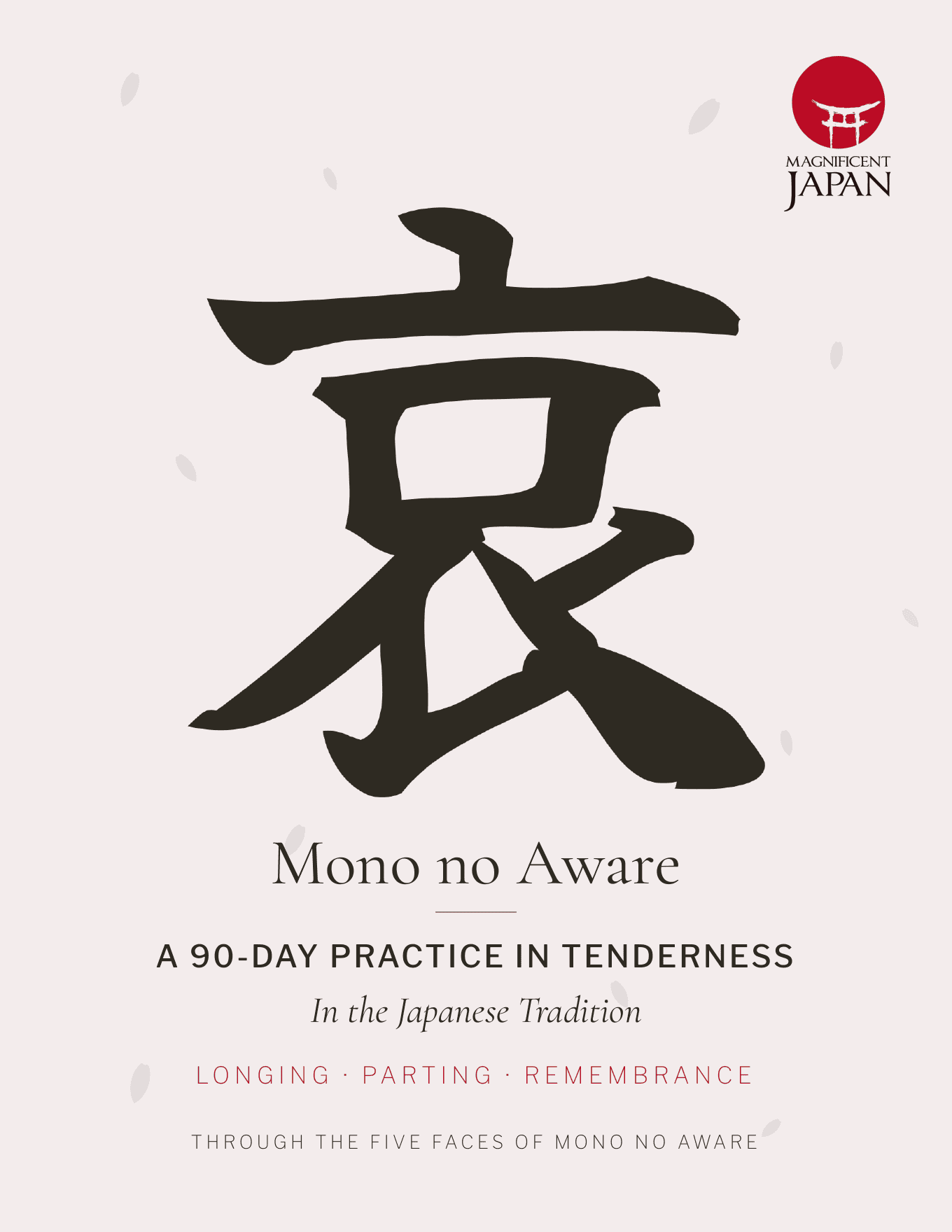
The word aware began as little more than a sound — the breath let out when something touches you. Over centuries it gathered its meaning, and in the eighteenth century the scholar Motoori Norinaga lifted it into a whole way of reading and living. Studying The Tale of Genji, he found its finest quality in knowing the pathos of things: a heart open enough to be moved by the people one loves and must one day lose.
Mono no aware is therefore the heart of this collection — the tenderness that holds the other practices together. Its ninety days turn toward the people in your life, moving through longing, parting, and remembrance. The prompts are loving rather than mournful. What Norinaga prized was never sadness for its own sake, but the fullness of a feeling heart. This practice keeps that heart in training, one page at a time.

Shoshin — the beginner’s mind
In the beginner’s mind there are many possibilities.
Shoshin
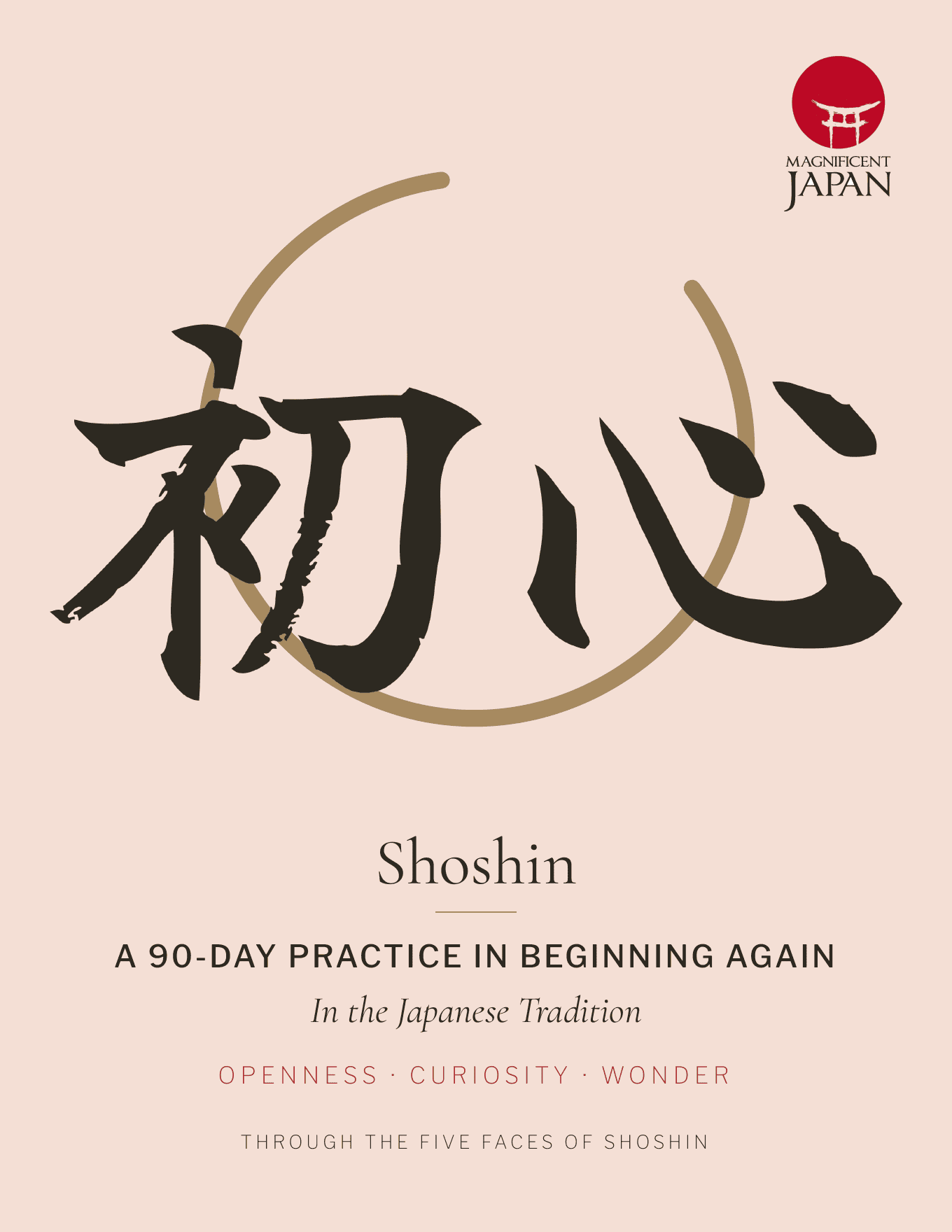
Shoshin is the beginner’s mind — the willingness to meet each thing as if for the first time, even when you know it well. Suzuki put it in one line: in the beginner’s mind there are many possibilities, in the expert’s there are few. Expertise is useful, yet it quietly closes doors. The practiced eye stops seeing what it has already labelled, and whole rooms of a life go unvisited because the mind is sure it has been there.
These ninety prompts empty the cup, a little at a time. They move across work, relationships, skills, and the places routine has gone blind, asking you to catch the moment your mind says it already knows. Early prompts are small enough to answer before the tea cools. Later ones assume you have been looking with fresh eyes, and ask a little more. What returns, across three months, is openness — the state that keeps you learning long after you have stopped being a beginner.

Ma — the space between
The Japanese sense that the space between things is not nothing.
The Interval
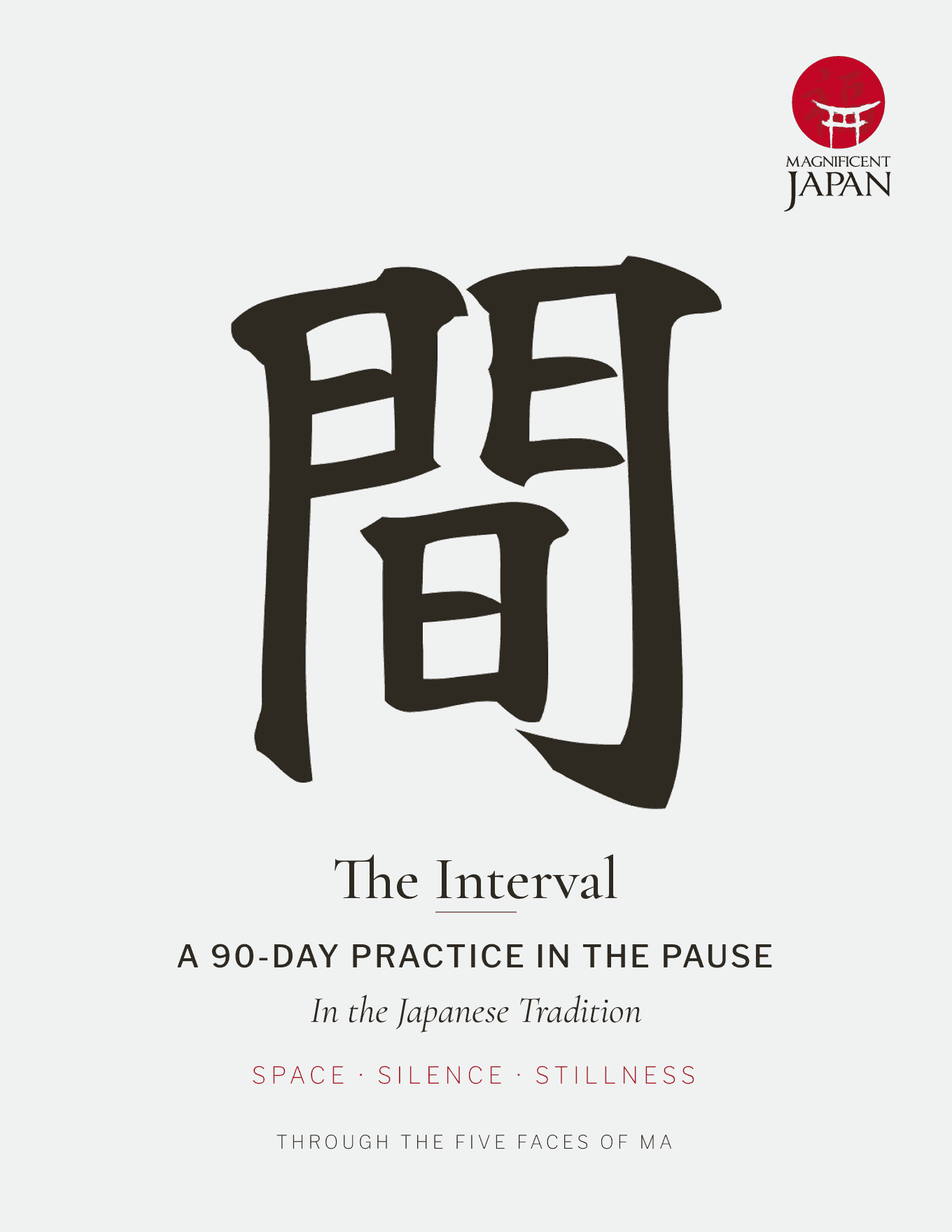
Every art in Japan knows how to use emptiness. The rest between notes, the bare wall of the alcove, the beat of silence before an answer — each is ma, and none of it is absence. Ma holds that the space between things carries weight of its own, and that a life with no intervals is not a full life but a crowded one.
The Interval makes a daily practice of the pause. Its ninety prompts move through the five faces of ma — the gap, the margin, the silence, the breath, and the rest — and turn each toward an over-full calendar. The practice does not ask you to abandon anything. Instead, it teaches the Japanese art of the pause as a skill: where to leave room, what to stop filling, and how much an unclaimed hour can hold. For most readers, this is the journal the present decade was asking for.
One collection, seven doors.
The seven practices form a circle rather than a sequence. Ikigai gives a life direction, nagomi gives it balance, wabi-sabi an eye for beauty, kintsugi a way to repair, shoshin a fresh start, and ma the room to breathe. Mono no aware holds them all — the tenderness for what passes. Begin at any door; no two journals repeat the other’s prompts, and many readers keep several across a year.
Together they are the only set of Japanese philosophy journals built from primary sources into a single, matched editorial line. They sit within the wider Magnificent Japan journal collection, beside the illustrated travel titles. For readers learning to write the language itself, the calligraphy practice tool makes a natural companion — the characters on these covers, traced by your own hand.
Ten Japanese proverbs worth writing down.
A beautifully typeset printable — ten proverbs with kanji, romaji, and meaning. Signing up also brings first word when new practices join the collection.
One email with your printable. Occasional letters after that. Unsubscribe anytime.
A single prompt rarely changes much. Ninety of them do.
Japan has kept written practices for a thousand years, from Heian pillow books to the travel diaries of Bashō, and the tradition asks for the same three things every time — honesty, brevity, and daily attention. The collection borrows that lineage deliberately. Five to fifteen minutes a day is enough, and by Day Ninety the review sets your first answers beside your last. The distance between them is the whole point.
The Japan these practices come from.
Slow mornings, a still tea room, a ryokan where the day softens. When you would like to stand inside the unhurried Japan this collection draws on, we shape the journey around how you want to travel.
Begin a Custom ItineraryBuilt to be returned to, not read through.
The print editions use smooth white paper at 74 to 90gsm, which takes fountain pen and pencil without complaint. The digital editions are write-on PDFs with tap-through navigation, at home in GoodNotes, Notability, Noteshelf, and every major annotation app. Finished journals deserve keeping. Date the spine, shelf them in order, and a few years of practice become a small library of who you were.