Manga and anime in Japan begin in ordinary rooms, on ordinary afternoons. In an unhurried Tokyo bookshop on a Wednesday afternoon, a salaryman in his forties picks up the latest Vagabond volume. He reads three pages standing, then adds it to a small stack of seinen manga. Across the city in Ikebukuro, a university student in carefully assembled cosplay walks toward Animate’s nine-story flagship. In a Setagaya living room, a woman in her thirties starts the next episode of Frieren: Beyond Journey’s End after putting her daughter to bed.
None of the three would describe themselves the same way, and none would reach for the word fan. Yet all three sit inside a single cultural form, one grown from postwar serial entertainment into a $25 billion industry that earns more abroad than at home. That is the useful starting point for manga and anime in Japan: a medium read in public, by grown readers, without apology.
This guide is for the reader who wants to understand manga and anime in Japan as a cultural form rather than as a checklist of must-watch titles. The pages below cover the industry’s current state and scale, the rankings that define what is being read and watched, the genres that organise the medium, the mangaka and directors who have shaped its grammar, and the places in Japan where the culture lives at street level. Cosplay, conventions, manga cafés, and anime pilgrimage all sit alongside the cultural-anchor essay. The guide is for the adult reader new to the medium and for the longtime fan who wants the bird’s-eye view. For the sourcing side — where to actually buy authentic Japanese collectibles — see our companion guide on the Japanese collectibles sourcing guide.
Why Manga and Anime Define Modern Japanese Culture

Manga and anime are not subcultures in contemporary Japan. They are the dominant popular literature and the dominant popular cinema, read and watched across every demographic from primary-school children to corporate executives in their sixties. The medium’s place in Japanese culture is closer to what television and the novel together occupy in Western culture than to what comics or animation hold in any single foreign country.
Scale makes the case. Japan’s anime industry reached a record $25 billion in 2024, according to data presented by the Association of Japanese Animations at TIFFCOM. The figure has more than doubled in a decade — the 2014 baseline was USD 10.6 billion. For the first time in 2024, overseas revenue accounted for 56 percent of the total. The medium has become one of Japan’s largest cultural exports, sitting alongside automobiles and pharmaceuticals as a category the government tracks at the Ministry of Economy, Trade and Industry level.
Akira is where the medium stopped reading as children’s material abroad, and the Akira 35th Anniversary Box Set prints it at the scale the drawing always asked for.
What this means at street level is harder to capture in revenue figures. A weekly manga magazine sells the way a major weekly newspaper does in other countries. Anime adaptations release at the same cultural temperature as new prestige television in the United States or new feature films in France. Conversations at a Tokyo izakaya glide from sports to a current anime series to a long-running manga the speakers have all been reading for fifteen years. The medium is in the cultural water. Not knowing the major works in Japan is closer to not knowing major novels in a country where literature still occupies the centre of cultural conversation.
How the Habit Took Hold
The reason for this density is partly historical. Manga’s modern form was shaped in the immediate postwar years by Osamu Tezuka and a small generation of contemporaries who treated comics as serious storytelling rather than children’s entertainment, and the medium expanded outward from that foundation into every age and audience category. The reason is also structural. The serialisation system — weekly and monthly magazines that publish hundreds of pages per issue, with reader rankings determining which series continue and which are cut — produces a constant flow of new work tested against actual reader attention. A series that fails ends in a few months. A series that succeeds runs for decades. The result is a literature shaped by sustained reader engagement rather than by single creative-team decisions, and it produces work of genuinely surprising depth.
For the international reader arriving at the medium, the right frame is not “Japanese cartoons” but “Japanese contemporary literature and cinema together, with a particular grammar of panels and animation that you learn to read.” Once that frame clicks, the conversation about what is worth reading and watching becomes a conversation about taste and interest rather than a conversation about whether the medium itself deserves the time.
The Industry Today — Size, Structure, Distribution

The anime industry is the easier of the two to size. The Association of Japanese Animations (AJA) publishes an annual industry report tracking studio production output, broadcast and streaming distribution, merchandise licensing, music revenue, and live events. Its 2024 figures are striking even in context. Total industry value reached JPY 3.84 trillion (USD 25.25 billion), a 14.8 percent year-on-year increase — the second-highest annual growth rate ever recorded, behind only the 15.3 percent surge of 2019.
The split between domestic and overseas revenue tells the more interesting story. Overseas revenue contributed JPY 2.17 trillion (USD 14.27 billion) — 56 percent of the total — and grew 26 percent year on year. Domestic revenue contributed JPY 1.67 trillion (USD 10.98 billion), up a modest 2.8 percent. The overseas figure first exceeded the domestic figure in 2020 during the pandemic, flipped back briefly, and has now sat above the domestic figure for three consecutive years. That shift looks structural rather than cyclical.
The narrower production-side figure — what anime studios themselves earn from making the shows — reached a record, though it remains a fraction of the headline number (USD 3.06 billion) in 2024, up 9.1 percent. The gap between the production-side figure and the industry-wide figure illustrates how the modern anime business actually works. A studio’s animation work is the seed. The licensing trees that grow from it — streaming rights, theatrical distribution, manga and light-novel sales, character merchandise, video games, music, themed cafés, theme parks, live concerts of voice actors — produce the trillion-yen industry around the few hundred billion yen of pure animation production.
What Streaming Changed
The streaming infrastructure has changed the international distribution model substantially. Crunchyroll, owned by Sony Pictures Entertainment, has built the largest Western-facing anime catalogue in the world and now ships near-simultaneous translations of new Japanese series within hours of their Japanese broadcast. Netflix has invested in original anime productions at the budget level of its high-end Western originals. Prime Video and Disney+ have entered the category with selective licensing strategies. The result is that an anime series that broadcasts on Japanese television on a Saturday night reaches a North American or European viewer at roughly the same moment, in their language, with full subtitling and frequently dubbing.
The Japanese government has noticed the export economics. The “New Cool Japan Strategy” sets a target of JPY 20 trillion (approximately USD 130 billion) in cultural exports including anime by 2033, more than five times the current figure. The plan treats anime, manga, video games, and Japanese fashion as a coordinated soft-power category alongside more traditional cultural diplomacy. Whether the target is realistic is a separate question. The political weight behind it is real.
The manga industry sits in a different but adjacent landscape. The major publishers — Shueisha, Kodansha, Shogakukan, Square Enix, Kadokawa — run the weekly and monthly magazine system that produces almost every commercial manga series in Japan. Weekly Shonen Jump remains the flagship for new shonen and breakthrough hits. The digital migration has accelerated since 2020, with platforms like MANGA Plus and Comikey distributing officially translated chapters globally on the same day as the Japanese print release.
Top-Selling Manga and Anime — What Leads the Rankings

Sales rankings are the bluntest instrument available for reading manga and anime in Japan, and they remain the most consistent one. The Oricon physical-sales ranking is the established annual benchmark for manga in Japan, covering each year’s sales from late November of the prior year through late November of the counting year. The ranking counts physical copies only — digital sales are tracked separately and are now substantial — so the figures below understate total readership but provide the most consistent year-over-year comparison.
The Oricon annual ranking for the December 2023 to November 2024 counting year placed Jujutsu Kaisen at the top with 7.6 million copies across four volumes, despite an 11 percent decline from 2023. The series passed 100 million copies in circulation during 2024, a milestone reserved for a small handful of titles in manga history. One Piece took second with 5.25 million copies across three volumes. The standout movers were Frieren: Beyond Journey’s End (up 99 percent year on year, driven by the anime adaptation) and The Apothecary Diaries (up 104 percent, also adaptation-driven).
| Rank | Series | Copies sold |
|---|---|---|
| 1 | Jujutsu Kaisen | 7,610,995 |
| 2 | One Piece | 5,250,210 |
| 3 | Frieren: Beyond Journey’s End | 4,988,170 |
| 4 | The Apothecary Diaries | 4,723,562 |
| 5 | Blue Lock | 3,881,269 |
| 6 | Kaiju No. 8 | 3,398,326 |
| 7 | Spy x Family | 2,662,408 |
Source: Oricon Annual Comic Rankings, 2024 — physical sales only.
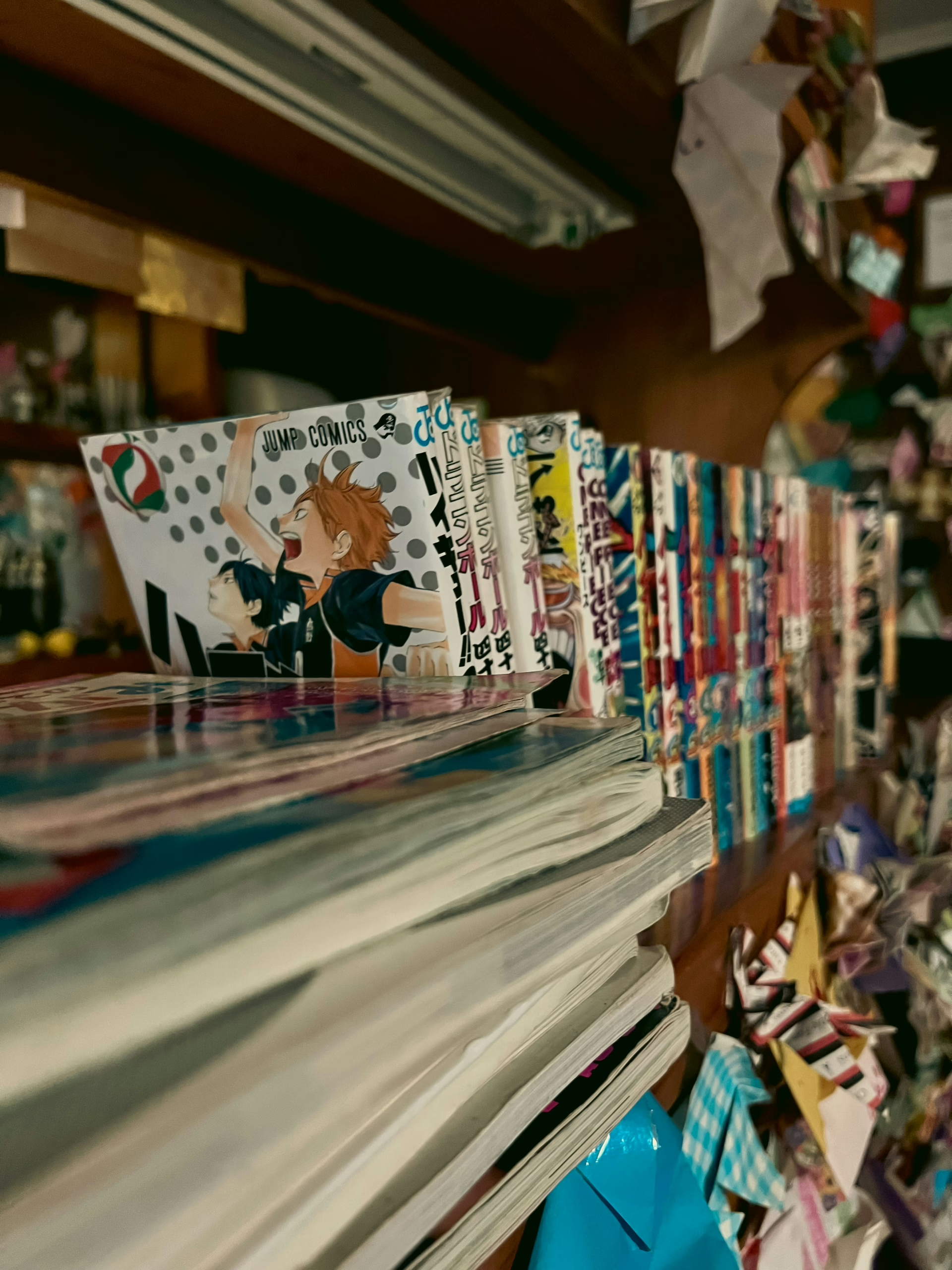
At the individual-volume level, One Piece Volume 108, released in March 2024, was the single best-selling manga volume of the year at 1,552,215 copies — the 14th time One Piece has held the top-volume ranking. The Oricon-era record for a single volume remains One Piece Volume 105 at 1.91 million copies in 2023. The top ten best-selling volumes in 2024 were all from Shueisha’s Jump Comics imprint — One Piece, Jujutsu Kaisen, Spy x Family, and Hunter x Hunter — a Shueisha clean sweep that had not happened in 2023.
Why the Anime Ranking Resists One Number
The anime ranking is harder to summarise because the metric is fragmented across linear broadcast (TV ratings), domestic streaming (subscription platforms), international streaming (Crunchyroll, Netflix, the retailer), and theatrical box office. The cleanest single recent data point is theatrical. Demon Slayer: Kimetsu no Yaiba — Infinity Castle, released in September 2025, became the highest-grossing Japanese film of all time within weeks of release and is widely reported to be tracking toward the all-time domestic box office record, surpassing Spirited Away and the previous Demon Slayer film Mugen Train. The current rolling theatrical record will be confirmed in early 2026 reporting.
For long-running international anime visibility, Crunchyroll’s catalogue and viewing data offer the most useful proxy. Sony has reported Crunchyroll subscriber growth across its anime-segment quarterly disclosures, and the platform now distributes near-simultaneous translations of nearly every commercially significant Japanese broadcast within hours of the Japanese release. The implication for the international reader is that any current Japanese series of note is accessible legally in English within the same week of its Japanese debut.
Where to start reading the top-selling series
For readers entering the medium through the works currently leading the rankings, the entry-point volumes are straightforward to source. Each of the titles below is the opening volume of its series — the right place to begin regardless of when the series originally started serialisation.
Jujutsu Kaisen Volume 1 — Gege Akutami

Gege Akutami’s series passed 100 million copies in circulation during 2024 and remained the top-selling manga in Japan for the year. The first volume introduces Yuji Itadori and the world of cursed energy that the series builds across its 30 volumes — a complete, concluded story.
One Piece Box Set 1 — Eiichiro Oda

Eiichiro Oda’s series has held the Oricon top-selling-volume ranking 14 times — the most by any series. The East Blue box set covers the opening arc across volumes 1–12, the right entry point to a series that is still ongoing after 1,100+ chapters.
Frieren: Beyond Journey’s End Volume 1

Kanehito Yamada and Tsukasa Abe’s series surged 99 percent year-on-year in 2024, driven by the celebrated 2023–2024 anime adaptation. The premise — what happens after the hero’s party defeats the demon king and goes home — is the inverse of every conventional fantasy structure.
The Apothecary Diaries Volume 1

Natsu Hyuga’s light novel adaptation surged 104 percent year-on-year in 2024 and became one of the most-watched anime of the recent seasons. The setting is an alternate-history imperial court; the protagonist is a young apothecary who solves medical mysteries that often turn out to be political.
Blue Lock Volume 1

Muneyuki Kaneshiro and Yusuke Nomura’s football manga reframes sports manga around individual ego rather than team harmony. The premise — Japan locks 300 striker prospects in a facility to identify the single best ego in the country — became one of the most-discussed sports series of recent years.
Kaiju No. 8 Volume 1

Naoya Matsumoto’s series follows a 32-year-old kaiju-corpse cleanup worker who gains the power to transform into one of the monsters he disposes of. The setup pairs middle-aged-protagonist sensibility with the action-spectacle conventions of the genre.
Spy x Family Volume 1

Tatsuya Endo’s series sold over 2.6 million copies in 2024 and has become the rare manga that crosses generational reading lines — children, teenagers, and parents read the same volumes. The premise is a fake-marriage spy comedy that turns into a sincere examination of what family means.
Reading a medium this large is easier with a route than with a list, and the route is what the sections below try to give. It moves from what the industry actually is, through the genres that sort it, to the districts and routes where the work is visible on the ground. Nothing here asks for prior knowledge. If you have read one volume, or none, the order still holds, because the argument runs from the page outward rather than from fandom inward.
You may also like
Genres Worth Understanding
Genre in manga works less like a shelf label and more like a register of address. A Japanese reader picks up a volume already knowing roughly who it was drawn for, and that knowledge shapes the reading before the first panel. Bookshops reflect this. The seinen and josei sections sit apart from the shonen and shojo walls, often on a different floor, under cooler light and beside a noticeably calmer crowd. Understanding the categories is therefore practical rather than academic, because it is how a reader finds the work that was written for someone like them.
Manga is categorised primarily by intended audience rather than by topic. The four primary audience categories — shonen, shojo, seinen, josei — each define a magazine demographic, a publishing schedule, and a set of conventions that a reader internalises after a few volumes. Anime borrows the same categories and layers genre tags on top. Understanding the audience categories first makes the rest of the landscape navigable.
Shojo is the category most often reduced to a marketing label, and the Sailor Moon Naoko Takeuchi Collection is the clearest demonstration that it is an authored body of work.
Shonen — adolescent boys (and the broader mainstream)

Shonen manga targets adolescent boys and runs in magazines such as Weekly Shonen Jump, Weekly Shonen Magazine, and Weekly Shonen Sunday. The conventions are friendship, perseverance, training arcs, increasingly powerful opponents, and serialised long-form arcs. One Piece, Jujutsu Kaisen, My Hero Academia, Demon Slayer, Blue Lock, and Hunter x Hunter sit in this category. The genre's reach extends far beyond its nominal demographic — Weekly Shonen Jump readers include substantial portions of every adult age cohort in Japan, and the magazine's flagship serialisations function as cultural events that the entire country can discuss.
Shojo — adolescent girls

Shojo manga targets adolescent girls and runs in magazines such as Ribon, Margaret, and Hana to Yume. The conventions include school romance, ensemble friendships, and emotional close-focus that favours interior monologue and atmosphere over the action choreography of shonen. The genre's classics — Sailor Moon, Cardcaptor Sakura, Fruits Basket, Nana — define the modern shojo style. Contemporary shojo titles continue to drive significant sales and frequent anime adaptations.
Seinen — adult men

Seinen manga targets adult men, typically university-aged and older. The category produces some of the medium's most ambitious work and tolerates the most narrative complexity. Berserk, Vagabond, Vinland Saga, Monster, 20th Century Boys, and Kingdom all sit in this category. The pacing is slower than shonen, the violence and sexual content can be more explicit, and the thematic range is the broadest of any audience category. For the adult reader entering the medium without childhood familiarity, seinen is often the most natural entry point.
Josei — adult women

Josei manga targets adult women and addresses workplace dynamics, adult romance, family complexity, and the texture of grown-up life. Princess Jellyfish, Honey and Clover, Nodame Cantabile, and Chihayafuru illustrate the category. Josei is smaller in market share than the other three audience categories but consistently produces some of the medium's most observed and emotionally precise work.
The genre tags within these categories

Beyond audience, manga and anime are sorted by genre tags. Isekai follows a protagonist pulled out of contemporary Japan into another world, often fantasy or game-like; That Time I Got Reincarnated as a Slime is the mainstream reference. Slice of life puts the texture of ordinary existence ahead of plot, and Yotsuba& remains its modern benchmark.
Mecha means giant piloted robots, a lineage running from Mobile Suit Gundam through Neon Genesis Evangelion. Sports manga holds a niche of its own — Slam Dunk for basketball, Captain Tsubasa and Blue Lock for football, Haikyu for volleyball. Iyashikei, sometimes rendered as healing, covers gentle observational work built to slow a reader down. Aria and Yokohama Kaidashi Kikou are its reference texts.
A single contemporary series may carry several tags at once. Frieren reads as seinen, fantasy and iyashikei together. The labels overlap by design, because they describe register rather than sorting titles into sealed boxes.
The Mangaka and Directors Who Shape the Medium
Manga and anime are unusual among contemporary mass media for the degree to which individual creators remain identifiable. Western television production tends to disperse credit across writers' rooms and showrunners. Japanese manga sits closer to the European bande dessinée model, where a single named author owns the work and signs every volume. Anime adapts manga but increasingly attracts identifiable directorial signatures. The names below are the foundation of the medium in its modern form, plus a working list of contemporary creators whose work most rewards attention.
Miura’s draughtsmanship is the work rather than its decoration, and the Berserk Deluxe Edition is the only format in which that argument is visible on the page.
Osamu Tezuka — the foundation

Osamu Tezuka (1928–1989) is the figure to whom every other name on this list owes structural debt. Trained as a physician, Tezuka brought feature-film pacing and panel grammar into postwar Japanese comics with Mighty Atom (Astro Boy), Black Jack, Phoenix, and Buddha. He founded the studio system that produced television anime in the early 1960s. The "father of manga" honorific is conventional but earned. A new reader unfamiliar with Tezuka has not yet encountered the originating sensibility of the entire medium.
Hayao Miyazaki and Studio Ghibli

Hayao Miyazaki is the director most international viewers encounter first, frequently through Spirited Away, which held the Japanese domestic box office record for nineteen years and remains a touchstone of how serious cinema treats animation. Studio Ghibli's catalogue — My Neighbor Totoro, Princess Mononoke, Kiki's Delivery Service, Howl's Moving Castle, The Wind Rises, The Boy and the Heron — defines one major register of what anime can be. The Studio Ghibli Collection Blu-ray is the foundation library for any home anime collection. The studio's Ghibli Museum in Mitaka is one of Japan's most reservation-protected cultural destinations.
Satoshi Kon

Satoshi Kon (1963–2010) directed four feature films — Perfect Blue, Millennium Actress, Tokyo Godfathers, Paprika — and the television series Paranoia Agent before his early death. The films pioneered editing and narrative techniques (notably the cross-cut between waking and dream states) that Inception and Black Swan both directly borrowed. For the viewer building an anime literacy, Kon's filmography is short, complete, and worth working through systematically.
Hideaki Anno and the Eva legacy

Hideaki Anno's Neon Genesis Evangelion (1995–1996) is the most influential and most argued-about anime of the past three decades. The series rewrote what mecha could be and what television anime could attempt narratively. Anno's subsequent Evangelion Rebuild films (2007–2021) and his live-action work with Shin Godzilla and Shin Ultraman extended the same sensibility. Whether the original series resolved its themes coherently remains one of the longest-running debates in anime fandom. Both answers are defensible.
Masaaki Yuasa

Masaaki Yuasa directs animation that consistently looks like nothing else in the medium. Mind Game, The Tatami Galaxy, Devilman Crybaby, Lu Over the Wall, and Inu-Oh share a fluid, hand-drawn distortion of figure and space that other studios cannot easily imitate. For the viewer who finds standard anime visual conventions limiting, Yuasa is the answer to the question of what else the medium can do.
Makoto Shinkai

Makoto Shinkai's Your Name (2016) was the box office event that broke the medium's commercial ceiling internationally. Weathering With You and Suzume followed in the same emotional register — adolescent connection set against contemporary Japanese landscapes rendered with photographic precision. For the viewer entering Shinkai's catalogue, the earlier short feature The Garden of Words is the more compact introduction to his visual sensibility, and 5 Centimeters Per Second is the earlier feature-length work that established the emotional template of his later commercial success. Shinkai's locations are now the most-visited seichi junrei (anime pilgrimage) destinations in Japan, a topic Section 10 below addresses.
Mamoru Hosoda

Mamoru Hosoda's filmography — The Girl Who Leapt Through Time, Summer Wars, Wolf Children, The Boy and the Beast, Mirai, Belle — sits in the family-drama register that Ghibli once occupied alone. Hosoda's work treats animation as the natural medium for stories about families negotiating change, and the films repay rewatching across the years of the viewer's own life.
Akira Toriyama — the most commercially significant mangaka

Akira Toriyama (1955–2024) created Dragon Ball, the manga and anime franchise that quantitatively shaped what international audiences understood as Japanese animation through the 1990s and 2000s. Toriyama's death in March 2024 produced one of the largest cultural mourning events in recent Japanese media history. Dragon Ball Volume 1 remains the entry point — the early Toriyama style before the series shifted into its later power-escalation register.
Hirohiko Araki — the long-form stylist

Hirohiko Araki has been writing and drawing JoJo's Bizarre Adventure since 1987 — across nine arcs, multiple protagonist generations, and a continuously evolving visual style that has become one of the most-imitated aesthetics in contemporary manga. The series is famously divisive on first encounter and increasingly persuasive across re-reads. Phantom Blood opens the saga; JoJolion is the most recent completed arc.
Rumiko Takahashi — the most prolific mangaka working today

Rumiko Takahashi has been one of the highest-selling mangaka in Japan continuously since the 1980s — Urusei Yatsura, Maison Ikkoku, Ranma 1/2, Inuyasha, and Rin-ne represent five separate decade-long serialised series. Takahashi's significance is structural: she is the figure who proved that women could sustain mainstream long-form shonen and seinen serialisation at the highest commercial level. Inuyasha Volume 1 is the most accessible entry point for the contemporary reader.
Mitsuru Adachi — the sports manga grammar

Mitsuru Adachi established the modern grammar of sports manga across Touch, H2, Cross Game, and Mix. Adachi's style — clean lines, sustained silence, character interiority carried through baseball-and-romance pacing — is the template the rest of the category measures against. Touch is the foundational text; Cross Game is the most-recommended later work.
The contemporary mangaka generation

The mangaka working at scale today include Eiichiro Oda (One Piece, since 1997), Hirohiko Araki (JoJo's Bizarre Adventure, since 1987), Naoki Urasawa (Monster, 20th Century Boys, Pluto), Kentaro Miura (Berserk, 1989–2021), Inio Asano (Solanin, Goodnight Punpun), Akira Toriyama (Dragon Ball, 1984–2024), Yoshihiro Togashi (Hunter x Hunter, since 1998), and Gege Akutami (Jujutsu Kaisen, 2018–2024). Several of these creators have decades-long careers that have shaped multiple generations of readers. Working through any one of them is its own substantial reading project.
>Reading a medium this large is easier with a route than with a list, and the route is what the sections below try to give. It moves from what the industry actually is, through the genres that sort it, to the districts and routes where the work is visible on the ground. Nothing here asks for prior knowledge. If you have read one volume, or none, the order still holds, because the argument runs from the page outward rather than from fandom inward.
The Reader’s Dispatch
[What the printable is, why it helps with THIS post's subject, and what signing up brings after.]
One email with your printable. Occasional letters after that. Unsubscribe anytime.
Surprising Facts, Milestones, and Record-Holders
Numbers do a particular job in this field. They rarely capture why a series matters, but they do settle arguments about scale, and they show where the medium has quietly outgrown the assumptions still attached to it abroad. What follows is a short set of figures and milestones, each one sourced rather than repeated. Read them as context for the sections above rather than as trivia. The most useful tend to be the least dramatic, because they describe habits — how often people read, and for how long — rather than records.

A handful of verified data points that most readers, even longtime fans, may not have encountered. Each is sourced.
The record belongs to the film, but the artefact of it is the score, and the Princess Mononoke Symphonic Suite remains the primary document rather than a souvenir.
Anime has more than doubled in a decade. The industry was worth USD 10.6 billion in 2014. It reached USD 25.25 billion in 2024 — a 138 percent increase in ten years. Source: Screen Daily on AJA 2025 report.
One Piece has won "best-selling manga volume" 14 times. Eiichiro Oda's series has held the single-best-selling volume ranking in 14 separate years of Oricon's tracking, the most by any series. Volume 108 took the 2024 ranking with 1,552,215 copies. Source: CBR on Oricon data.
Comiket's all-time attendance record is 750,000 people across four days. Comic Market 97 in 2019, the last pre-pandemic event, drew 750,000 attendees across its four days at Tokyo Big Sight — an average of around 187,500 per day. The annual two-event total that year reached 1.48 million attendees. Source: Anime News Network on Comiket attendance history.
Crunchyroll subscribers count in the tens of millions. Sony Pictures Entertainment's anime streaming arm now reports subscribers at a scale that places anime alongside major international streaming categories. The platform's catalogue exceeds 25,000 anime episodes and 15,000 hours of content.
Circulation Milestones
Circulation milestones mark a series rather than measure it. A circulation figure that includes both sold and printed-but-unsold copies, the 100 million mark is reserved for a small handful of titles in manga history. The series achieved this milestone less than six years after starting serialisation in Weekly Shonen Jump in 2018. Source: Comics Beat on Oricon data.
The Japanese government targets about $13 (¥20 trillion in cultural exports by 2033. The "New Cool Japan Strategy" treats anime, manga, video games, and Japanese fashion as a coordinated category and targets roughly USD 130 billion in cultural-exports revenue by 2033 — a five-fold expansion from the current figure. Source: Animation Magazine on Japanese government strategy.
Comiket draws participants from 75 countries. Comic Market 105 in December 2024 attracted attendees from 75 different countries, the most internationally diverse event in its history. The event's international desk operates in English, Chinese, and Korean. Source: Frontline Gaming Japan on Comiket 105.
Where to Experience Manga and Anime in Japan
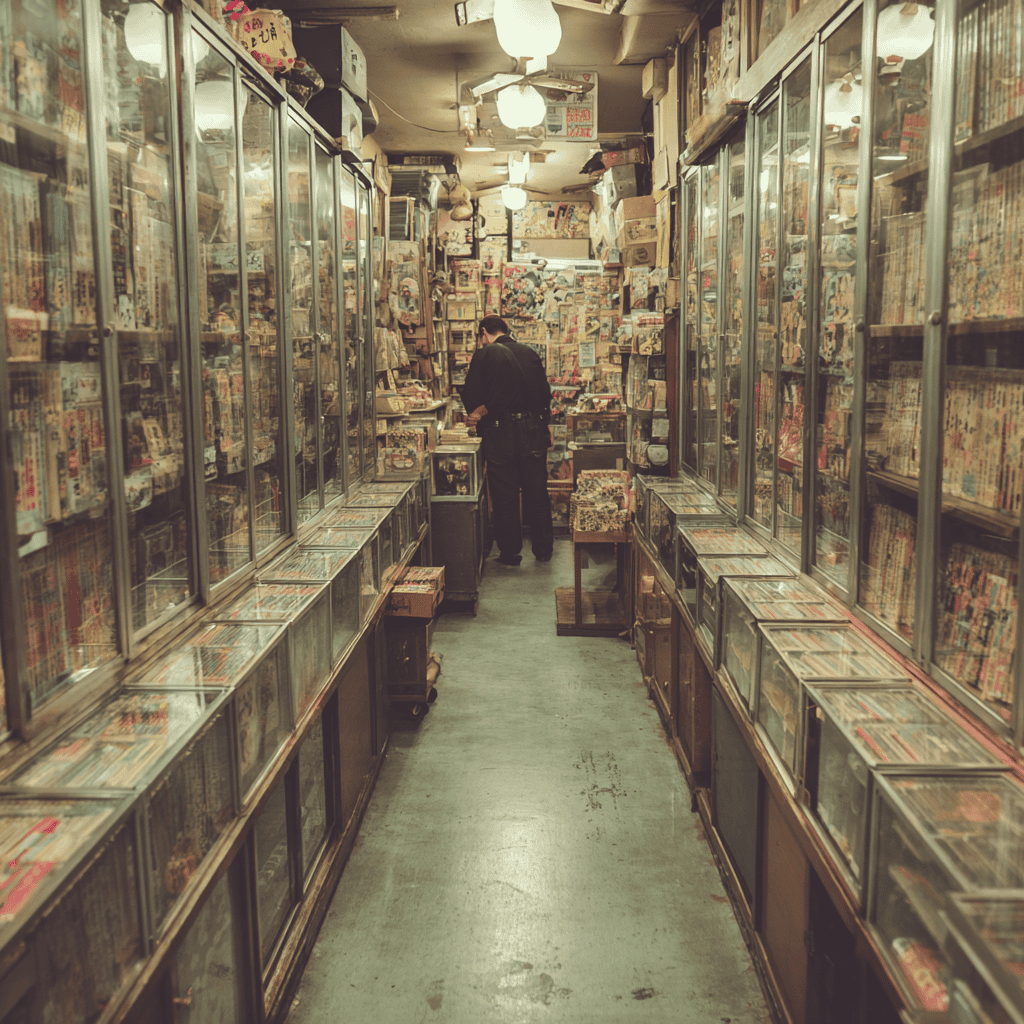
Manga and anime live at street level in Japan in a way that very little contemporary culture lives at street level anywhere else. The districts below are the foundation. Each has its own register and its own relationship to the medium.
The floors run on pre-order rather than depth of stock, which is why a current Berserk figure in the POP UP PARADE line is announced months before it is produced.
Akihabara — the foundational district
Tokyo's Akihabara neighbourhood, ten minutes by train from Tokyo Station, is the foundational anime and manga district. The major chain stores — Animate, Mandarake, Surugaya, Toranoana, Melonbooks, Lashinbang — all operate substantial multi-floor flagships within the district. Animate's Akihabara flagship is the largest specialty store in the world for current anime and manga merchandise. The character cafés, gachapon arcades, and figure shops surround the chain stores. For the first-time visitor, Akihabara is the place to start.
Nakano Broadway — the collector's district
Anyone tracing manga and anime in Japan past the obvious ends up here. Nakano Broadway, a four-story mid-century shopping centre five minutes west of Shinjuku, hosts roughly thirty Mandarake outlets along with dozens of independent specialty dealers. The Nakano register is the deeper collector market — vintage figures, out-of-print manga, cels from classic anime productions, signed memorabilia, and the kind of inventory that has been turning over for decades. Less polished than Akihabara, considerably more rewarding for the collector who wants to dig.
Ikebukuro Otome Road — the female-oriented district
Otome Road, a single street in Ikebukuro on the north side of Sunshine City, is the female-oriented complement to Akihabara. The shops here orient toward shojo and josei manga, BL (boys' love) titles, idol-series merchandise, and the broader female-oriented otaku market. Animate's Ikebukuro flagship is the largest anime store in the world by floor area and serves as the anchor for the district.
Den Den Town — Osaka's Akihabara
Osaka's Den Den Town, in the Nipponbashi district, is the western Japan equivalent of Akihabara. The district hosts Mandarake, Animate, Volks, Yellow Submarine, and a substantial concentration of figure and model-kit shops. For the visitor whose Japan trip skips Tokyo, Den Den Town offers the full district experience in compressed form.
Nagoya, Sapporo, Fukuoka
The major chain stores — Animate, Mandarake — operate flagships in Nagoya, Sapporo, and Fukuoka. The selections are smaller than the Tokyo equivalents but cover the current releases and a respectable selection of the deeper catalogue. For travellers spending time in regional Japan, the local Animate is often the most convenient anchor.
Guidebooks and references for the Tokyo otaku tour

A reading habit travels badly without a plan. For the visitor planning a methodical pass through manga and anime in Japan by district — Akihabara, Nakano Broadway, and Ikebukuro's Otome Road — a dedicated print guidebook saves the on-the-ground search time the internet often duplicates. Akihabara-focused visitor guides from the publisher include shop maps, price expectations, and Japanese-phrase references for the specific exchanges that come up in collector shops.
Tokyo Geek's Guide — the cultural-context companion

Beyond shopping logistics, the visitor benefits from cultural context for what otaku culture actually is in contemporary Tokyo — its history, internal categories, neighbourhood concentrations, and the social codes that govern the spaces. A dedicated Tokyo geek-culture guide covers the context that the shopping-focused guides skip.
JOC Goods anime art prints — the wall-art register

For the visitor wanting to bring some of the visual register of the Tokyo otaku districts home in a more refined format than poster-tube purchases allow, hand-finished Japanese art prints work as the bridge between fan culture and adult home decor. JOC Goods carries Japanese art prints and small framed pieces that ship internationally.
Manga kissa (manga cafés)

The manga kissa — literally "manga café" — is a uniquely Japanese institution. The shops stock tens of thousands of manga volumes across genres and offer per-hour pricing for a private booth, often with internet, soft drinks, and shower facilities. Pricing typically runs around JPY 300–500 per hour, with overnight packages around JPY 2,000–3,500. The format works as a reading library, a casual nap location, an internet café, and occasionally as overnight accommodation for travellers between train connections. The major chains include Manboo, Gera Gera, Bagus, and Jiyu Kukan. For readers wanting to bring the manga-kissa register home — small Japanese stationery items that pair well with extended manga reading — JOC Goods carries hand-selected washi tapes and notebooks, and the brush pen and calligraphy starter sets work for the reader who wants to follow manga panels with their own quick sketches.
Museums and themed attractions
The Ghibli Museum in Mitaka requires reservations months in advance and offers no walk-up tickets. The Kyoto International Manga Museum holds approximately 300,000 volumes across its open-stack collection and operates as a working library. Themed attractions include the Pokémon Center flagships (Shibuya, Mega Tokyo, Osaka, Kyoto), the Sanrio Puroland indoor theme park, and the touring exhibitions at the Mori Arts Center Gallery in Roppongi Hills.
How to spend an afternoon at a manga kissa
Choose a location near a station you will pass anyway. Manboo and Gera Gera keep branches across central Tokyo, and most stations have at least one independent shop. Walk in and ask the desk for a kojin-shitsu (個人室), the fully enclosed room rather than an open booth. Bring ID on a first visit, because you will be registered and given a card to swipe afterwards.
Take a three-to-five-hour package. These usually include unlimited soft drinks, and often a shower or a massage chair. Spend the first ten minutes walking the shelves. Pull four to six volumes that catch your eye, and vary the genre deliberately, since breadth is the point of a manga kissa rather than depth in one series.
Then settle in. The room is small and private, the light low, the air faintly stale, the concentration total. Read until the stack runs out or the clock does, then return the volumes at the desk on your way out. It is an atmosphere that does not survive export.
Reading a medium this large is easier with a route than with a list, and the route is what the sections below try to give. It moves from what the industry actually is, through the genres that sort it, to the districts and routes where the work is visible on the ground. Nothing here asks for prior knowledge. If you have read one volume, or none, the order still holds, because the argument runs from the page outward rather than from fandom inward.
You may also like
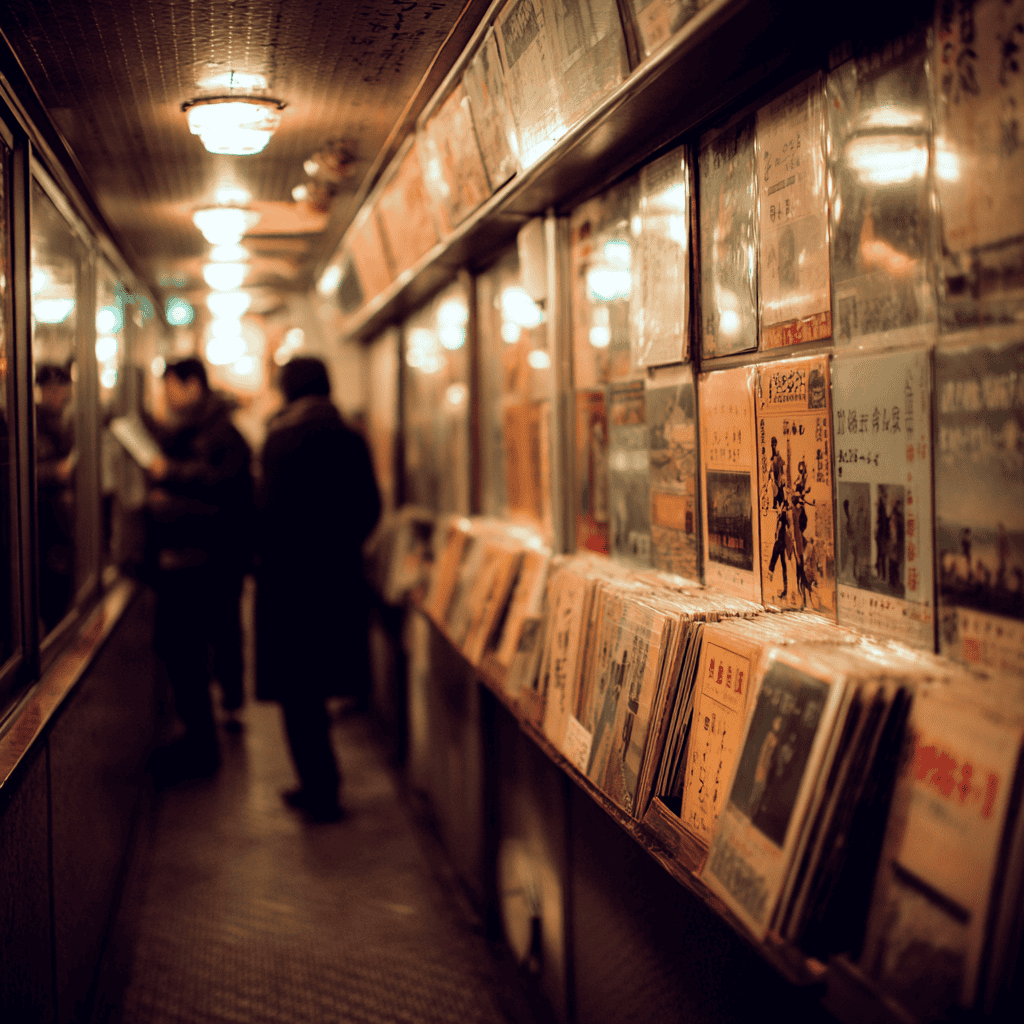
Major Events — Comiket, AnimeJapan, Jump Festa
Events are where the medium stops being a private habit and becomes a crowd. Three dominate the calendar, and each does something different. One is a marketplace for self-published work, another is an industry showcase, and the third belongs to a single publisher. Attending any of them means accepting a particular kind of day: early trains, long queues in weather that is rarely kind, and halls loud enough that conversation happens at close range. The material below covers what each event is for, and what a first visit realistically involves.
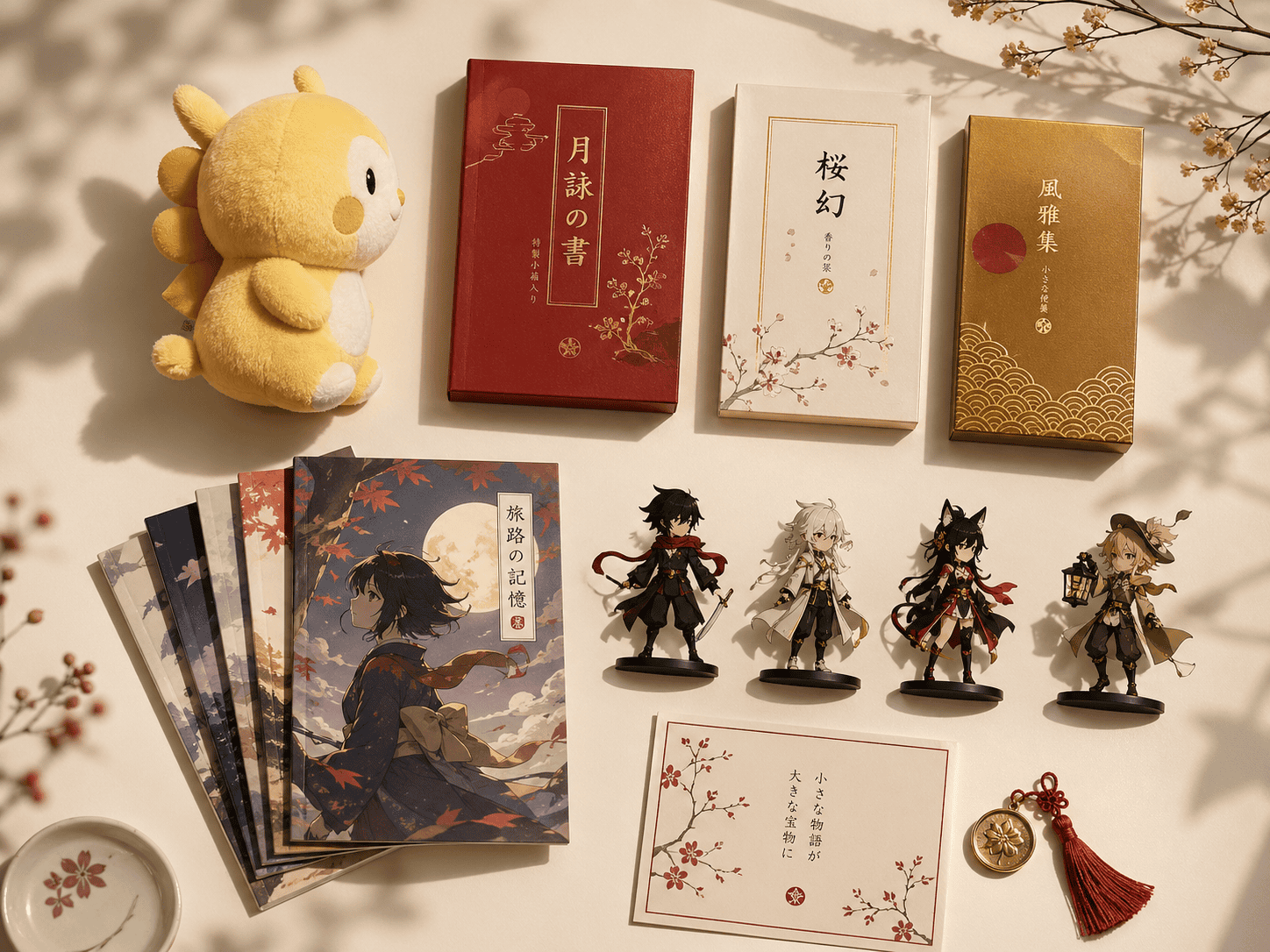
Japan's anime and manga calendar revolves around four major industry events and a calendar of regional conventions. The first three are the foundation and warrant planning around if a trip can include them.
Comic Market (Comiket) — twice yearly, Tokyo Big Sight
Comiket runs in mid-August and late December each year at the Tokyo Big Sight exhibition complex in the Odaiba district. The event is the world's largest doujinshi (self-published manga) convention. Comiket 106 in August 2025 drew approximately 250,000 attendees across two days. Comiket 105 in December 2024 drew 300,000 across two days with 14,500 exhibiting circles per day. The first Comiket in December 1975 hosted around 700 attendees and 32 exhibiting circles; the event has grown by a factor of roughly a thousand in fifty years. Attendance crosses every cosplay register, from no-cosplay readers to elaborate construction work. For the first-time visitor, the practical considerations matter as much as the cultural ones.
AnimeJapan — March, Tokyo Big Sight
AnimeJapan is the industry-facing event held in late March each year at Tokyo Big Sight. The event functions as the major commercial announcement venue for the year's anime production schedule, with studios revealing upcoming series, new film projects, and licensing announcements. Tickets sell out months in advance for the public days. AnimeJapan is the right event for the visitor who wants to encounter the industry as a business rather than as a fan culture.
Jump Festa — December, Makuhari Messe
Jump Festa is Shueisha's annual exhibition for its Weekly Shonen Jump titles, held in late December at the Makuhari Messe convention centre in Chiba (the secondary Tokyo-area convention venue, about an hour from central Tokyo by train). The event features stage events, voice actor appearances, exclusive merchandise releases, and major announcements for the next year's Jump anime adaptations. Attendance reaches around 130,000 over two days.
Tokyo Comic Con — December, Makuhari Messe
Tokyo Comic Con, run under the international Comic Con licensing umbrella, holds the Japanese edition at Makuhari Messe in early December. The event covers both Japanese and international comics, anime, video games, and film, with substantial Hollywood-celebrity appearances alongside Japanese voice actors and manga artists. The register is closer to San Diego Comic Con than to Comiket.
Regional conventions
Regional conventions include Comic City (held in major cities across Japan), Sunshine Creation, J. Garden, and several smaller doujinshi events that produce the kind of small-press output that the major events do not centre. For the deeper collector, the regional circuit is where rare and limited-edition material first surfaces.
How to navigate Comiket as a first-timer
Arrive at Tokyo Big Sight by eight if you want to be inside when the doors open at half past ten. Buyers queuing for specific popular circles start much earlier, but eight is enough for a first general visit. Take the Yurikamome line from Shimbashi, or the Rinkai line from Osaki, to Kokusai-Tenjijo. The walk from the station is well signed and long.
Carry water, particularly at the summer edition, where the halls hold heat through the afternoon. Inside, the self-published circles fill the East Halls and the corporate booths fill the West. Pick a register before you start walking. Most first-timers should begin in the West Halls, where registered companies sell official merchandise, exclusive releases and collaboration items.
The East Halls are denser and reward navigation, with circles arranged by genre and series. Watch the clock, because popular items go early and experienced buyers plan the morning route around exactly that. The catalogue, printed or in the app, is what makes a focused visit possible. Bring small notes, since many circles take cash only and the on-site machines queue badly. The day is walking, crowds and improvisation, and the reward is a concentration of creative culture that exists nowhere else.
Cosplay Culture in Japan

Cosplay in Japan operates under a different set of social conventions from the cosplay culture that has developed internationally. Understanding these conventions in advance matters both for visiting cosplayers and for visitors observing the practice. The basic principles below cover most situations.
The on-site change rule
Japanese cosplay etiquette is built around changing into costume at the venue rather than travelling in costume. Convention venues provide dedicated changing rooms (often gendered, sometimes private), prop storage areas, and frequently mirror rooms for last-minute adjustments. The expectation is that cosplayers arrive in regular clothes, change at the venue, attend the event in costume, and change back before leaving. Wearing a costume on the train or in the surrounding streets is generally discouraged outside specifically permitted contexts (Halloween in Shibuya is the main exception).
Photography etiquette
Photographing a cosplayer in Japan requires asking permission first. The standard practice is to approach the cosplayer, indicate that you would like to take a photograph, and wait for their consent. Most cosplayers expect a brief conversation before and after — a compliment on the costume's construction, a question about the character, a quick exchange about which day they will be at the event. Candid photography without consent is a minor breach of etiquette at small events and a significant breach at the major conventions, where venue staff will intervene if asked.
Where cosplayers source costumes
The Akihabara district hosts several major cosplay-supply shops. ACOS (operated by Animate) is the largest, with multiple floors of pre-made costumes, props, wigs, and individual fabric pieces. Cospatio, located in the Don Quijote building in Akihabara, sells licensed costume kits for current popular series with manufacturer-grade construction quality. Smaller shops scattered through the district handle bespoke construction, alterations, and harder-to-source materials. For the international cosplayer travelling to Japan specifically to assemble a costume, Akihabara provides a one-day shopping radius for nearly any current series.
Conventions where cosplay is centred
Comiket, World Cosplay Summit (held annually in Nagoya), and Tokyo Game Show all centre cosplay as part of the event identity. The World Cosplay Summit in particular hosts an international competition with national teams from over forty countries — the event takes place in late July in Nagoya and is closer to a championship than to a convention. Smaller dedicated cosplay events run throughout the year at locations like the Tokyo Big Sight outdoor plaza and several rented studios in Ikebukuro and Akihabara.
The adult cosplay register
Japan's adult cosplay community runs from amateur weekend activity through professional layer (レイヤー) careers. Professional cosplayers in Japan publish photobooks, run paid photoshoot studios, attend events on contract, and operate substantial social-media presences. The construction standards at the professional level approach feature-film costume work. For the foreign visitor encountering this register for the first time, the polish can be striking; the same conventions of consent and respect apply regardless of the cosplayer's level.
How to source a cosplay outfit in Akihabara
Start at the ACOS flagship near Akihabara Station's Electric Town exit. The store carries the broadest catalogue, and staff will tell you whether a costume is in stock. If it is, try the size in store. Japanese sizing runs small against Western sizing, so the standing advice is to size up.
If the piece is unavailable, or you want better construction, walk five minutes south to Cospatio in the Don Quijote building. Manufacturer-grade kits for current series cost more and are built noticeably better. For wigs, the dedicated shops along Chuo-dori carry deeper selections than the costume stores, and Assist Wig and Airily Wig cover most current and classic characters.
Props are the variable. Simple ones are on the shelf. Large weapons and elaborate armour usually need commission work, which the shops can start but which takes weeks. Allow a full half-day for a complete sourcing trip. Bring measurements in centimetres and a reference image showing the character from several angles. You leave with a folding bag of components and the assembly still ahead of you.
Reading a medium this large is easier with a route than with a list, and the route is what the sections below try to give. It moves from what the industry actually is, through the genres that sort it, to the districts and routes where the work is visible on the ground. Nothing here asks for prior knowledge. If you have read one volume, or none, the order still holds, because the argument runs from the page outward rather than from fandom inward.
You may also like

Anime Pilgrimage (Seichi Junrei)
Seichi junrei sits at the point where watching turns into travelling. The practice is unglamorous in the best way. It usually involves a regional train, a walk past ordinary houses, and a few minutes spent matching a remembered frame to a real street corner. Nothing about the destination announces itself, and that restraint is much of the appeal. Towns have noticed, and many now publish walking maps of their own animated locations. What follows covers how the practice works, where it began, and how to plan a day around it without reducing it to a checklist.

The Japanese practice of seichi junrei (聖地巡礼) — literally "protected site pilgrimage" — borrows vocabulary from religious tradition and applies it to the act of visiting real-world locations that appear in anime and manga. The term carries no irony in Japanese usage. A pilgrim to Hida-Furukawa to walk the streets that Your Name animated is engaged in a practice that the local government, the JR train system, and the local tourism board all recognise. The phenomenon has become substantial enough that several local economies now depend on it.
Matching a place to a frame is what the practice consists of, and The Art of My Neighbor Totoro reproduces the background paintings a visitor is recognising.
Hida-Furukawa — Your Name (2016)

The town of Hida-Furukawa, in Gifu Prefecture, appears throughout Makoto Shinkai's Your Name as the rural counterpart to the Tokyo storyline. Hida-Furukawa train station, the Hida City Library, and the surrounding countryside all feature in identifiable scenes. The local tourism office distributes a printed map of pilgrimage sites with frame-accurate photographs alongside the corresponding film stills. The town is reachable in around three hours from Nagoya by JR Takayama line.
Numazu — Love Live: Sunshine (2016)

The coastal city of Numazu in Shizuoka Prefecture serves as the setting for the Love Live: Sunshine series, and the city has embraced the association with notable enthusiasm. Numazu Port, the Awashima ferry terminal, the Numazu municipal aquarium, and dozens of local cafés and shrines all carry official Love Live signage. The city's tourism economy has been transformed by pilgrimage traffic from a category of visitor it did not have ten years ago.
Washinomiya Shrine — Lucky Star (2007)

Washinomiya Shrine in Kuki, Saitama Prefecture, was the foundational location that established seichi junrei as a recognised phenomenon. The shrine appears in Lucky Star as the home shrine of the Hiiragi twin characters, and the surge of fan visits beginning in 2007 prompted the shrine to embrace the association. The annual Lucky Star festival held at the shrine each September now draws thousands of pilgrims, and the shrine sells official Lucky Star ema (votive plaques) alongside its traditional offerings.
Tokorozawa and the Ghibli Park

The Tokorozawa area in Saitama Prefecture is the broader setting for several Studio Ghibli works, with My Neighbor Totoro referencing the surrounding Sayama Hills directly. For viewers preparing for a Ghibli pilgrimage, Spirited Away on Blu-ray remains the foundational watch — it set the studio's box-office record and introduced most international viewers to the catalogue. The Ghibli Museum in Mitaka remains the established Ghibli destination in Tokyo. The Ghibli Park in Nagakute (Aichi Prefecture), opened in 2022, offers a substantially larger encounter with the studio's world, with reservations required well in advance.
Other Ghibli pilgrimage anchors

For pilgrims building a broader Studio Ghibli itinerary beyond Mitaka and Nagakute, Castle in the Sky sits as the foundational early Miyazaki feature that established the visual register the studio would continue refining for the next four decades. The Welsh-village references in the film map onto multiple real locations Miyazaki visited during pre-production research.
The Whisper of the Heart pilgrimage — Tokyo Tama Hills

The Seiseki-Sakuragaoka district in western Tokyo is the original setting of the 1995 Ghibli film Whisper of the Heart, and the local tourism office maintains a marked pilgrimage walking route through the residential streets that appear in the film. The walk takes roughly two hours and is one of the most peaceful anime pilgrimages in greater Tokyo.
The Demon Slayer Mugen Train pilgrimage

The 2020 theatrical film Demon Slayer: Mugen Train generated a separate, train-specific pilgrimage circuit. The Kyoto Railway Museum's vintage steam locomotive on display became one of the most-photographed pilgrimage objects of recent years; visitors line up to photograph the locomotive from the same angle as the film's hero-shot framing.
How the practice works

Anime pilgrimage in practice combines basic travel with a small ritual element. Pilgrims typically carry a smartphone or a printed reference image, locate the precise framing the anime used, photograph the live location at the same angle, and frequently leave a small votive offering at the location — an ema at a shrine, a small note in a designated guestbook, a few coins in a donation box. The Japanese phrase often used to describe a successful pilgrimage is "聖地を踏む" (seichi wo fumu) — literally "to step on the protected site." The phrase captures the practice's character as a physical, located act rather than a virtual one. For a film that itself centres pilgrimage as its subject, Shinkai's Suzume (2022) traces a young woman's journey across multiple Japanese locations — and most of those locations have now joined the pilgrimage map themselves.
How to plan an anime pilgrimage
Choose a single work first, because the practice works around one anime or film rather than a compilation. Identify three to five scenes whose real locations are documented, using the maps local tourism boards publish and the fan-curated databases that cover the rest. Plan the day around train access, since most destinations sit at the end of a regional line running every thirty to sixty minutes. Walk to each framing on your list and photograph it from the angle the work used. That exercise is the centre of the practice, and it sharpens both the memory of the scene and your attention to the road, the level crossing, the four o'clock light. Leave time afterwards for lunch, a residential street, and a few minutes on the platform where a key scene was staged.
How to Start Your Own Manga and Anime Journey
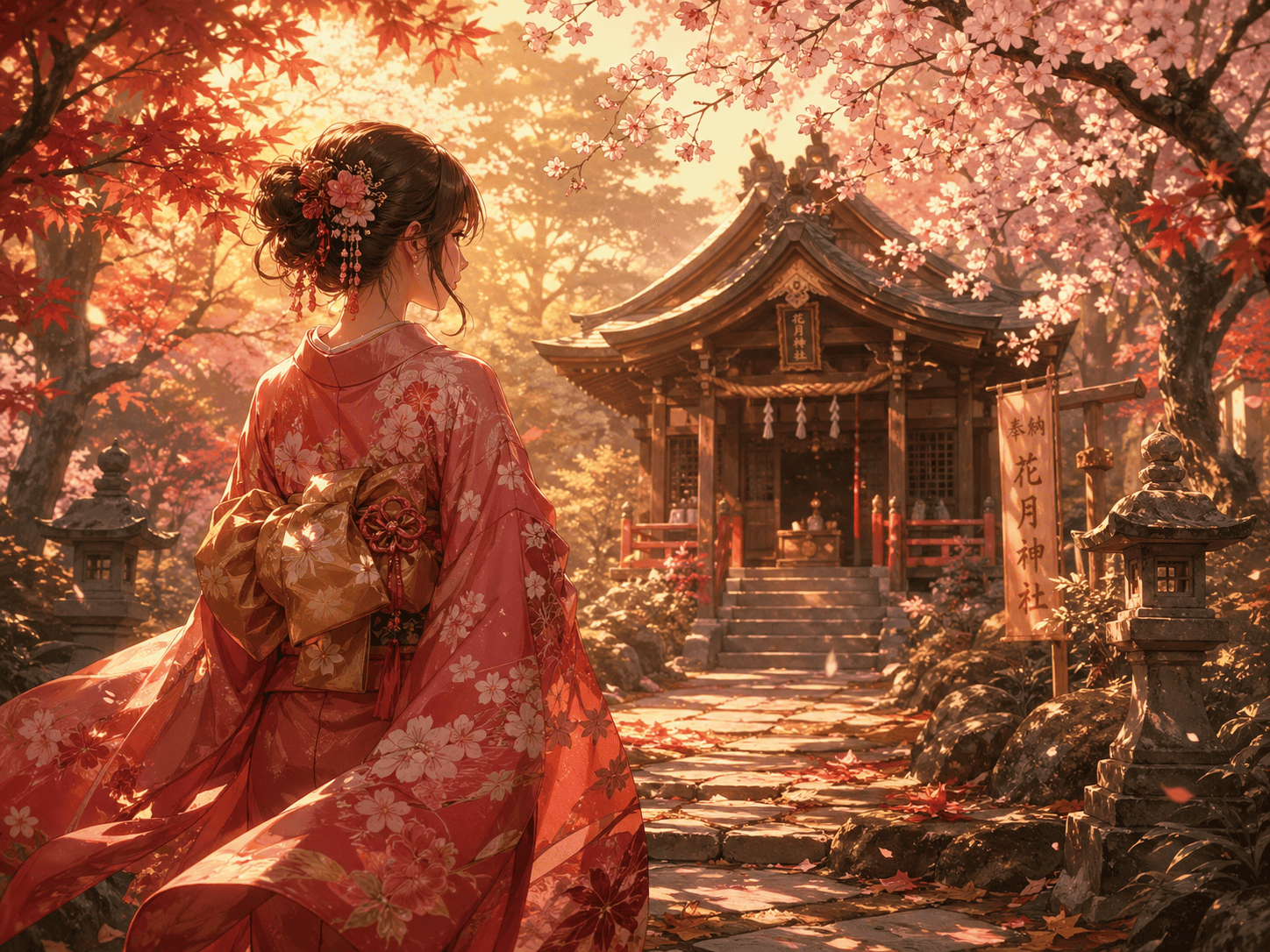
For the adult reader new to the medium, the volume of available material is its own obstacle. The recommendations below are not lists of the "best" titles in any objective sense. They are practical starting points calibrated to common reader sensibilities, with the expectation that the reader will diverge from the recommendation within ten volumes based on what holds their attention.
If you read literary fiction
Start with Naoki Urasawa's Monster (eighteen volumes complete) for a psychological thriller in the seinen register, or Inio Asano's Solanin (two volumes) for a self-contained young-adult literary novel in manga form. Both repay the kind of attention a reader brings to a literary novel. Anime equivalents: Satoshi Kon's Millennium Actress film, or Mamoru Hosoda's Mirai.
If you watch prestige television

Start with Vinland Saga (anime adaptation available with two seasons; manga ongoing) for a long-form historical drama in the seinen register, or Frieren: Beyond Journey's End (anime adaptation available; manga ongoing) for a contemplative fantasy that has been the most adaptation-driven seller of the past two years. The pacing of both works tracks the pacing of contemporary prestige television.
If you read fantasy or science fiction

Start with Berserk (forty-two volumes, ongoing posthumously) for dark fantasy at scale, or Vagabond (thirty-seven volumes, on indefinite hiatus) for samurai-era historical fiction by Takehiko Inoue. For anime, Cowboy Bebop (twenty-six episodes, complete) remains the touchstone science-fiction anime and rewards adult attention immediately.
Also worth starting with

Takehiko Inoue's Vagabond is the foundational samurai manga of the modern era — Inoue's brushwork on the historical setting set the standard the rest of the category measures against.

Shinichiro Watanabe's Cowboy Bebop remains the bridging work between Japanese animation and the international jazz-noir cinematic tradition — the rare anime that converts non-anime viewers in one viewing.
If you watch animation already

Start with Studio Ghibli's catalogue in order of release if you have not seen it complete. Move from Ghibli to Satoshi Kon's filmography (four films, easily watched in a month). From Kon, move to Mamoru Hosoda's filmography for the family register, and Masaaki Yuasa's filmography for the formal-experimentation register. For the viewer specifically interested in how anime has shaped contemporary live-action cinema, Mamoru Oshii's Ghost in the Shell (1995) is the single most-borrowed-from anime film in Hollywood science fiction.
If you want the cultural touchstones

Watch Neon Genesis Evangelion (the original 26-episode television series plus the End of Evangelion film) for the most-argued-about anime of the past thirty years. Read the first three volumes of One Piece to encounter the bestselling manga series of the modern era. Watch Your Name to encounter the box-office-record film that made anime mainstream-cinematic for an international audience. Add Katsuhiro Otomo's Akira (1988) as the foundational text — the single film most responsible for international recognition of anime as a serious cinematic form.
If you want to follow a current series in real time

Subscribe to Crunchyroll for the simulcast schedule. Pick one currently-airing series — Dandadan, the latest Jujutsu Kaisen season if available, the latest Frieren if ongoing, or Sakamoto Days for the action-comedy register — and watch it on the Japanese broadcast cadence with the international community. The shared-week experience around a current series is one of the medium's distinctive pleasures.
From Reading to Owning — Where to Buy
This guide focuses on the cultural landscape, not the sourcing layer. For the practical question of where to actually buy authentic manga volumes, anime figures, character merchandise, and pop-culture collectibles — and how to spot the fakes before they ship — our dedicated companion guide handles that work.
For sourcing methodology: Where to Buy Authentic Japanese Collectibles Online maps the legitimate routes — the retailer, JOC Goods, Discovery Japan Mall, official brand stores, specialty curators, luxury department stores, and Japan forwarding services — alongside the red flags that mark the counterfeits.
For Japan-domestic manga and anime stores: Discovery Japan Mall carries roughly 37,000 SKUs across Japan-domestic brands including Pokémon Center Japan exclusives, Bandai Spirits items shipping Japan-only, and Tomica Premium diecast lines.
For English-language manga and anime merchandise: the retailer's Sanrio, Studio Ghibli, and Bandai Spirits brand storefronts are the foundation, with the "ships from and sold by the retailer" filter eliminating most counterfeit risk. Browse the licensed catalogue.
For travel itself. If a trip to Japan is on the horizon and you want to build the anime cluster into the itinerary — Akihabara, Nakano Broadway, Ghibli Museum, regional pilgrimage sites — a custom itinerary can structure the trip around the cultural register that matters to you.
Reading a medium this large is easier with a route than with a list, and the route is what the sections below try to give. It moves from what the industry actually is, through the genres that sort it, to the districts and routes where the work is visible on the ground. Nothing here asks for prior knowledge. If you have read one volume, or none, the order still holds, because the argument runs from the page outward rather than from fandom inward.
Before You Book the Trip
[What the printable is, why it helps with THIS post's subject, and what signing up brings after.]
One email with your printable. Occasional letters after that. Unsubscribe anytime.
Questions Worth Asking
How big is the Japanese anime industry?
Japan's anime industry reached a record $25 billion in 2024. Growth ran to 14.8 percent, its second-strongest year on record. Overseas revenue accounted for roughly $14 billion of that total and rose 26 percent. The domestic market added 2.8 percent. For the third time, earnings from outside Japan exceeded earnings within it.
What is the best-selling manga in Japan right now?
One Piece volume 108 was the single best-selling volume of 2024, at 1,552,215 copies. That result gave the series its fourteenth year at the top of the annual ranking. Oricon counts physical sales only, so digital purchases sit outside the figure. Rankings also track serialisation schedules, because a volume can only sell in a year it appears in.
What is Comiket and how many people attend?
Comic Market, or Comiket, is the largest self-published manga event in the world. It runs twice a year at Tokyo Big Sight. Comiket 105 took place on 29 and 30 December 2024 and drew about 300,000 people across two days. Comiket 106 followed on 16 and 17 August 2025, with roughly 250,000. The pre-pandemic record stands at 750,000 across four days in 2019.
What is seichi junrei (anime pilgrimage)?
Seichi junrei is the practice of visiting the real places behind an anime or manga. Readers locate the street, the station platform or the hillside a scene was drawn from, and then stand in it. The appeal is unhurried rather than spectacular. Many towns now publish walking maps of their own animated locations, because the visits bring steady arrivals outside peak season.
Where should I go for anime and manga in Tokyo?
Akihabara is the starting point for new releases, character goods and figures. Nakano Broadway serves the deeper collector market, with vintage figures and out-of-print volumes. Ikebukuro's Otome Road is oriented toward the female readership. The Ghibli Museum in Mitaka works on a different register, and it requires a reservation made in advance. In Osaka, Den Den Town covers much of the same ground as Akihabara.
Is cosplay welcome at Japanese conventions?
Yes, within a clear set of conventions. Cosplayers arrive in ordinary clothes and change on site, in the rooms organisers provide. Wearing a costume to and from the venue is not accepted practice. Photography starts with asking, and most cosplayers expect a short exchange rather than a candid frame. Akihabara's studios rent changing space and prop storage by the day.
What are the main anime and manga genres?
Manga sorts by readership before subject. Shonen is aimed at adolescent boys, shojo at adolescent girls, seinen at adult men, and josei at adult women. Anime borrows those categories and layers genre tags over them — isekai, slice-of-life, mecha, sports, iyashikei. Most works carry several labels at once. The labels describe an intended reader rather than the quality of the writing.
How do I read manga in the correct order?
Japanese manga reads right to left. Start where an English reader expects to find the back cover. Within a page, move from the top-right panel down to the bottom-left. English editions have preserved the original orientation since the early 2000s rather than flipping the artwork. The direction feels awkward for a few pages, and then it stops registering at all.
Reading a medium this large is easier with a route than with a list, and the route is what the sections below try to give. It moves from what the industry actually is, through the genres that sort it, to the districts and routes where the work is visible on the ground. Nothing here asks for prior knowledge. If you have read one volume, or none, the order still holds, because the argument runs from the page outward rather than from fandom inward.
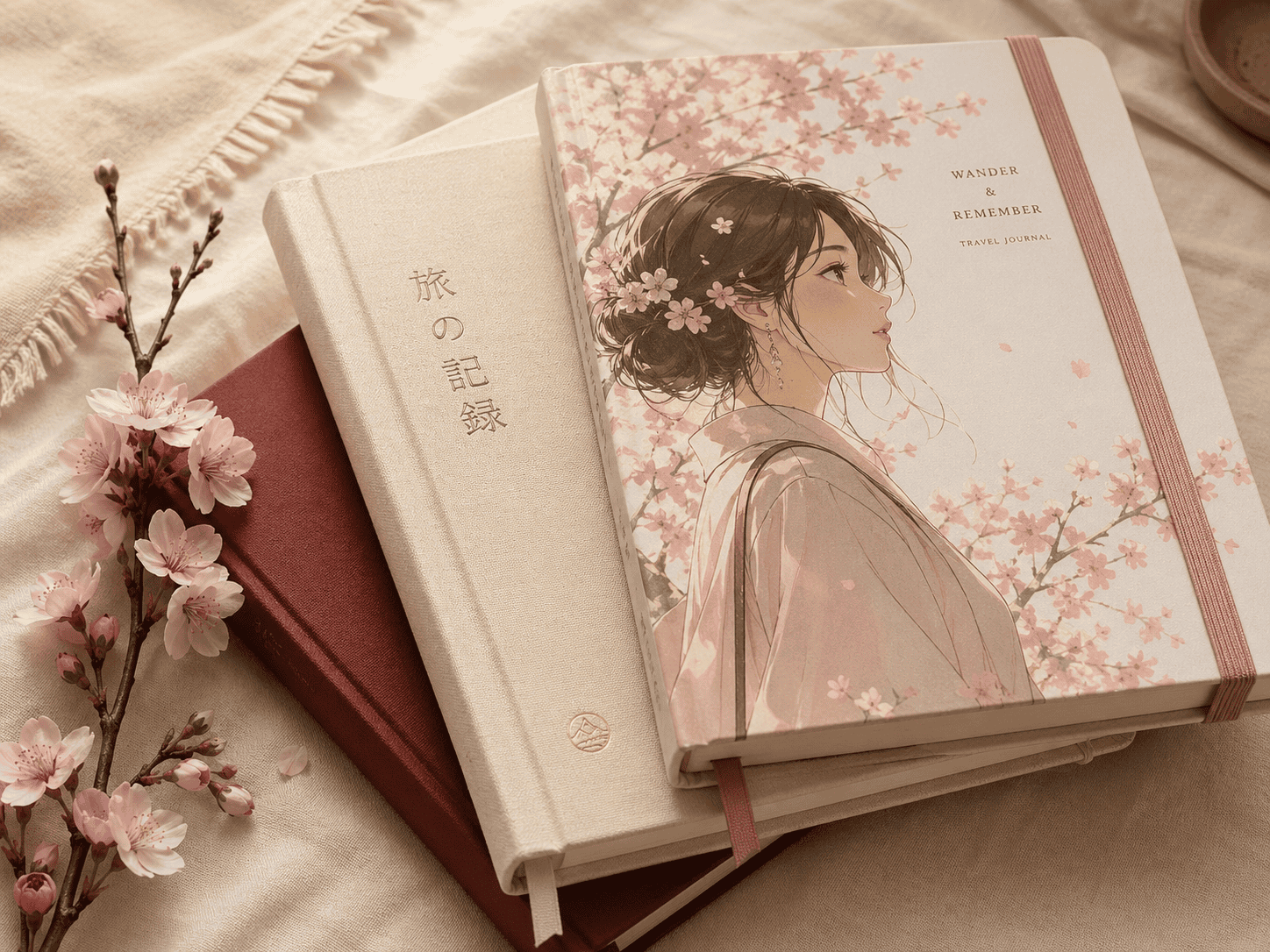
![[The The Magnificent Japan Journals Japan travel journal by Magnificent Japan]](https://www.magnificentjapan.com/wp-content/uploads/2026/03/Magnificent-Japan-Journals.avif)
[One descriptive paragraph — what the journal is, what it is made for, and how it connects to this post's subject. Ends by placing it in the wider collection.]
View The CollectionReading a medium this large is easier with a route than with a list, and the route is what the sections below try to give. It moves from what the industry actually is, through the genres that sort it, to the districts and routes where the work is visible on the ground. Nothing here asks for prior knowledge. If you have read one volume, or none, the order still holds, because the argument runs from the page outward rather than from fandom inward.
The Reader You Become
The reward for the time spent reading manga and watching anime as an adult is harder to name than the reward for reading novels or watching films. Part of it is access to a body of contemporary storytelling that operates with a different relationship to seriality, character continuity, and reader investment than any other contemporary medium. Part of it is the texture of contemporary Japan — the cafés, the train rides, the seasonal observations, the way a city sounds at dusk — that the work documents at a level of attentive density that no other foreign-language medium reaches at scale.
The reader who follows One Piece for twenty years has not just read a comic. They have spent two decades inside a particular sensibility, watched its concerns shift across the years of their own life, and accumulated a relationship with a body of work that is closer to a long marriage than to a casual entertainment habit. The viewer who watches the Studio Ghibli catalogue twice across the years of their twenties and thirties has a similar relationship with that body of work. The pleasures of the medium are cumulative, and they reward the long-form reader more than the binge consumer.
For the next step, the sourcing guide at sourcing collectible manga and figures handles the practical side of owning the work — manga volumes, figures, art books, character merchandise. The Magnificent Japan anime hub indexes the rest of the cluster, including deeper guides to Studio Ghibli's filmography, the Tokyo anime tour itinerary, and the curated anime gift recommendations. The conversation continues across the rest of the library.
If a trip to Japan is on your horizon, the in-person encounter — Akihabara at dusk, the Ghibli Museum reservation, an anime pilgrimage to Hida-Furukawa, a day at Comiket — can be built into your itinerary alongside the broader cultural and travel registers MJ specialises in.
Plan Your Custom Japan Itinerary