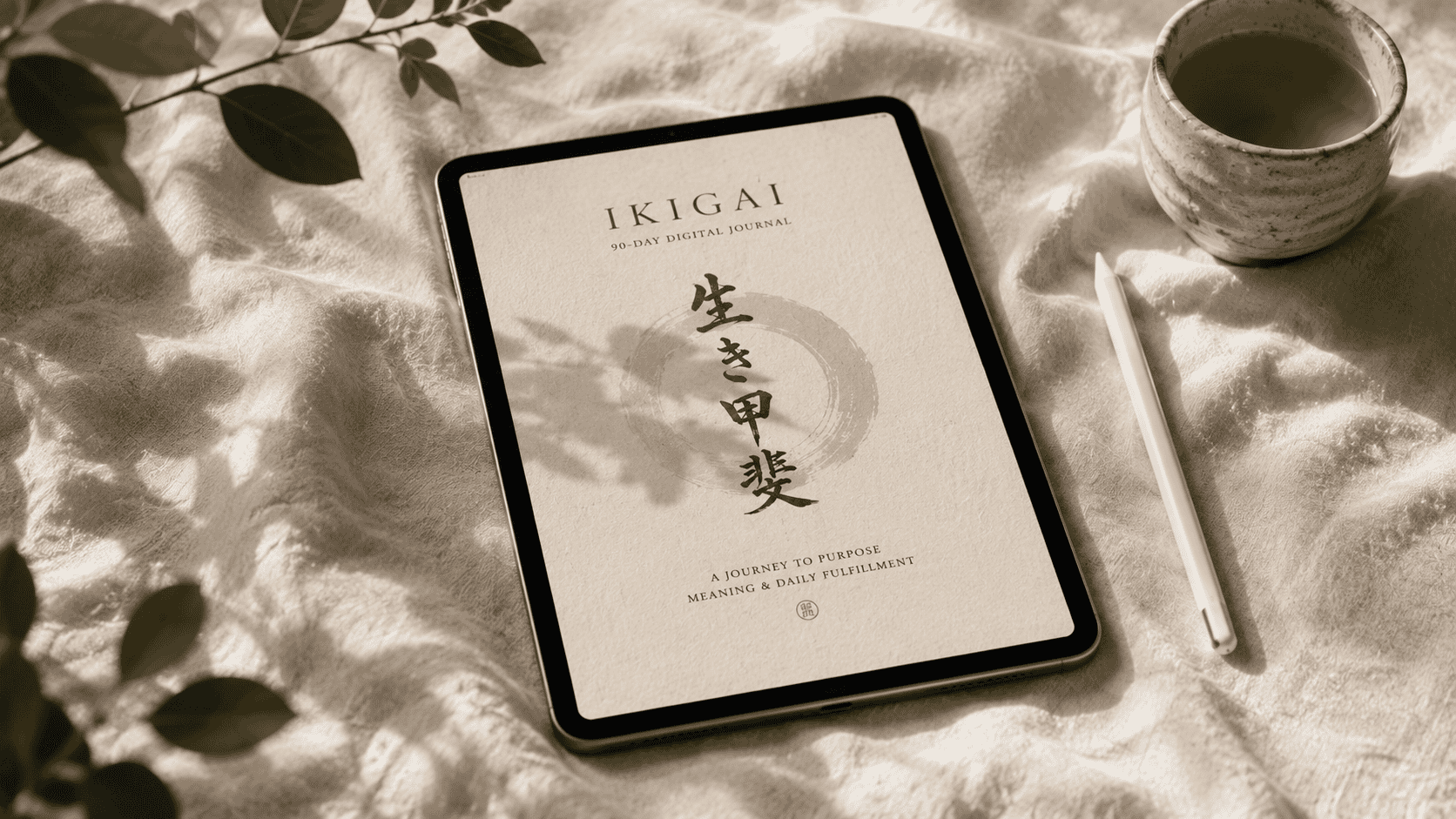
Search for ikigai journal prompts and you will find lists of fifty, a hundred, sometimes more. Most ask the same kind of question: name your passion, find what the world will pay you for, locate your one true purpose. Those prompts come from the four-circle diagram, and the diagram is not what ikigai means.
This piece takes a different path. It treats the ikigai journal as what it actually is — a reflective journaling practice, the kind that quietly repairs a person’s relationship with their own days. A prompt built on the wrong picture produces the wrong reflection; it raises a low anxiety about career and calling instead. So here are seven prompts, grouped by the five pillars that describe the idea, each with an honest account of how it heals.
Good ikigai journal prompts are not career questions. They are small, reflective questions about the day you are already in, grounded in the five pillars rather than the four-circle diagram. Reflection of this kind heals in a specific way — through attention, naming, return, and review. Below are seven prompts to start, each with what it works on beneath the surface.
Why most ikigai prompts miss
The popular prompt lists almost all inherit the same frame. They ask you to find the single pursuit where what you love, what you are skilled at, what the world needs, and what pays all overlap. That is the career-fit diagram a British blogger built in 2014, and it has very little to do with the Japanese word. The full account of that mix-up sits in our piece on why the ikigai Venn diagram is wrong.
The frame matters because it shapes the question, and the question shapes the answer. A Venn-framed prompt asks what your dream job is, so it returns worry about whether you have found it. A pillar-framed prompt asks what was worth noticing today, so it returns attention. One reflection leaves you anxious about a destination. The other returns you to the morning you are already in.
How reflective journaling heals
The healing in a reflective practice is not mystical, and it does not require a therapist’s vocabulary. It runs on four plain mechanisms, and each of the seven prompts below leans on at least one of them.
The first is attention. Distress feeds on vagueness — a day that feels bad in general, for no reason you can point to. Writing forces the general to become specific. The second is naming. A tension located and described is smaller than a tension merely felt; the page holds what the body was holding alone. The third is return. One entry changes nothing, but the same attention paid most mornings slowly retrains what you notice by default. The fourth is review. Reading a month of short entries back shows you the shape of your own life — what actually restores you, what actually drains you — with an honesty no single day can supply.
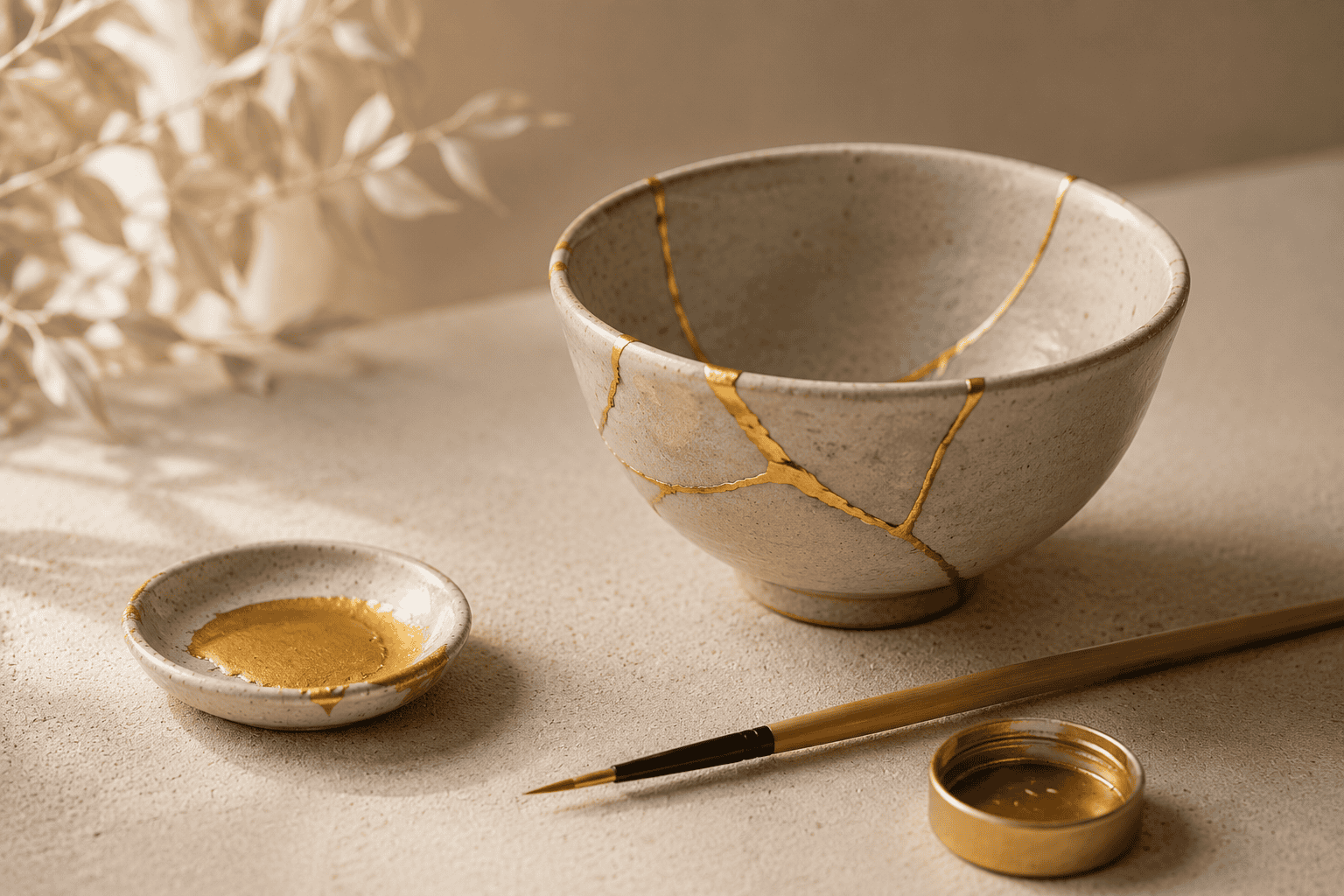
Kintsugi, the craft of repairing a broken bowl with gold, is the usual metaphor here, and for once the metaphor is accurate. The repair does not hide the crack. It makes the crack legible, and the bowl more itself. Reflective journaling does the same with a week: nothing is erased, and nothing needs to be. It is simply seen, named, and joined back into the whole.
Seven ikigai journal prompts, and how each one helps
Take one a day, in any order. Write a few lines, then stop. The aim is noticing, not a finished answer. Under each prompt is what it is working on beneath the surface — the return it offers when you come back to it across a week.
Reclaiming the first hour

Most mornings begin on autopilot — the phone, the inbox, the same route — and the day chooses for you before you are awake to it. Naming the first real decision you made pulls one small moment back under your own hand. Ikigai begins here, in the modest and specific, not in a grand plan.
When you notice that the first thing you did today was reach for a screen rather than a window, you are not judging yourself; you are locating the exact point where the day stopped being yours. That is the point you can change tomorrow. The healing here is agency restored in miniature. Even one deliberate choice, made early — brewing loose tea in a small glass kyusu instead of reaching for the phone — resets the tone of everything after it, and the page is where you catch yourself doing it.
The thing you would do unseen

So much of what we do is bent toward an audience — the version of ourselves we want others to approve. This prompt removes the audience. What is left is the thing you would do for its own sake, and that thing is usually closer to your ikigai than anything on a resume.
The healing here is release: for a moment you are not performing competence or managing an image, and the pressure that comes with both drops away. What surfaces — a language you would learn badly, a craft you would be slow at, a walk with no step count — is not trivial. It is the shape of a want that approval had been sitting on top of.
Who holds your week

Ikigai is rarely a solitary thing; it grows inside the web of people who hold your days up, most of them invisible until you look. This prompt turns the attention outward, to the person who covers the small logistics, listens without being asked, or keeps a routine running that you never think about.
Naming what they carry does two things at once. It heals the low ache of isolation — the reminder that your week is not held up by you alone — and it gently repairs the relationship itself, because gratitude noticed on the page tends to find its way into how you treat the person tomorrow. Harmony, in the Japanese sense, is this: a life that works because it is shared, and a practice that keeps you from forgetting it.
The taste you rushed past
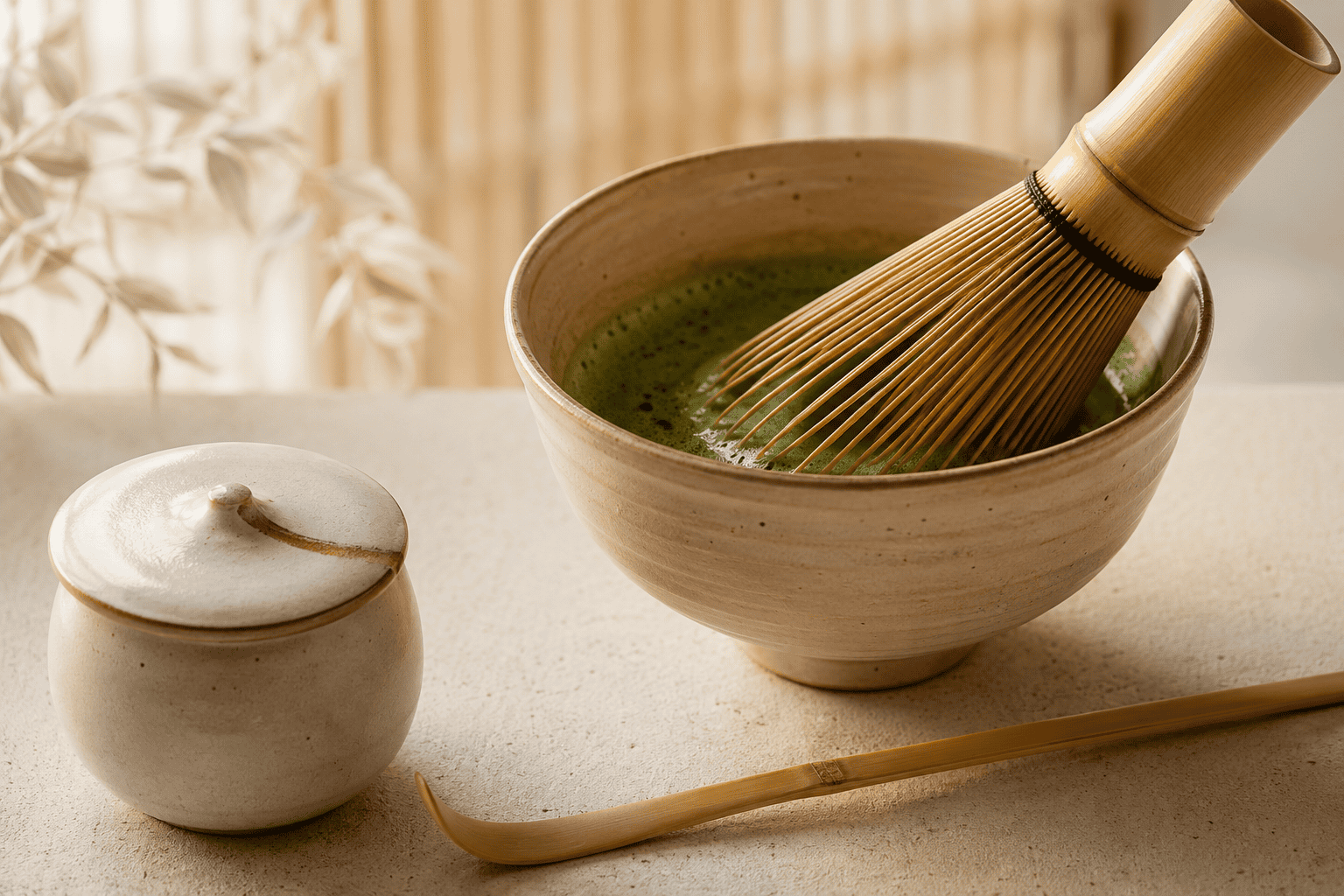
The instruction is strict on purpose. By banning the usual vocabulary — good, fine, healthy — it forces you back into your actual senses, into the warmth of the cup and the give of the bread. This is where the joy of little things lives, and it is almost always the part of the day we swallow without tasting. If mornings need a ceremony to slow them, whisking a bowl of matcha with a simple bowl and whisk set gives the prompt something worth describing.
The prompt heals by slowing a single ordinary moment down until it becomes vivid again. You cannot describe the temperature of your tea without having been present for it, and presence, repeated over small pleasures like this one, is a large part of what ikigai actually is — not a grand purpose, but a day fully inhabited.
Seeing what you have stopped seeing
Attention wears grooves. The plant on the sill, the photograph by the door, the view you once chose deliberately — the mind files them as known and stops looking. This prompt asks you to look again, and the small shock of really seeing something familiar is a return to the present that no distant goal can give you.
The benefit is not sentimental. Re-seeing what you have stopped seeing is attention repaired — a trained skill, and it transfers: a person who can find their own windowsill interesting is a person less at the mercy of the next new thing. Ikigai favours this steadiness. Worth is found in what is already here, rather than in what is always about to arrive.
Where the day is sitting in you
Most self-help asks you to fix the tension; this asks you only to find it and stay. The instruction not to release it is the whole point. When you describe the tightness in your jaw or the held breath in your chest without rushing to make it go away, you stop treating your body as a problem to be solved and start treating it as information to be read.
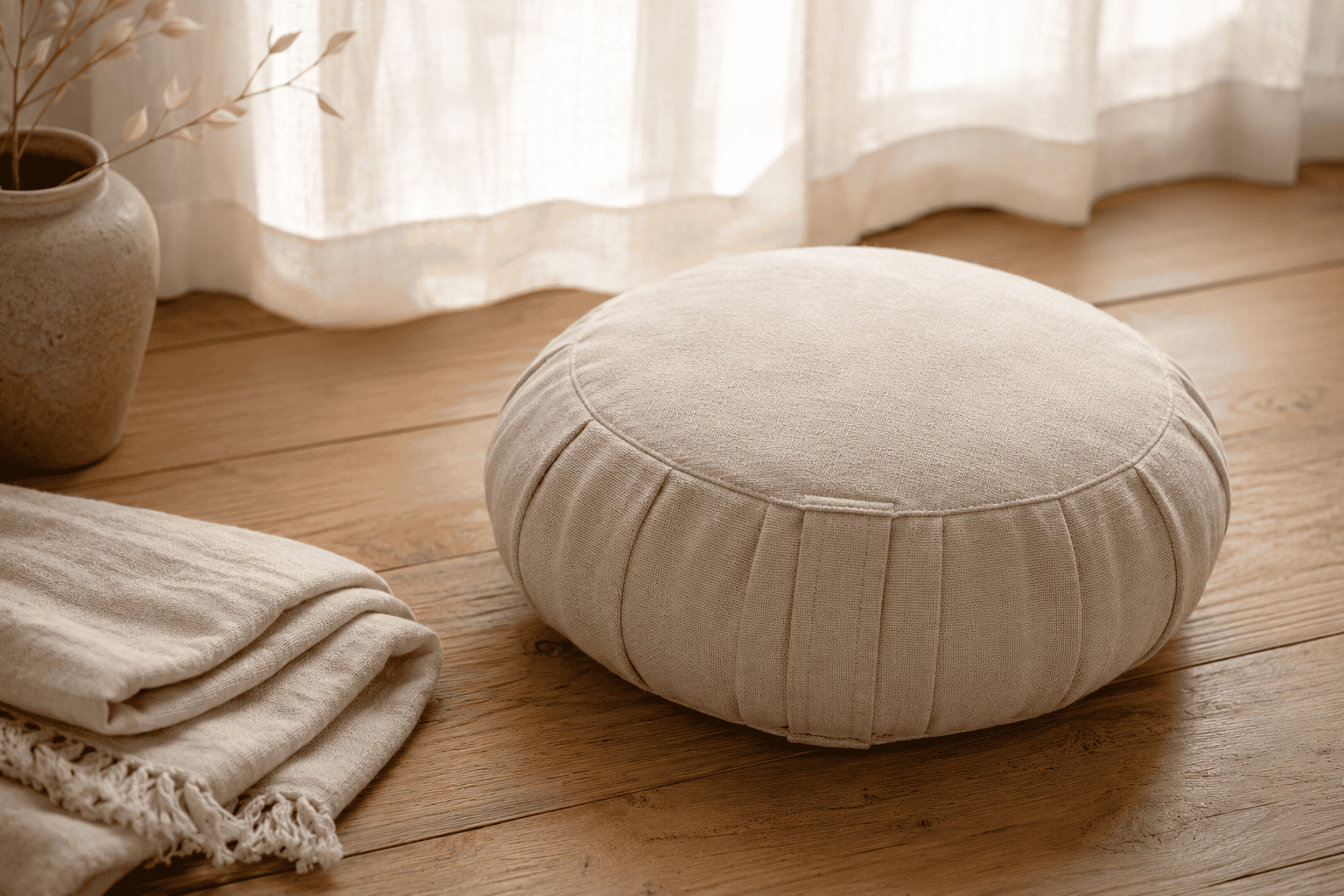
That shift is where a lot of real healing begins. Ikigai is lived in a body, not only thought in a head, and a practice that can sit with discomfort — noticing it, naming it, letting it be — builds the kind of steadiness that makes the harder days feel worth living rather than merely survived. Sitting itself matters here; five minutes on a firm buckwheat zafu cushion before writing puts the spine upright and the attention where the prompt needs it.
The pleasure you will not cut
This is the prompt that turns noticing into a practice. A pleasure you would protect is a pleasure you have decided matters, and deciding is what separates ikigai from a passing mood. The healing is in the protecting: on a full day, the first thing to be cut is usually the small good thing — the morning page, the walk, a single stick of Japanese incense burned while you write.
Cutting it, day after day, is how people slowly lose the thread of their own lives. Naming the pleasure you will not sacrifice draws a line. It is a small vow, and a life is largely built from small vows kept. This is the note the full ninety-day practice is tuned to.
If these ikigai journal prompts suit you, the practice they belong to is small and repeatable — a few lines a day, grounded in the five pillars rather than the four circles. Three of our editions and tools are built around that same daily rhythm, from the sequenced ninety-day journal to a browser tool for practising kanji stroke by stroke.


Why a list is not a practice
Seven prompts will get you started. They will not, on their own, build the thing the prompts are for. A list is unsequenced. You answer one, then another, in no particular order, and the entries do not accumulate into anything you can read back.
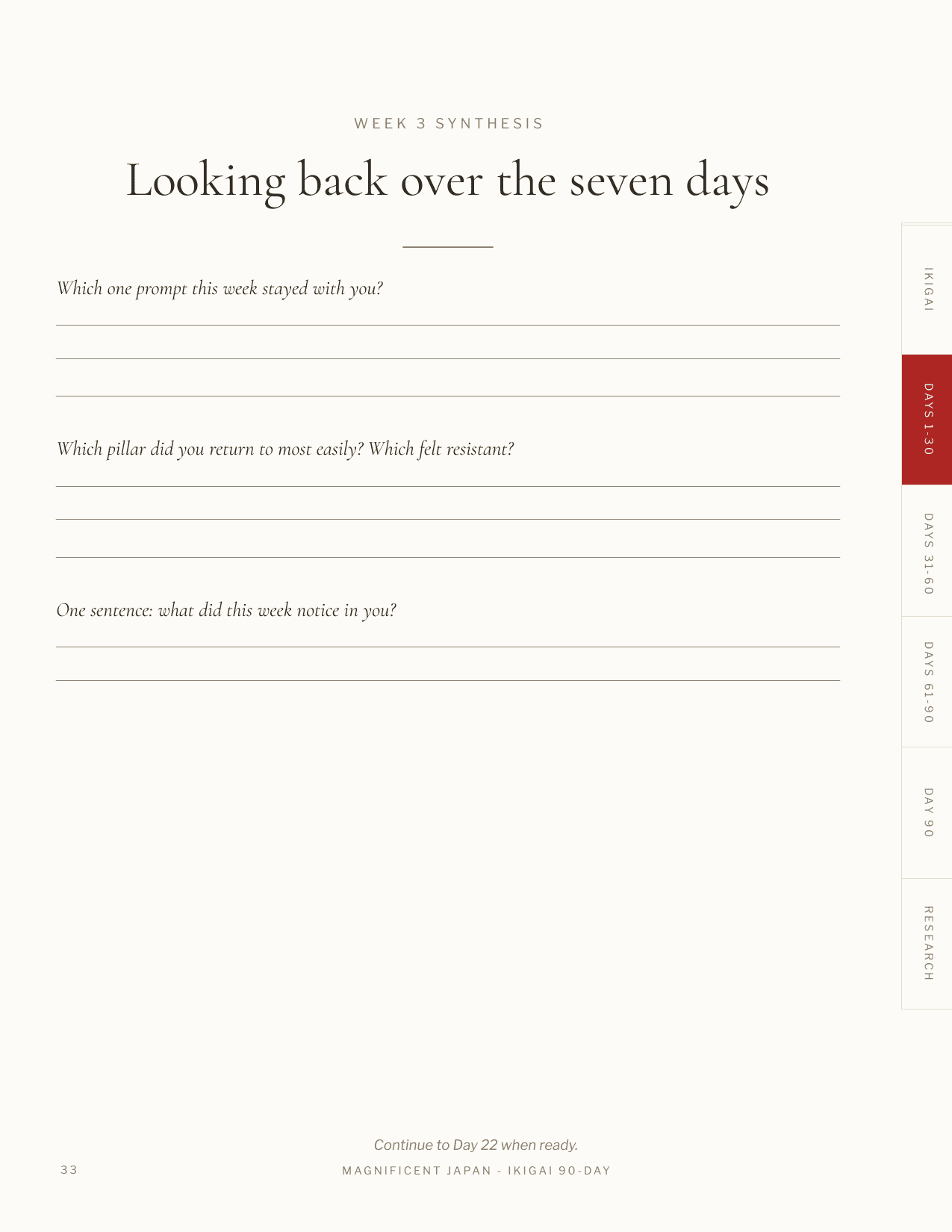
The work is in two habits a loose list cannot supply. The first is return: the same kind of attention, paid most mornings, until it stops feeling like an exercise. A small anchor helps — the same chair, the same hour, the same fountain pen kept beside the journal and used for nothing else. The second is review: looking back across a week or a month, where a single entry says little but a run of them starts to show the shape of what matters to you.
That is the difference between prompts and a practice. A sequence decides what to ask, and when, so the questions deepen as the weeks go on rather than circling the same ground. It is the reason a structured ninety days does something a page of prompts cannot, and it is what the journal below was built to hold.
Questions Worth Asking
Start small and concrete. Pick one prompt from a single pillar, write a few lines, and stop. The aim on day one is not insight but the habit of noticing. Keep the entries short enough that you will return tomorrow, and let the pattern build over weeks rather than forcing an answer in one sitting.
Daily, but briefly. Ikigai is noticed in repetition, so a few minutes most mornings does more than a long weekly session. The value comes from cadence and from reviewing across time. A single entry says little, while a month of short entries begins to show what actually holds your attention.
Prompts grounded in the five pillars, room for a few lines a day, and a way to look back. A useful journal sequences the questions so they deepen over time, and it builds in periodic review across weeks and months. The point is a record you can read back, not a single page of disconnected questions.
They overlap but differ. Gratitude prompts ask what you are thankful for. Ikigai prompts ask what made the day feel worth living, which can include effort, difficulty, and even loss. Gratitude looks for the pleasant. Ikigai looks for the meaningful, whether or not it was pleasant.
One is enough. The practice rewards a few lines on a single prompt, most days, over a long entry that empties the list in one sitting. Answering several at once turns noticing into a task, which is the opposite of what the prompts are for. Take one, write briefly, and leave the rest for other mornings.
From a list to a practice
Use the seven prompts above and you have a start: a frame that matches the word, and a set of questions that point at the day rather than the dream job. What they cannot give you, on their own, is sequence — the part that turns a habit into something you can read back.
Two ways to take it further follow below. The sampler is the easiest way in, and the journal is the sequenced version of the same practice.
Seven mornings of guided ikigai practice, drawn from the five pillars — one short prompt a day, by email. A real taste of the sequenced version. No newsletter follow-ups unless you opt in.
Seven emails, one a day. Unsubscribe anytime.
For those who would rather hold the practice in their hands, the journal sequences ninety days of prompts, weekly and monthly reviews, and a beginning-and-end self-reading — built on the five pillars rather than the circles.
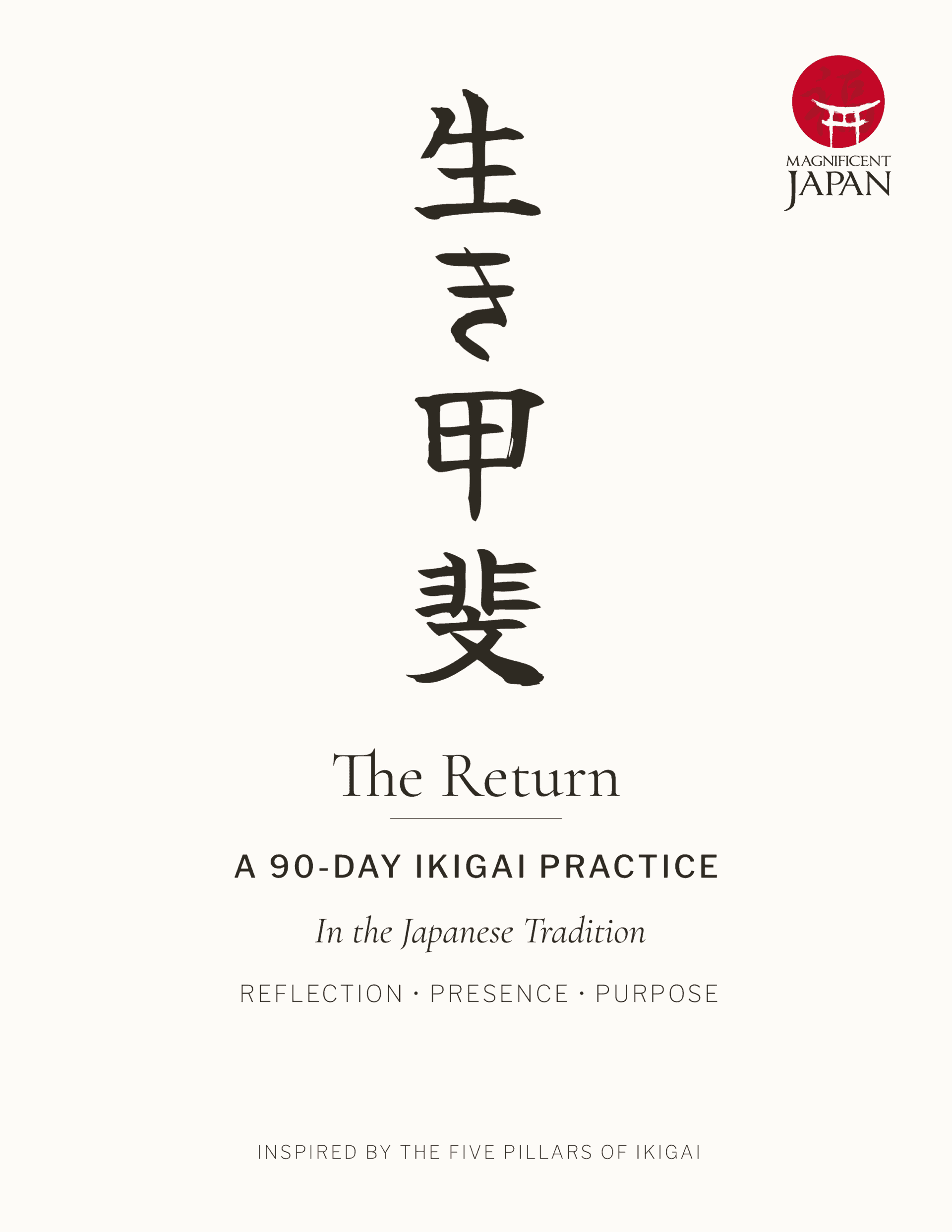
Ninety days of guided prompts, sequenced so the questions deepen week by week — the part a prompt list cannot supply. Designed for slow mornings, built to be returned to.
View This JournalWhether you begin with the sampler, the seven prompts above, or the full ninety-day journal, the ikigai journaling practice works the same way: small, specific questions returned to often, grounded in the five pillars rather than the four-circle diagram. The reading below carries that same idea further, into what ikigai means and where the popular framing goes wrong.
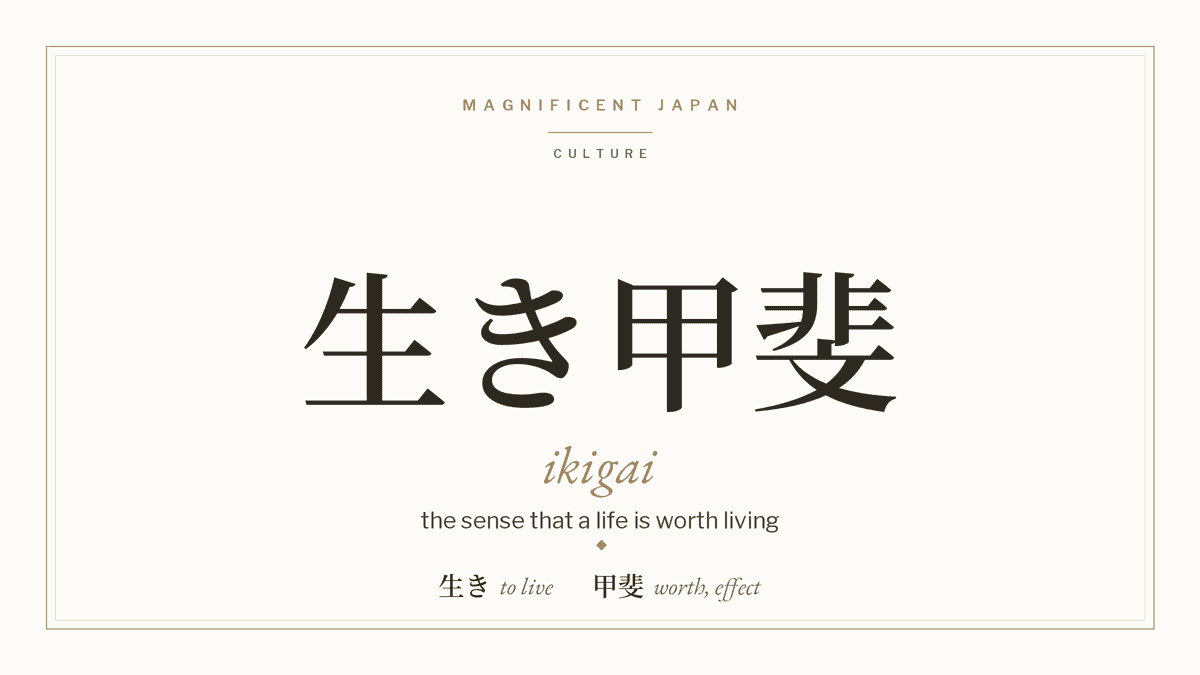 What is ikigai, reallyThe full definition, the five pillars, and why the four-circle diagram is not what the word means.
  Why the ikigai Venn diagram is wrongWhere the four-circle chart came from, and why it frames these prompts the wrong way.
  The Magnificent Japan journalsGuided ninety-day journals that carry the same slow-attention practice across other Japanese ideas.
  The calligraphy practice toolTrace kana and kanji stroke by stroke — the same attentive habit, in a browser practice tool.