A Considered Guide
Japanese Green Tea: A Considered Guide to Matcha, Sencha, Gyokuro, Hojicha & Genmaicha

The five major Japanese green teas — matcha, sencha, gyokuro, hojicha, genmaicha — share a single plant and a single country. They share almost nothing else. This is what each one is, how to brew it properly, and where in Japan it comes from.
Most green tea written in English collapses into one flavour: green, grassy, healthy. Japan does not see it that way. There are five teas worth learning first, each grown differently, processed differently, brewed differently, and reached for at a different hour. Sencha is the everyday cup. Gyokuro is the connoisseur’s pour. Matcha is the ceremony. Hojicha is the evening. Genmaicha is the meal. They are not interchangeable. Train your palate on the difference between sencha at seventy degrees for sixty seconds and gyokuro at fifty-five degrees for two minutes. Once you can taste it, the entire category opens.
This guide covers each of the five varieties. What it is. What it tastes like. How to make it. Where in Japan it grows. For cultural depth, see the considered guide to the Japanese tea ceremony. For practice, see the practical guide to making matcha at home.
Jump to a Variety
- Matcha — the powdered ceremonial tea
- Sencha — the everyday Japanese cup
- Gyokuro — the connoisseur’s premium pour
- Hojicha — the roasted evening tea
- Genmaicha — the food-friendly daily blend
- Brewing parameters by variety
- The six tea regions of Japan
- Where to drink tea in Japan
Matcha — the powdered ceremonial tea
Matcha is the only Japanese tea in which the entire leaf is consumed. The plant is shaded for twenty to thirty days before harvest, which suppresses catechin production and concentrates chlorophyll and L-theanine. The shaded leaves are called tencha at this stage. Tencha is steamed, dried, and de-veined, then stone-ground into a powder so fine it suspends in water rather than dissolving. A small amount whisked into water is denser in caffeine, antioxidants, and amino acids than any cup of leaf tea. Nothing is left behind in the spent leaf.
The flavour is creamy, vegetal, and umami-forward, with a sweetness on the finish that lifts as the grade rises. Ceremonial-grade matcha is what the Japanese tea ceremony uses. It is sweet enough to drink straight, with a soft bitterness that balances the umami. Culinary-grade matcha is bolder and more bitter, designed for lattes, baking, and ice cream where milk and sugar will balance it. The two are not interchangeable: ceremonial matcha for whisked drinking, culinary for cooking.
Matcha’s ritual home is the Japanese tea ceremony, but a daily bowl at home is simpler than the ceremony suggests. The practical guide to making matcha at home walks through the equipment and the eight-step preparation. After a year of practice the natural upgrade is a hand-thrown chawan from a named Japanese kiln. The Floral Moonlight Matcha Bowl from JOC Goods is one example. It is made in Kyoto in the Kiyomizu ware tradition, with a fine crackled glaze.
Sencha — the everyday Japanese cup
Sencha is what Japan actually drinks. It accounts for roughly seventy to eighty percent of all green tea produced in the country. Sencha is the cup served alongside meals in homes, ryokan, and most restaurants. The plant is grown in full sunlight, which raises catechin levels and produces the brisk, slightly astringent finish that defines the tea. After harvest, the leaves are steamed within hours to halt oxidation. They are then rolled into the long needle shape that lets them open evenly during brewing.
Well-made sencha tastes like a balancing act: grassy, sweet, savoury, and faintly marine, with a clean bitterness on the finish. The flavour shifts dramatically with brewing temperature. At sixty degrees the umami and sweetness lead. At eighty degrees the catechins assert themselves and the cup turns brisk. Most beginners brew sencha too hot. Cooler water and a shorter steep almost always improve the result.
The ideal vessel is a kyusu — a small Japanese teapot with a side handle and a built-in mesh strainer. The side handle keeps the wrist relaxed during the slow, even pour that distributes the tea uniformly across cups. A solid everyday sencha to start with is an organic Yabukita-Saemidori blend from Uji. The cup is balanced and deep-steamed, and rewards a sixty-second brew at seventy degrees.
Gyokuro — the connoisseur’s premium pour
Gyokuro is widely considered the highest grade of Japanese green tea. Like matcha, the plant is shaded before harvest. The shading lasts roughly twenty days, on overhead frames called tana. But the leaves are steeped, not ground. The shading concentrates L-theanine and slows catechin production, which means the cup reads as deeply sweet and umami-forward rather than astringent. The name translates as “jade dew”, which is what the brewed liquor looks like: a viscous, almost broth-like infusion the colour of pale jade.
Gyokuro is brewed unlike any other tea on this list. Use water that is cool — fifty to sixty degrees, almost lukewarm. Steep long: ninety seconds to two minutes. A traditional vessel is the houhin, a handle-less low-spout teapot designed for cool-water brewing, but a small kyusu works fine. The first cup arrives intensely concentrated, with the characteristic dashi-like umami. Re-steeped slightly hotter, the second cup opens up sweetness. By the third infusion, the cup edges into grassy territory. A good gyokuro rewards three or four infusions.
This is not a beginner tea. The brewing parameters are unforgiving. Water that is too hot will turn the cup bitter and waste the leaf. The flavour profile takes time to appreciate. A sensible entry point is a premium Kyoto gyokuro from a single-cultivar Asatsuyu shading. It is sweeter and more accessible than the more austere classical styles. Use it at the end of a long week. It is a slow tea, deliberately.
Hojicha — the roasted evening tea
Hojicha is what happens when sencha or bancha is roasted at high temperature — typically over charcoal or in a pan at around 200°C. The roast converts catechins, volatilises caffeine, and turns the leaf the warm reddish-brown that gives the tea its signature look. The cup tastes of caramel, toasted nuts, and faint smoke. There is almost none of the green-tea grassiness or astringency that unfamiliar drinkers tend to find difficult.
Two practical advantages make hojicha the best entry point for readers new to Japanese tea. First, it is almost impossible to brew badly. Hot water and a short steep work, and even an over-extracted cup is forgiving. Second, the high-temperature roasting reduces caffeine to roughly one-tenth that of matcha. That makes hojicha the natural choice for evening drinking, after-meal sipping, or anyone who finds green tea too stimulating in the afternoon. It is the tea Japanese parents give their children and elderly relatives.
A JAS-organic hojicha from Uji is a strong everyday choice. The blend uses sencha, bancha, and kukicha. The roasting brings out toasted depth without losing the underlying tea quality. Brew at near-boiling water for thirty to sixty seconds. The same leaves give two or three good infusions.
Genmaicha — the food-friendly daily blend
Genmaicha is sencha or bancha blended with roasted brown rice, sometimes with a small addition of matcha for colour and depth. Originally the rice was added to stretch the leaf supply for ordinary households. At one time the blend was called “the people’s tea”. Today it is enjoyed for its own merits: a nutty, toasted, almost popcorn-like flavour that sits naturally alongside savoury food.
Brown rice dilutes the leaf content. Genmaicha therefore runs lower in caffeine than straight sencha and lands closer to hojicha on the caffeine ladder. Round and slightly sweet, the cup carries a roasted finish that pairs beautifully with rice dishes, light grilled fish, or onigiri. It is the tea most Japanese restaurants serve free with the meal because it neither overpowers nor disappears against food.
An organic genmaicha from a 100-year-old Japanese tea house brews at around 175°F for sixty seconds and gives two reliable infusions. Use slightly more leaf than for plain sencha — the rice takes up volume without contributing flavour density. Keep it within reach of the kitchen. It is the most useful daily tea on this list.
Brewing each variety properly
Temperature is the single biggest lever you control in Japanese tea. Cooler water preferentially extracts L-theanine and sugars, which is why gyokuro reads sweet at fifty degrees. Hot water pulls catechins hard, which gives sencha its brisk snap at seventy and turns hojicha rich and aromatic at near-boil. The table below gives the parameters that work for the everyday-grade leaf you can buy in the United States. Start here, then adjust to your palate.
| Tea | Temperature | Time | Leaf : Water | Re-steeps |
|---|---|---|---|---|
| Matcha | 175°F (80°C) | Whisk 20–30 sec | 2 g per 70 ml | Single bowl |
| Sencha | 160–175°F (70–80°C) | 60 sec | 3 g per 100 ml | 2–3 infusions |
| Gyokuro | 120–140°F (50–60°C) | 90–120 sec | 5 g per 60 ml | 3–4 infusions |
| Hojicha | 185–200°F (85–93°C) | 30–60 sec | 3 g per 200 ml | 2–3 infusions |
| Genmaicha | 175°F (80°C) | 60 sec | 4 g per 200 ml | 2 infusions |
A variable-temperature electric kettle pays for itself in a fortnight. Without one, the workaround is straightforward. Boil water, then pour it from kettle to empty cup once or twice before pouring it onto the leaves. Each transfer drops the temperature by roughly ten degrees Fahrenheit. Two transfers takes boiling water down to a usable sencha temperature; three takes it close to gyokuro range.
If you only buy one tea
- Sencha — if you want one tea for daily, all-day drinking
- Hojicha — if you want low caffeine or evening sipping
- Genmaicha — if you drink tea with food and want something that pairs
- Matcha — if you want a single morning ritual with sustained, calm focus
- Gyokuro — if you have a year of Japanese tea practice behind you and want the connoisseur’s pour
The six tea regions of Japan
Japanese green tea is grown across the southern two-thirds of the archipelago, but six regions account for almost all the meaningful production. Each has a climate, a leaf style, and a specialty.
Shizuoka
Shizuoka, on the southern Pacific coast of Honshu, produces roughly forty percent of all Japanese tea — by far the largest single region. Most of what it makes is sencha, including the deep-steamed fukamushi style developed locally. Tea fields run from the coast up the slopes of the inland mountains, where day-night temperature differences and morning mist concentrate flavour. Kawane and Honyama are the named premium districts within the prefecture. If you have ever drunk sencha in Japan, it almost certainly came from Shizuoka.
Uji (Kyoto)
Uji, just south of Kyoto, is the historic and spiritual centre of Japanese tea. Tea cultivation here dates to the thirteenth century. Matcha used in the formal tea ceremony has been associated with Uji for nearly that long. The region produces the highest-grade matcha and gyokuro in Japan, alongside top-quality sencha. The volume is small relative to Shizuoka, but the prestige and price reflect the centuries of refinement.
Kagoshima
Kagoshima, at the southern tip of Kyushu, is Japan’s second-largest tea region and the most diverse. The warm, humid southern climate allows five harvests a year, from early April through mid-October. The region produces the broadest variety of styles — sencha, gyokuro, kabusecha, and the regional kamairicha (pan-fired green). Kagoshima is also the heart of Japan’s organic tea production. Many of the everyday-quality teas reaching the United States come from here.
Yame (Fukuoka)
Yame, in Fukuoka Prefecture on northern Kyushu, is the country’s premium gyokuro region. Roughly forty percent of Japan’s gyokuro comes from Yame. The very highest grades — hand-picked, traditionally shaded with natural straw rather than plastic sheeting — are almost exclusively from here. Yame also produces a notable hojicha. Buying gyokuro at the connoisseur tier almost always means buying Yame leaf.
Sayama
Sayama, in Saitama Prefecture north of Tokyo, is the northernmost major tea region in Japan. The cooler climate produces fewer harvests per year but a leaf with a thicker, fuller body. Sayama tea is known for its distinctive “Sayama firing” — a final firing step that gives the cup a deep, slightly roasted character. The volume is small, but Sayama’s regional character is unmistakable.
Miyazaki
Miyazaki, on the eastern coast of Kyushu, is best known for kamairicha — pan-fired green tea. The processing follows the older Chinese style rather than the steaming used elsewhere in Japan. The result is a tea with a distinctive curled leaf shape and a less vegetal, more roasted character. Miyazaki also produces tamaryokucha, a related curled-leaf style. Both are speciality teas, made in small volumes.
Ten Japanese Proverbs on the Considered Life
A small, beautifully set printable. Ten proverbs the considered tea drinker carries through the year. Free for the journal collection’s readers.
One email. Unsubscribe in one click. No spam, ever.Where to drink tea in Japan
The named tea houses below are the historical and contemporary anchors of Japanese tea culture. They are the places to taste the differences described above, on the leaf’s home ground, brewed by people who do nothing else.
Ippodo Tea Co. — Founded in Kyoto in 1717 and operated by the same family ever since. The mother shop on Teramachi serves as a quiet shrine to high-grade matcha, gyokuro, and sencha. A small adjoining tearoom lets you order a bowl whisked at the counter while your purchases are wrapped. There are now small Ippodo branches in Tokyo (Marunouchi) and overseas, but the Teramachi shop remains the one to visit.
Tsujiri — A long-established Uji tea house with shops across Japan and a small international footprint. The Uji flagship is a working production base as well as a tearoom. Both the matcha desserts and the matcha lattes are correctly proportioned, in a way most international imitators have not figured out. A reliable everyday pause if you find yourself in Uji or near a station with a Tsujiri counter.
Aoyama Flower Market Tea House — A small Tokyo café in the Minami-Aoyama flower district that serves Japanese teas alongside floral-themed light meals. Not a traditional tea specialist, but the tea selection is taken seriously. The room itself, built around the flower market it shares space with, is one of the more atmospheric tea spaces in central Tokyo.
Nakamura Tokichi Honten — A historic tea house in Uji on Byodoin Omotesando, the road that leads from the river up to the Byodo-in temple. Roasting and selling tea since 1854, the shop pairs a working production line with a quiet tearoom. Matcha desserts and a respectable matcha-tasting flight anchor the menu. The tea itself is some of the most accessible high-grade matcha you can buy in person on a single afternoon.
Marumo Takagi — A small, quiet tea shop in central Kyoto known for its high-quality sencha and matcha, and for the tranquillity of its interior. Less famous than Ippodo and less commercial than Tsujiri, it is the kind of place tea drinkers in Kyoto recommend to one another quietly. Worth a stop if you have already visited the bigger names.
For wider context on Kyoto, including the temples and gardens that still serve formal matcha to visitors, see the Kyoto guide.
Buying Japanese green tea in the United States
The single most important variable in Japanese green tea is freshness. Sencha and gyokuro are at their best within six months of harvest and noticeably degrade after twelve. Look for sources that show the harvest date or the packaging date on the label. Prioritise tea that is nitrogen-flushed in its packaging to displace oxygen. Choose suppliers that move stock fast. Anything bought from a grocery shelf with a six-to-twelve-month best-by date is almost certainly past its peak.
The single biggest equipment upgrade is the kyusu — a small Japanese teapot with a side handle and built-in strainer. Using one improves the tea you already own more than any other change. After the kyusu, the second most useful purchase is a variable-temperature kettle. Beyond those two the upgrades are incremental. Whisking matcha calls for a proper bamboo chasen. Committing to gyokuro calls for a houhin. Measuring leaf properly calls for a small kitchen scale.
Recommended
From the Journal Collection
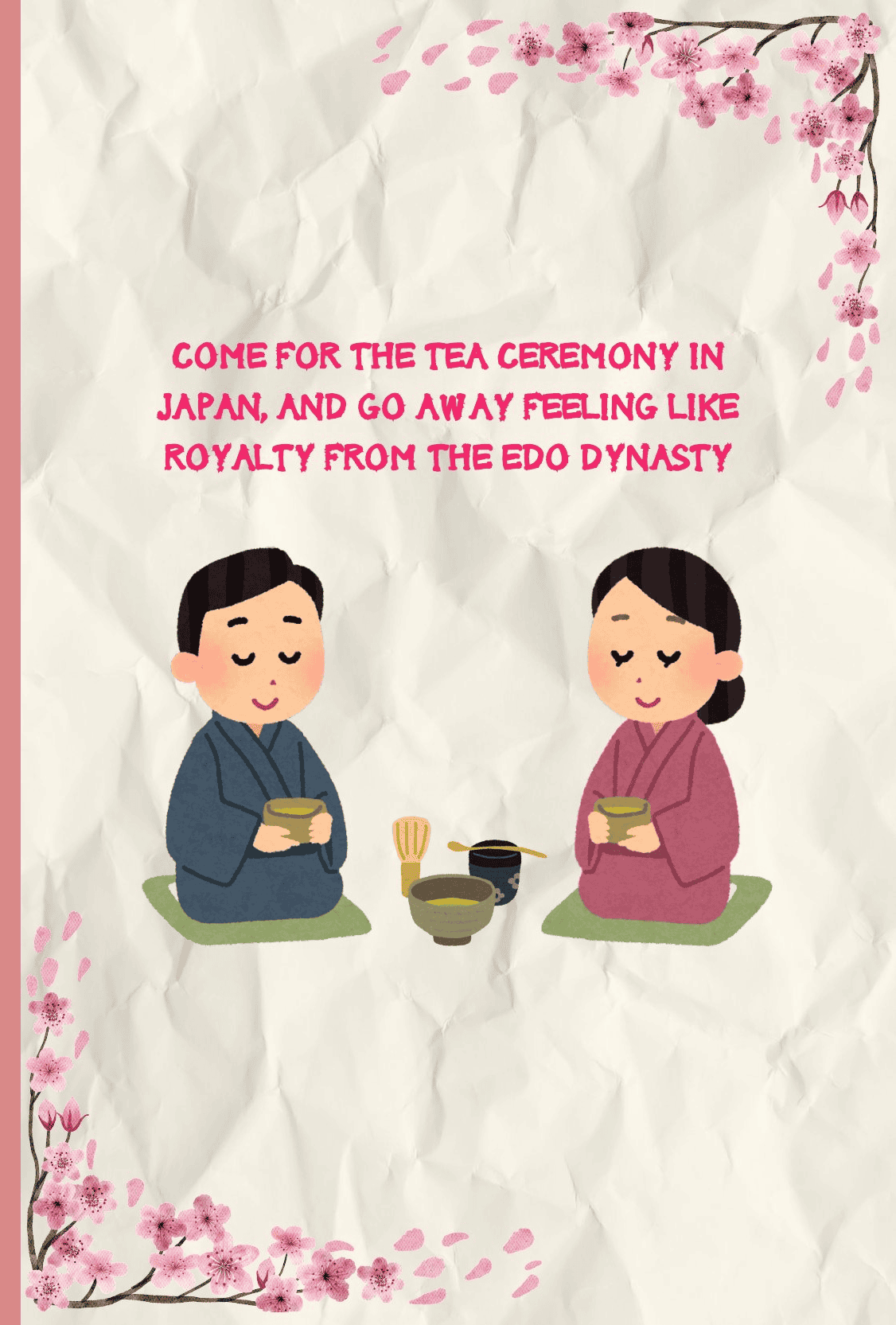
The Tea Ceremony
Come for the tea ceremony, and leave feeling like royalty from the Edo dynasty.
6×9 in · 120 blank pages · Matte softcover
View the JournalFrequently asked questions
What is the most popular Japanese green tea?
Sencha. It accounts for roughly seventy to eighty percent of all green tea produced in Japan and is what most Japanese households drink daily, often served alongside meals.
What is the difference between matcha and sencha?
Matcha is shade-grown for twenty to thirty days before harvest, then stone-ground into a fine powder that is whisked with water. Sencha is sun-grown, steamed and rolled into needles, then steeped in a teapot. Matcha is creamy, rich, and umami-forward. Sencha is grassy, balanced, and refreshing.
Which Japanese green tea has the most caffeine?
Matcha, by a wide margin per cup, because the entire powdered leaf is consumed rather than steeped. Gyokuro is second, then sencha. Hojicha and genmaicha contain the least caffeine — hojicha because the high-temperature roasting reduces it, genmaicha because the brown rice dilutes the leaf content.
What is the highest grade of Japanese green tea?
Gyokuro is widely considered the highest grade. The leaves are shaded for twenty to thirty days before harvest, increasing chlorophyll and amino acid production, then carefully hand-picked from the first flush. The result is a tea with deep umami sweetness, low astringency, and a brewing protocol that rewards cooler water and longer steeping.
What is the best Japanese green tea for beginners?
Sencha for everyday drinking — balanced, easy to brew, and forgiving of small temperature variations. Hojicha for evening or low-caffeine drinking — its high-roast preparation makes it almost impossible to brew badly. Both reward a small upgrade in leaf quality without requiring a precision kettle or specialised teapot.
Plan a Japan trip built around tea
A custom itinerary for the considered traveller — Uji, Kyoto, the tea houses worth visiting, and the rest of Japan beyond them.
Request a quote