The kanji workbook for the patient hand.
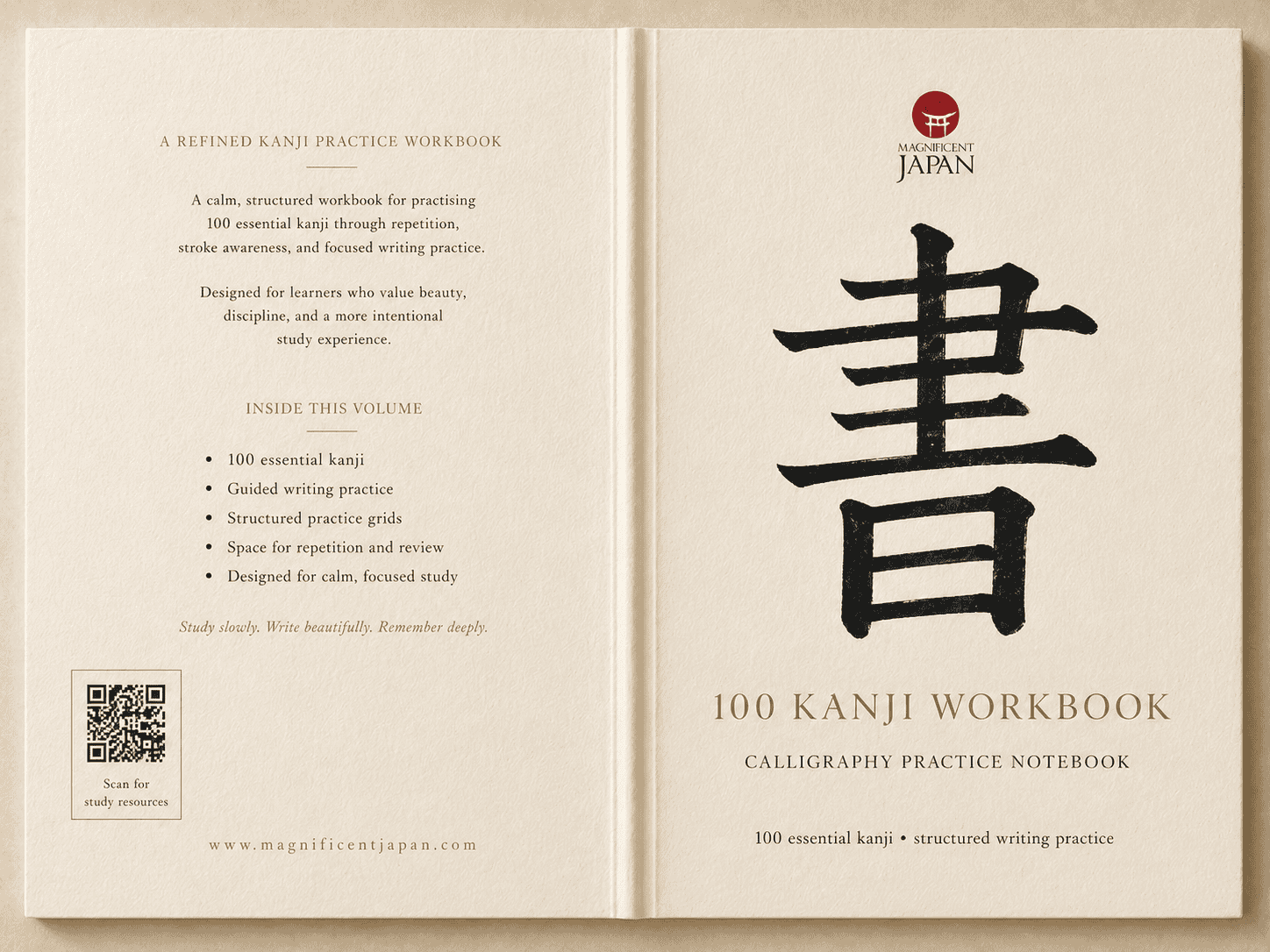
The Magnificent Japan kanji workbook teaches one hundred essential JLPT N5 and N4 kanji by hand. Each character builds one stroke at a time, paired with real vocabulary and its readings. The digital and 6×9 print editions are available now.
Volume 1 · Digital $9.99 · 6×9 paperback in print now
JLPT N5 and N4
JLPT N4
Completion + N3
Beginner
Capstone
First, the practice space — then the kanji workbook deepens it.
The Magnificent Japan practice page is already online. It carries one hundred essential JLPT N5 and N4 kanji. Animated demonstrations teach the stroke order, while a brush simulation gives the feel of shodō without the ink. The page and the workbook work together, not against each other. On screen, you build recognition. With pen on paper, you build muscle memory.
Practice on screen until the strokes feel natural, then move to paper. Twenty minutes online and twenty minutes with the workbook beats an hour of either alone. The screen trains your eye; the paper trains your hand.
One hundred kanji. One thousand nine hundred practice boxes. One workbook.
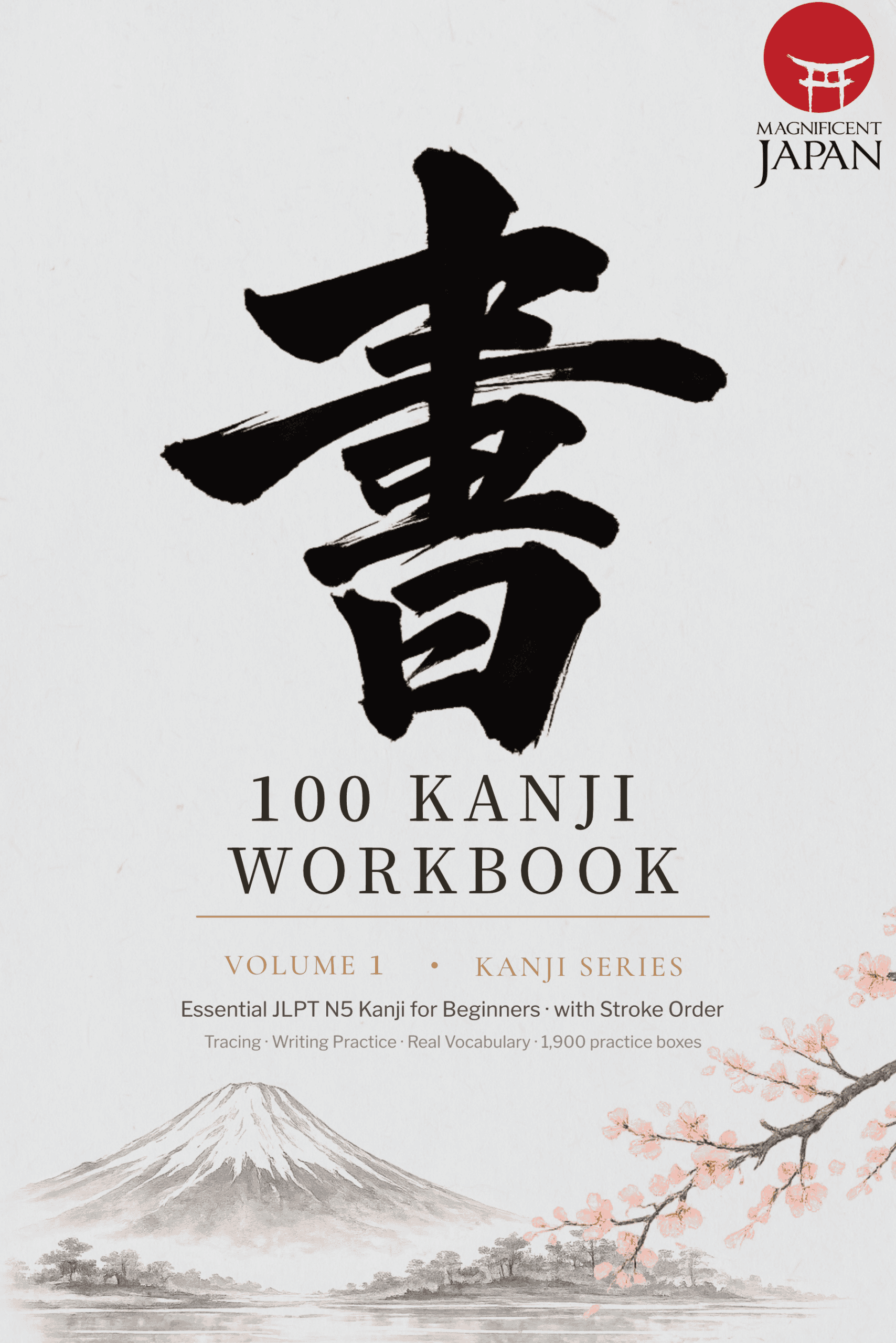
Volume 1 draws its one hundred characters from the full JLPT N5 set and on into JLPT N4. They appear by frequency of use, not by mnemonic sequence. Every character builds across a multi-row grid with progressive stroke teaching. Each one pairs with two vocabulary compounds, each carrying on’yomi and kun’yomi readings plus an English meaning. The 6×9 edition gives nineteen practice boxes per character. The digital and 6×9 print editions are both available now.
Coverage drawn from the JLPT N5 and N4 standards.
Inside the kanji workbook, page by page.
Every spread in the workbook follows the same steady rhythm. The character sits large at the top of the page. Beneath it, the progressive build shows each stroke arriving in order. Then the grid opens — box after box of guided practice, fading from traced to freehand as your hand learns the shape.
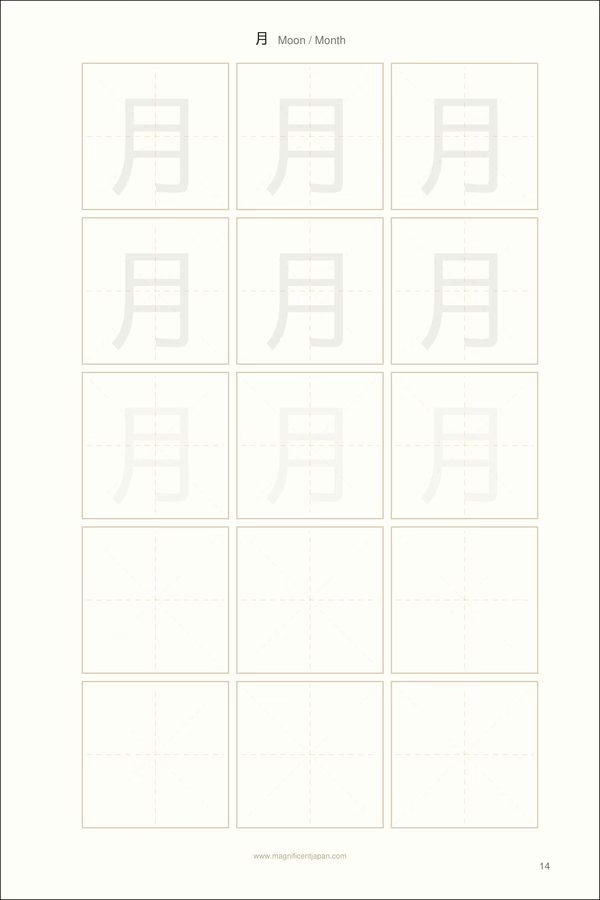
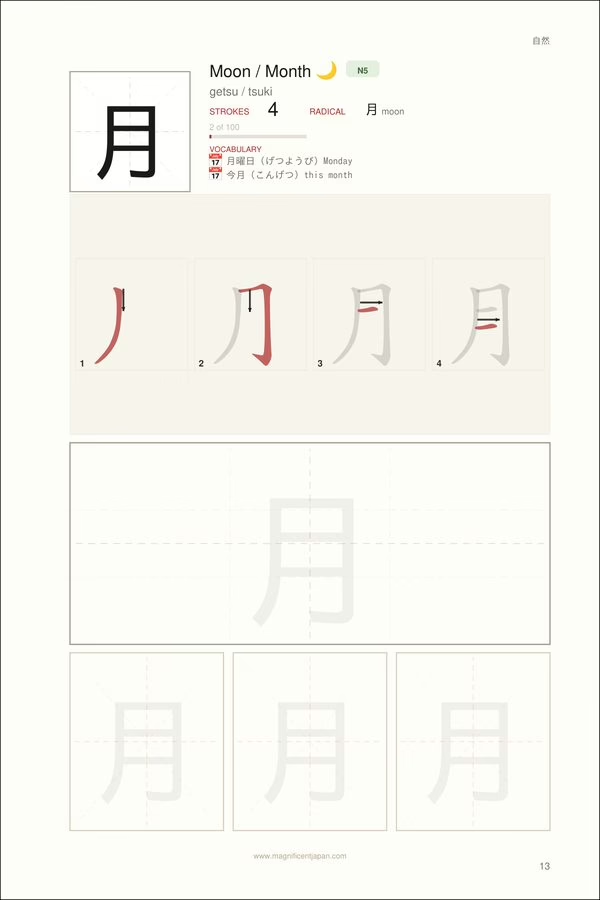
What is progressive stroke kanji teaching?
Progressive stroke teaching shows a kanji as it builds. First, stroke one appears in colour. Then stroke two joins it, with stroke one still grey behind it. Each later stroke adds on, the earlier strokes staying grey. Finally, the last stroke completes the character. In effect, the kanji emerges through the practice — the way a teacher draws it on the board.
Every Magnificent Japan kanji workbook uses this method. Few paper workbooks teach the character this way. The grey-to-colour build mirrors how a calligraphy teacher actually works at the desk.
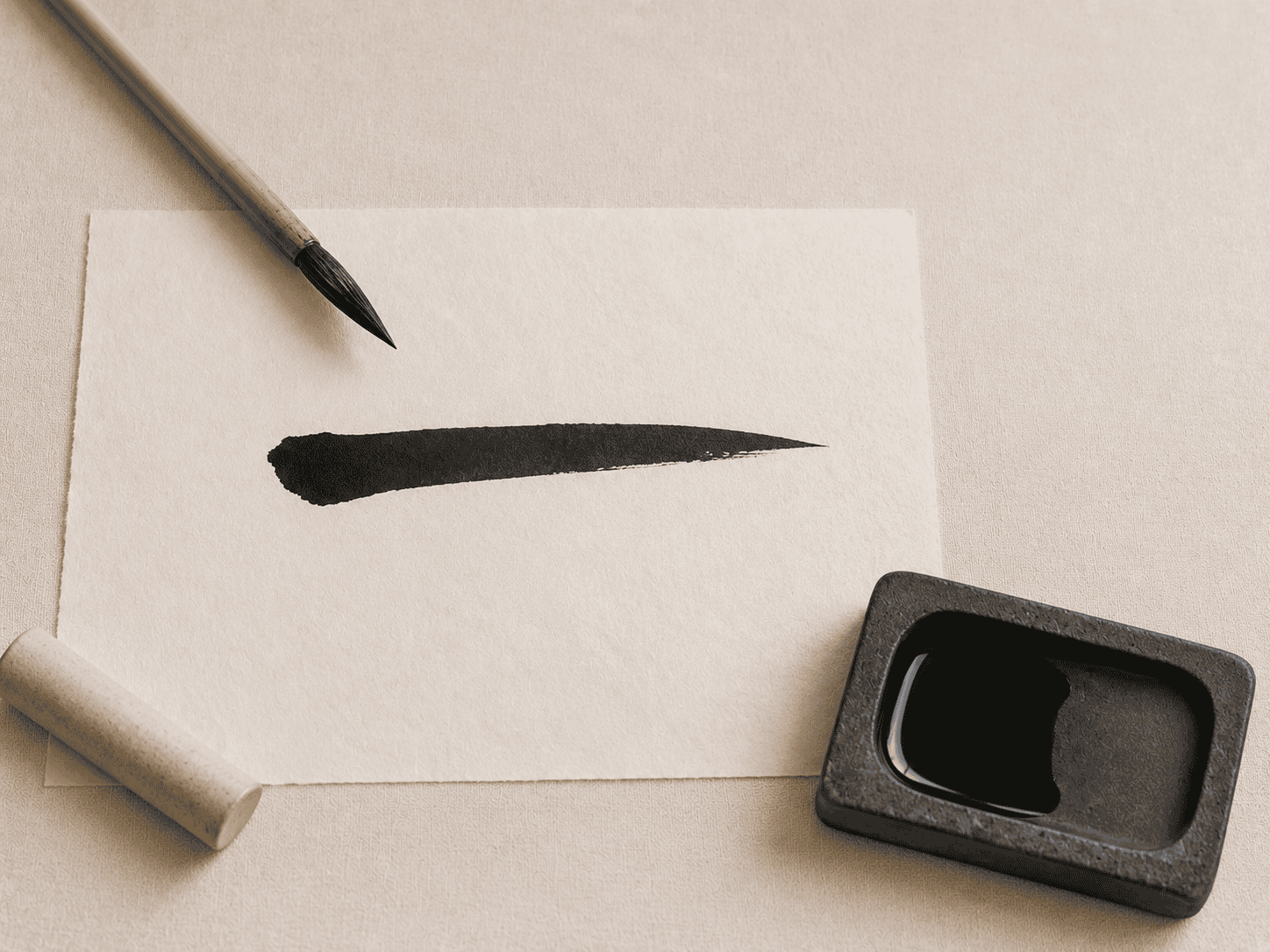
三 (san) — three — built top to bottom in three strokes. The brush begins, as the workbook does, with 一.
The first twelve kanji in the workbook.
Volume 1 opens where Japanese itself opens — with the elements. Sun, moon, fire, water. These are the characters a learner meets in the first week of any JLPT N5 course, and the ones that appear most often on street signs, menus, and calendars in Japan. Here is the opening dozen, in the order the kanji workbook teaches them.
| Order | Kanji | Meaning |
|---|---|---|
| 1 | 日 | sun, day |
| 2 | 月 | moon, month |
| 3 | 火 | fire |
| 4 | 水 | water |
| 5 | 木 | tree, wood |
| 6 | 金 | gold, money |
| 7 | 土 | earth, soil |
| 8 | 山 | mountain |
| 9 | 川 | river |
| 10 | 田 | rice field |
| 11 | 空 | sky, empty |
| 12 | 海 | sea |
The full hundred, with readings and stroke counts, live on the JLPT N5 kanji list — or study one a day with the daily flashcards.
Study the kanji workbook on your iPad.
The digital edition is a write-on PDF, built for tablet study. Import it once, then write every one of the 1,900 practice boxes with an Apple Pencil or stylus. Made a mess of a character? Erase and try again — something paper never forgives. The file works in any PDF annotation app that accepts stylus input.
More on tablet study lives at the digital kanji workbook guide.

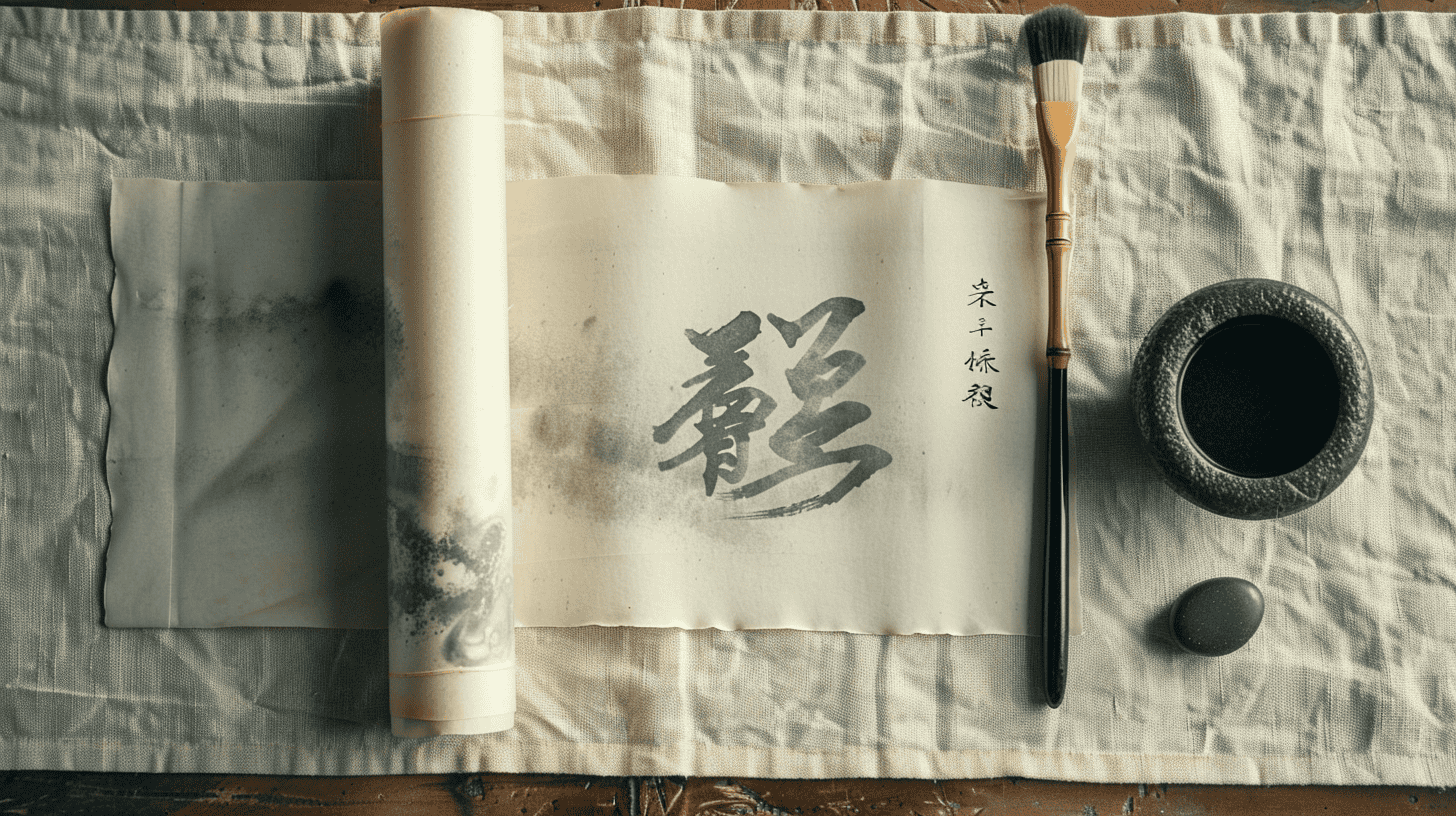

How to practice kanji by hand.

Writing a kanji is not drawing a picture of it. Stroke order exists because the hand, moving correctly, produces the correct shape almost on its own. So the method is simple. Trace the character slowly, following the numbered build. Then write it unaided, smaller each time, until the shape holds without the guide.
Ten minutes a day beats an hour on Sunday. Research on handwriting and memory points the same way — the motor act of writing binds a character to memory more firmly than recognition drills alone. The neuroscience of calligraphy covers why, and the flashcard method guide shows how to pair writing with review.
The kanji workbook series — from first kanji to brush capstone.
A learner moving from JLPT N5 to N4 to N3 is on a multi-year path. A single workbook cannot serve all of it. Therefore, each volume picks up where the last left off. Meanwhile, the Kana Workbook runs parallel for beginners. Every kanji in the series appears exactly once, so the set forms one complete path with no wasted repetition.
The series extends as the catalogue grows, continuing into JLPT N3 by the same deduplicated method.
Practice now — on screen, on paper, or both at once.


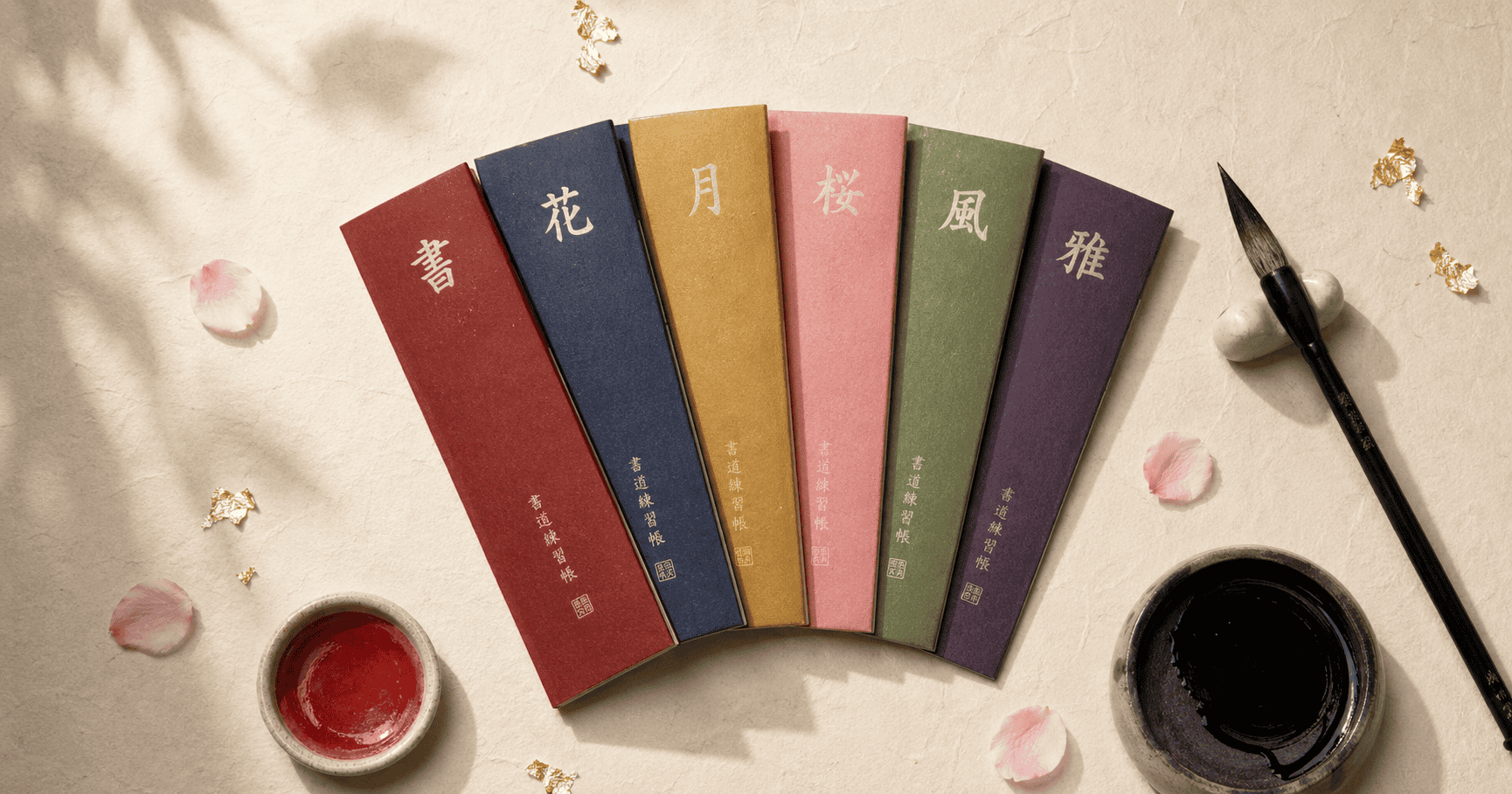
Writing by hand rewards a few good tools. A brush that holds its line, ink that sits dark on the page, paper that takes the stroke cleanly.
For the desk and the daily practice
Brushes, ink, and the small tools that make writing by hand a pleasure.
Volume 1 is available now. The later volumes publish one at a time — the launch list is how you hear the day each one goes live, and nothing else.
Be told when each volume goes live.
One email per release. You will hear from Magnificent Japan only when there is news to share.
Done. You are on the launch list — the next release lands in your inbox.
If you would rather start studying today, one printable reference is ready now.
The JLPT N5 and N4 kanji cheat sheet.
All one hundred essential JLPT N5 and N4 kanji on a single printable page — with meanings, on’yomi and kun’yomi readings, and stroke counts. It pairs as the reference companion to the practice page.
Done. Watch your inbox — the cheat sheet is on its way.
A few questions come up often about the workbooks and how they fit together.
Questions Worth Asking.
What is progressive stroke kanji teaching?
It shows a kanji as it builds. First, stroke one appears in colour. Then stroke two joins it, with stroke one still grey behind. Each later stroke adds on, the earlier strokes staying grey. In effect, this teaches the character as a sequence rather than a finished shape.
Is Volume 1 of the kanji workbook available now?
Yes. The digital edition of Volume 1 — 100 Essential JLPT N5 and N4 Kanji — is available now for $9.99, formatted for iPad with Apple Pencil through GoodNotes or Notability. A 6×9 paperback print edition is available now.
Which kanji does Volume 1 teach?
Volume 1 teaches one hundred foundational characters drawn from the full JLPT N5 set and on into JLPT N4, ordered by frequency of use. The sequence opens with elemental characters such as sun, moon, fire, water, tree, and mountain.
What is the difference between calligraphy, kanji, and kana?
Kana are the two phonetic alphabets of Japanese, hiragana and katakana. Kanji are the logographic characters that came from Chinese. Calligraphy, or shodō, is the art of writing them with brush and ink. The Magnificent Japan series teaches all three as a single practice.
Can I use the kanji workbook on an iPad?
Yes. The digital edition is a write-on PDF built for tablet study. Import it into GoodNotes, Notability, or any PDF annotation app, then write every practice box with an Apple Pencil or stylus.
Will there be a Kindle version?
No. A workbook is for writing in, and a Kindle edition would not allow that. The digital edition is a PDF instead, designed for tablet apps that accept stylus input.
Why a series rather than a single book?
A learner moving from JLPT N5 to N4 to N3 is on a multi-year path. A single workbook cannot serve all of it. Each volume picks up where the last left off, and every kanji across the series appears exactly once.
Can I use the practice page without buying a workbook?
Yes. The practice page needs no signup. It carries one hundred essential JLPT N5 and N4 kanji with animated stroke order and a brush simulation. The workbooks deepen the practice; they do not gate it.
How will I be told when the next volumes go live?
Sign up for the launch list above. You will hear from Magnificent Japan only when there is a release.