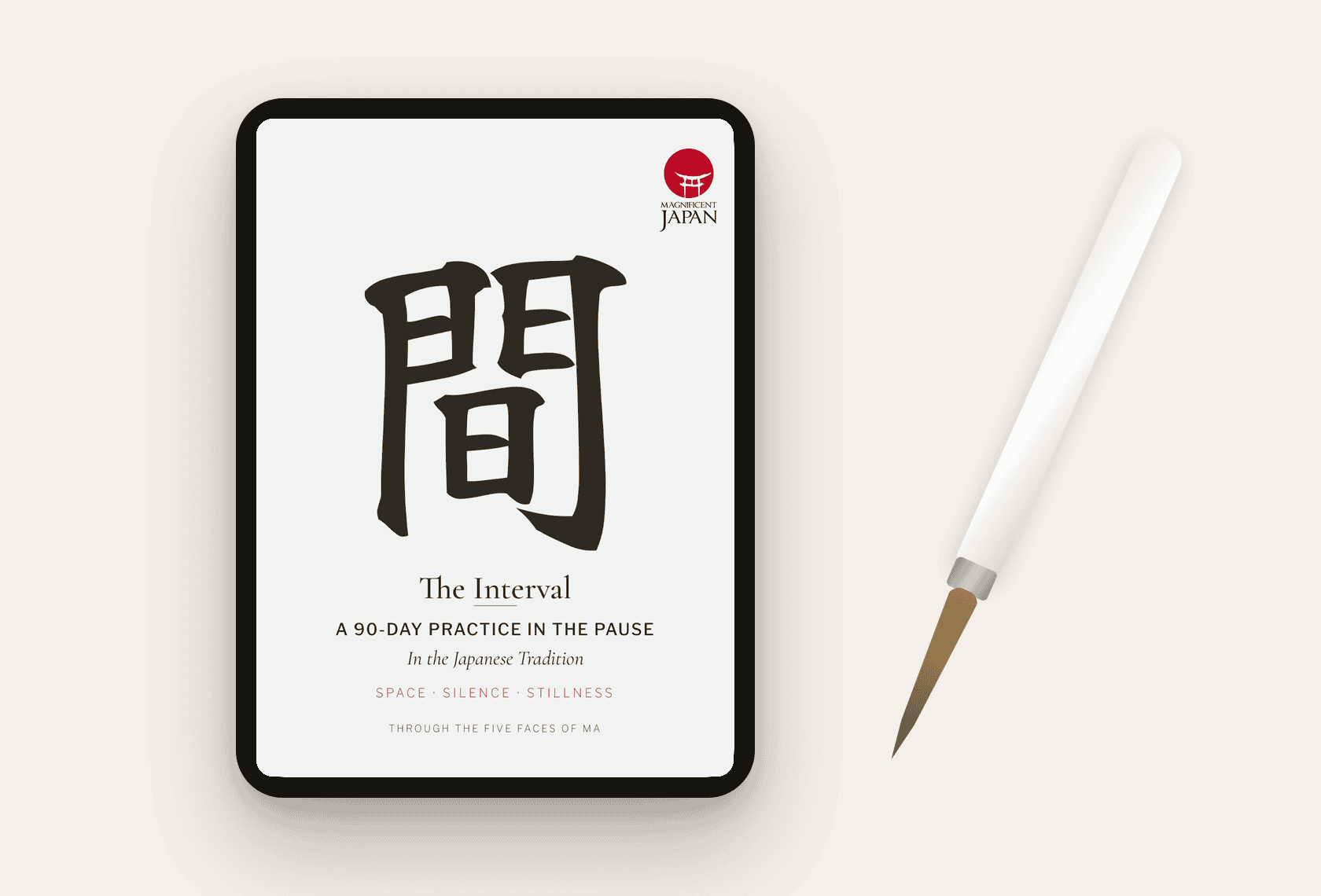
The Interval — a ninety-day practice in the pause
Ikigai is your direction. Ma is your pause.
Ma 間 is the Japanese sense that the empty space between things is not nothing — it is what gives them meaning. The silence that shapes the music. The margin that makes the page readable. In a life with too little room left in it, ma is the practice of making some. Ninety prompts follow, one a day, moving through the five faces of ma.
Digital: instant download, every major tablet app · Paperback: ships worldwide
Most journals ask you to add something
A gratitude list. A habit tracker. A morning routine stacked on top of the morning you already have. Our wider journal collection takes a different view. Each one asks for more of a day that has none left to give, and the effect is another obligation wearing the costume of self-care.
This one asks the opposite question. Not what else you might fit in, but where the room went — and what happens in the spaces you have stopped noticing.
Optimise the day, fill the gaps, track the streak. It asks you to do more with the same hours, and it tends to produce pressure.
Notice the interval, leave it unfilled, let it do its work. It asks you to make room in the same hours, and it tends to produce attention.
What ma actually means
Ma 間 means gap, space, interval, pause. The character shows a gate with light shining through the crevice between its doors — a space, framed. It is one of the ideas Japanese aesthetics returns to most often, and one the English language never quite found a word for. Scholars usually render it as negative space, interval, or emptiness.
In ikebana, the space around the flowers matters as much as the flowers. In the tea ceremony, the pauses between the movements are the point. In music, the silence between the notes is the music. One Western observer put it plainly: we have neither the word nor the term for it, and that is a serious omission.
Ma is not a technique anyone invented for modern life. It is what the tea room, the Noh stage and the calligrapher’s page have always understood — that the interval is not empty, and that what happens in it shapes everything on either side.
Five faces of ma, ninety days
The ma journal moves through five faces of ma, each one a different way the space between shows itself. You do not study them — the prompts teach them, asking each in turn and deepening as the weeks go on.
What the ma journal includes
Both editions of the ma journal carry the same ninety-day structure. The digital edition is a write-on PDF for GoodNotes, Notability, Noteshelf, or any annotation app; the paperback puts the same practice on paper.
- Ninety daily prompts — moving through the five faces of ma
- Twelve weekly syntheses — to gather what surfaced across each week
- Three monthly reviews — to see how you have moved
- Two Beginning pages — revisited on Day Ninety, to measure the distance
- Hyperlinked navigation — side tabs and day links, in the digital edition
- Research foundations — drawn from the Japanese tradition, with further reading
- A per-app setup page — so it works cleanly in your reading app
Begin the practice
One journal, two editions, one price. Choose the screen or the page — the ninety days are the same, and both are made to be written in, not read once and shelved.
A write-on PDF for iPad and tablet, with tap-through side tabs and links to any day. Yours the moment you order.
Begin the Practice — DigitalInstant download · GoodNotes, Notability & every major tablet app
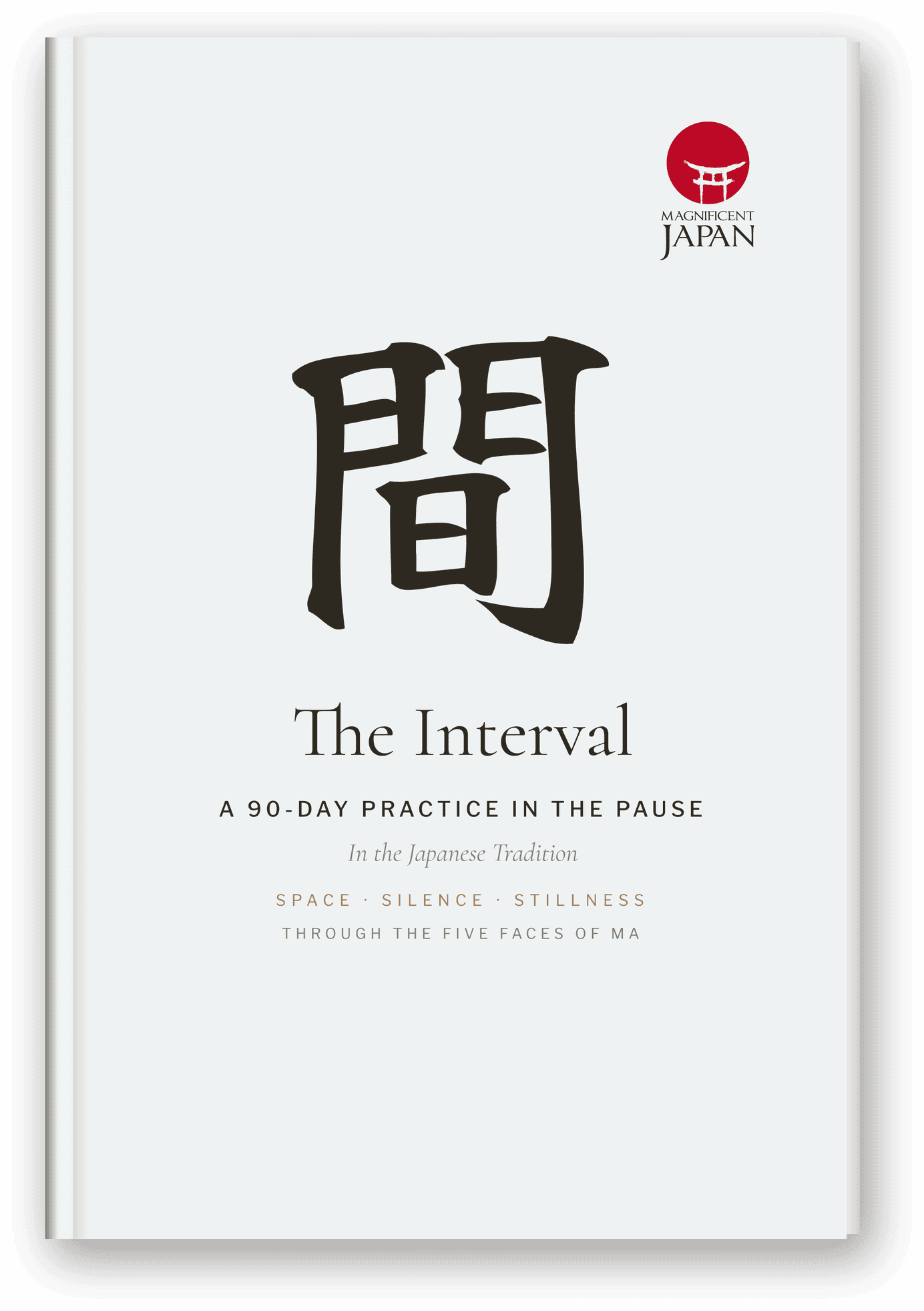
The same ninety days in print — a matte-cover paperback for the desk, the bag, and the shelf it will one day join.
Order the PaperbackShips worldwide · part of the Cultural Reflection Collection
Why a ma journal, and why ninety days
Most reflection tools ask you to look inward. This ma journal asks you to look at the edges instead. Ma lives in the space between things. So the prompts point at the gaps in your day rather than the events. Consequently you start noticing the moments you have been skipping past. The walk between two meetings. The beat before you answer. Meanwhile the day itself stays as full as it was. That is the point, because nothing here asks for another habit.
Ninety days matters for a simple reason. A single prompt shifts your attention for an afternoon, whereas a sequence changes what you notice by default. Therefore the structure moves in three arcs. Month one works on recognition, so the questions stay small and concrete. Month two assumes you have been paying attention and asks for more. By month three the prompts turn outward, toward the pauses you leave for other people. Finally, on Day Ninety, you return to the Beginning pages and read your first answers again.
The Japanese art of the pause is not a modern invention, although it suits a modern problem well. Ma shapes the tea ceremony, the dry garden and the Noh stage. In each one, the emptiness carries the meaning. Similarly, this journal treats the blank half of the page as part of the practice. If you already keep a guided journal, ma will feel unfamiliar at first. Nevertheless it settles quickly, because the idea is older than any method built on it.
Look inside the ma journal
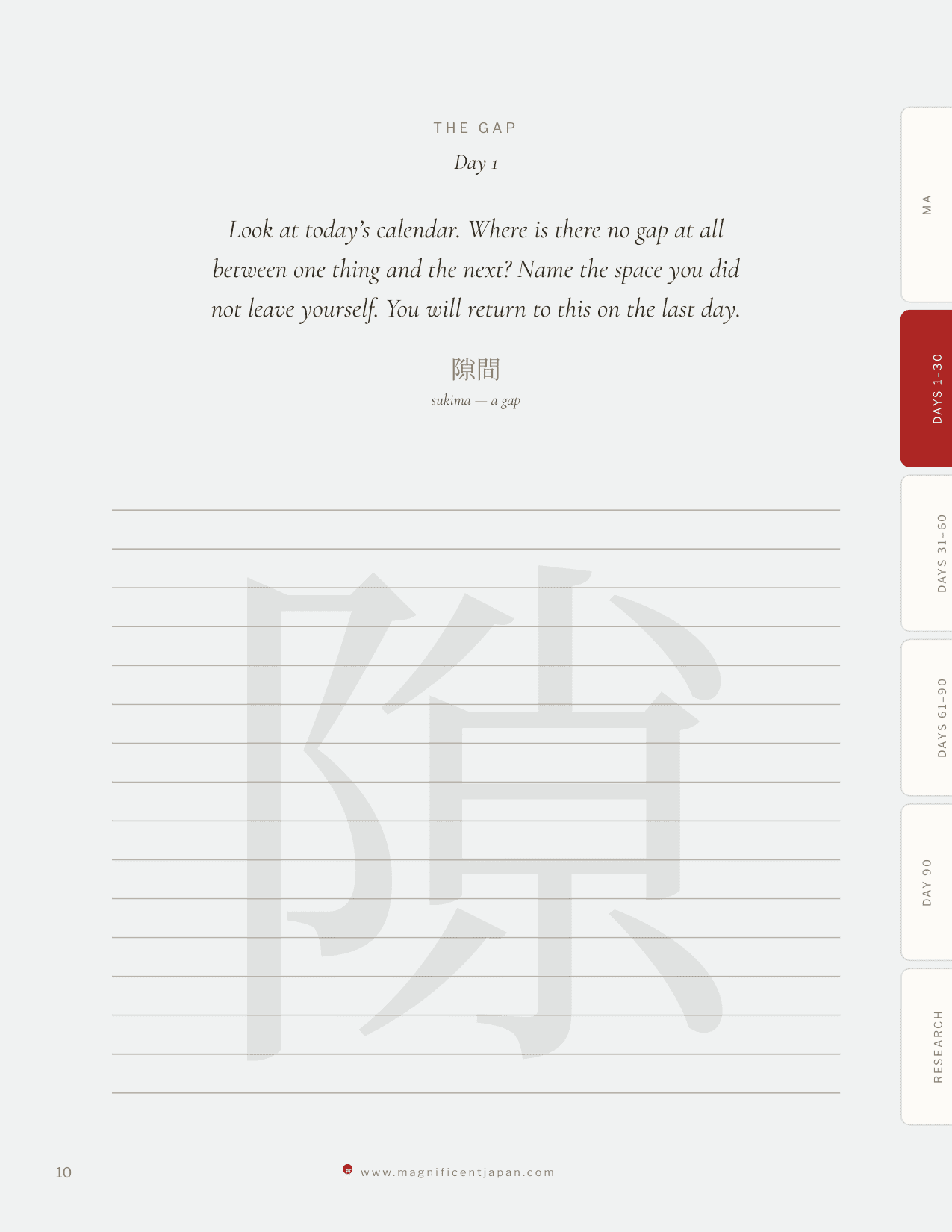
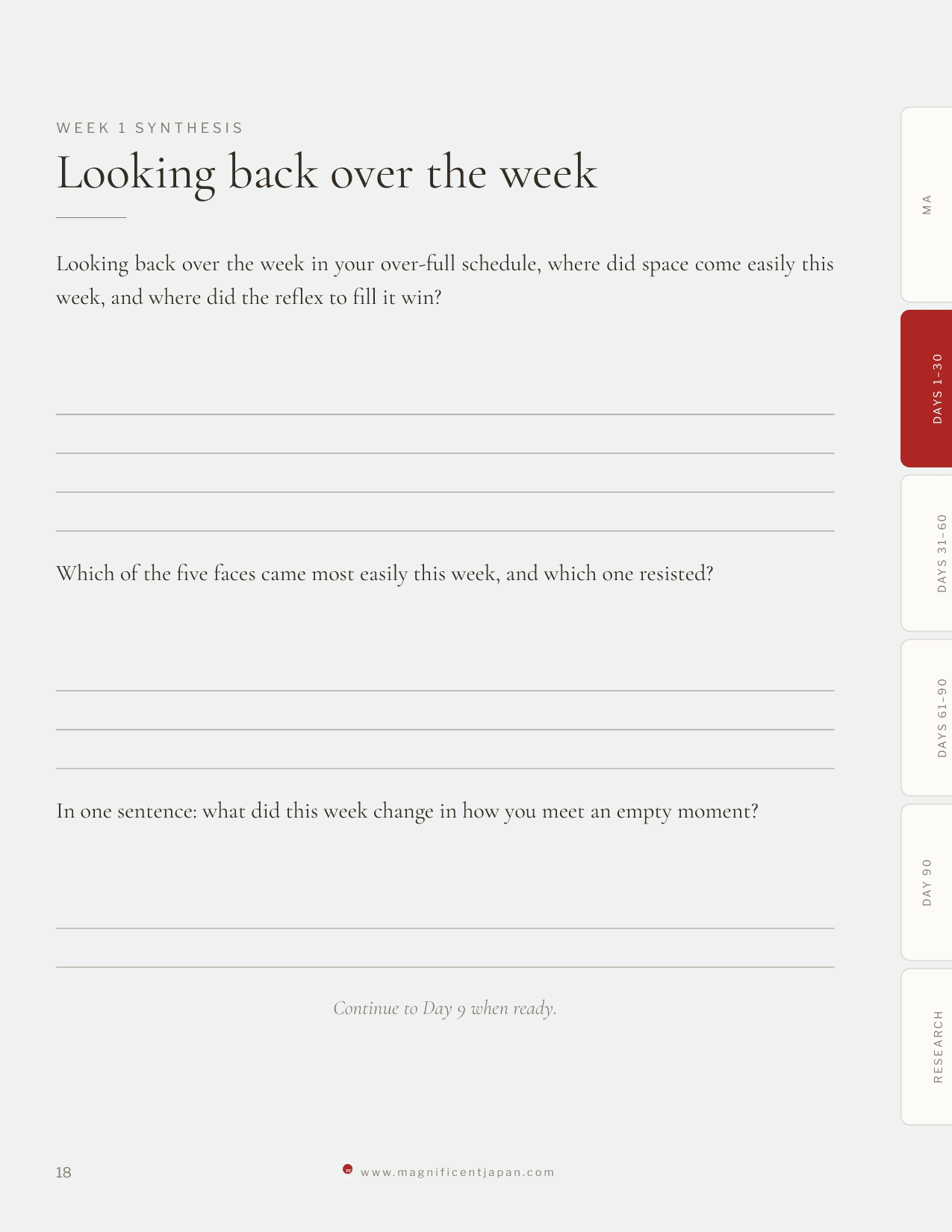
Three real pages, shown full size — the Beginning you return to on Day Ninety, a daily prompt, and a weekly synthesis. Tap any page to open it larger. The pages are the same in both editions.
How it works
What ninety days with a ma journal does
A single prompt rarely changes much, which is why the ma journal runs to ninety. Ninety of them, in sequence, do something a list never could. The early weeks ask small questions about the gaps you already have and have stopped seeing.
By the second month the prompts assume you have been paying attention, so they ask a little more. On Day Ninety you return to the Beginning pages you started with, and the distance between them is the practice.
Where ma comes from
Ma is old. It predates every wellness idea now sold beside it, and it was never a self-help concept at all. It began as a way of describing structure — first in space, then in time, then in the way people speak to one another.
The character itself is the earliest clue. 間 pairs a gate with the sun, so the written form shows light in the opening between two doors. The gap is not the absence of the gate. The gap is what the gate is for.
In classical court music, the rests carry the phrasing, and a player who fills them has misread the piece. On the Noh stage the same logic governs movement, because the held pause before a gesture is where the audience does its work. In the tea room the host’s timing between actions is judged as closely as the actions themselves. And in ikebana the arrangement is read through the space around the stems rather than the stems alone.
Architecture carried the idea furthest. Traditional Japanese rooms are measured in ken, an interval rather than a fixed unit, so a room is described by the spaces it contains. The sliding screen makes that literal — a wall that can become an opening, then a wall again. In the twentieth century Japanese architects took ma abroad as an exportable idea, and it entered Western design vocabulary through them.
What none of those traditions treat ma as is emptiness for its own sake. The interval is worked, shaped and deliberate. That distinction is the whole premise of this ma journal: leaving room is a skill, not a mood.
Who this ma journal can help
The practice suits a particular reader. If you recognise yourself below, the ninety days will land; if you do not, one of the other journals in the collection is likely the better fit.
The over-scheduled
Your calendar has no white space, and the day runs you rather than the reverse. The prompts start with your schedule, because that is where the room went.
The person who reacts first
You answer before you have finished hearing, then replay it later. Ma names the interval between the two, and the prompts widen it.
The perpetually behind
Rest feels like something to earn. The repose face of ma treats it as structural instead, which is a different argument entirely.
The one who fills every silence
Conversations feel like something to keep afloat. Two of the five faces work directly on that habit.
The reader drawn to Japan
You came for the culture rather than the productivity. The ma journal is built on the tradition first, and it reads like it.
What this practice does not claim
This is a reflective writing practice rooted in a Japanese aesthetic idea. It is not a clinical tool, it treats nothing, and it is no substitute for professional care.
What ninety days of returning to the same page builds is consistency — and a wider gap between what happens and what you do about it. That is a modest claim, and it is one we can stand behind.
Where the practice comes from
The intervals this journal asks you to notice were, for the people who first wrote about ma, Japanese ones. The pause on the Noh stage. The gravel between the stones. The moment in the tea room where nothing happens and everything is held.
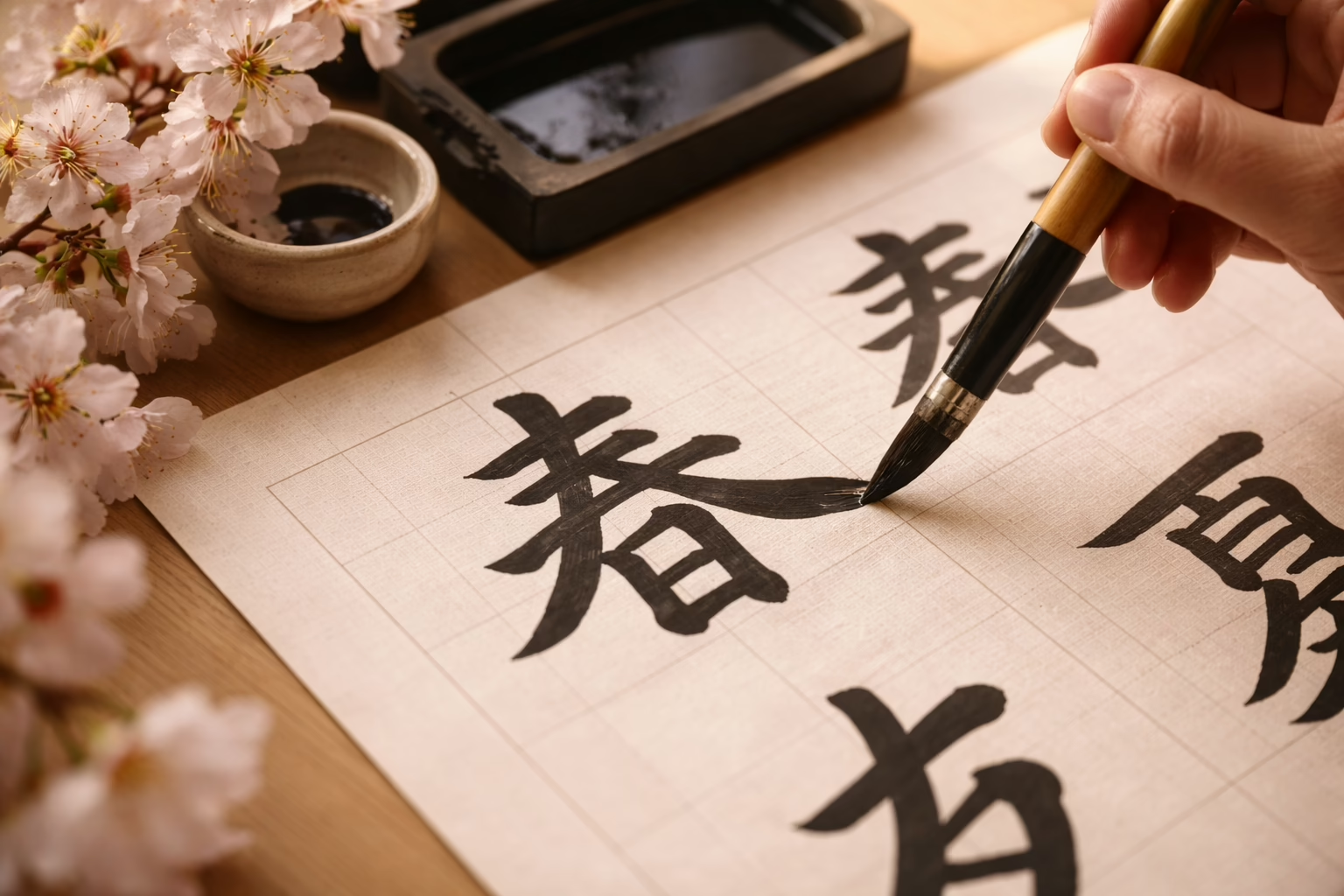
The practice works wherever you sit with it, and it sits well beside brush practice or the kanji workbooks if you are learning to write the language by hand. Yet once it settles, some readers want to stand inside the unhurried Japan it draws from — and that is a journey worth shaping with care.
A still tea room, a raked garden at first light, a ryokan where the evening keeps its own pace. When you would like to step into the Japan this practice draws on, we shape the journey around how you want to travel.
Begin a Custom ItineraryQuestions Worth Asking
Is this a digital journal or a paper book?
Both. The Interval comes as a write-on digital PDF for tablet annotation apps, and as a paperback print edition. Both carry the same ninety days at the same price.
What does ma actually mean?
Ma means gap, space, interval, pause. The character shows a gate with light shining through the crevice between its doors. In ikebana the space around the flowers matters as much as the flowers; in music, the silence between the notes is the music.
Which apps does the digital edition work in?
GoodNotes, Notability, Noteshelf, Penly, Xodo, and Samsung Notes. The side tabs and links work in any app that opens annotatable PDFs.
Do I have to write every day?
No. Write daily, or write when you can. The structure holds either way, and the practice is built around returning to it rather than around a perfect streak.
Is this a wellness or clinical tool?
No. It is a reflective writing practice rooted in a Japanese aesthetic idea. It makes no clinical claim and is not a substitute for professional care.
How is this different from the Ikigai journal?
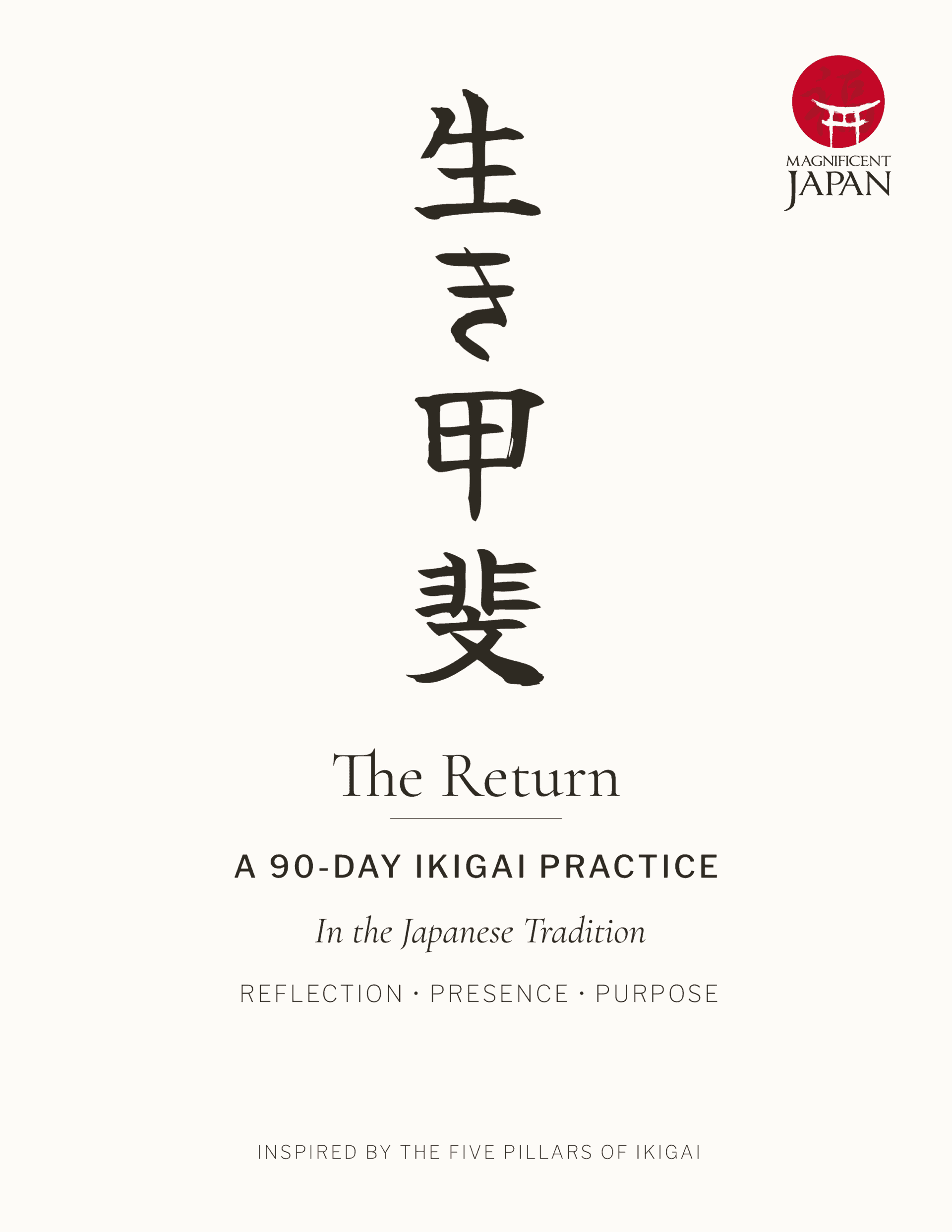
Ikigai is your direction. Ma is your pause. The Return asks what makes your days worth living; The Interval asks how much room you leave in them. They work well in either order.
Part of a longer practice
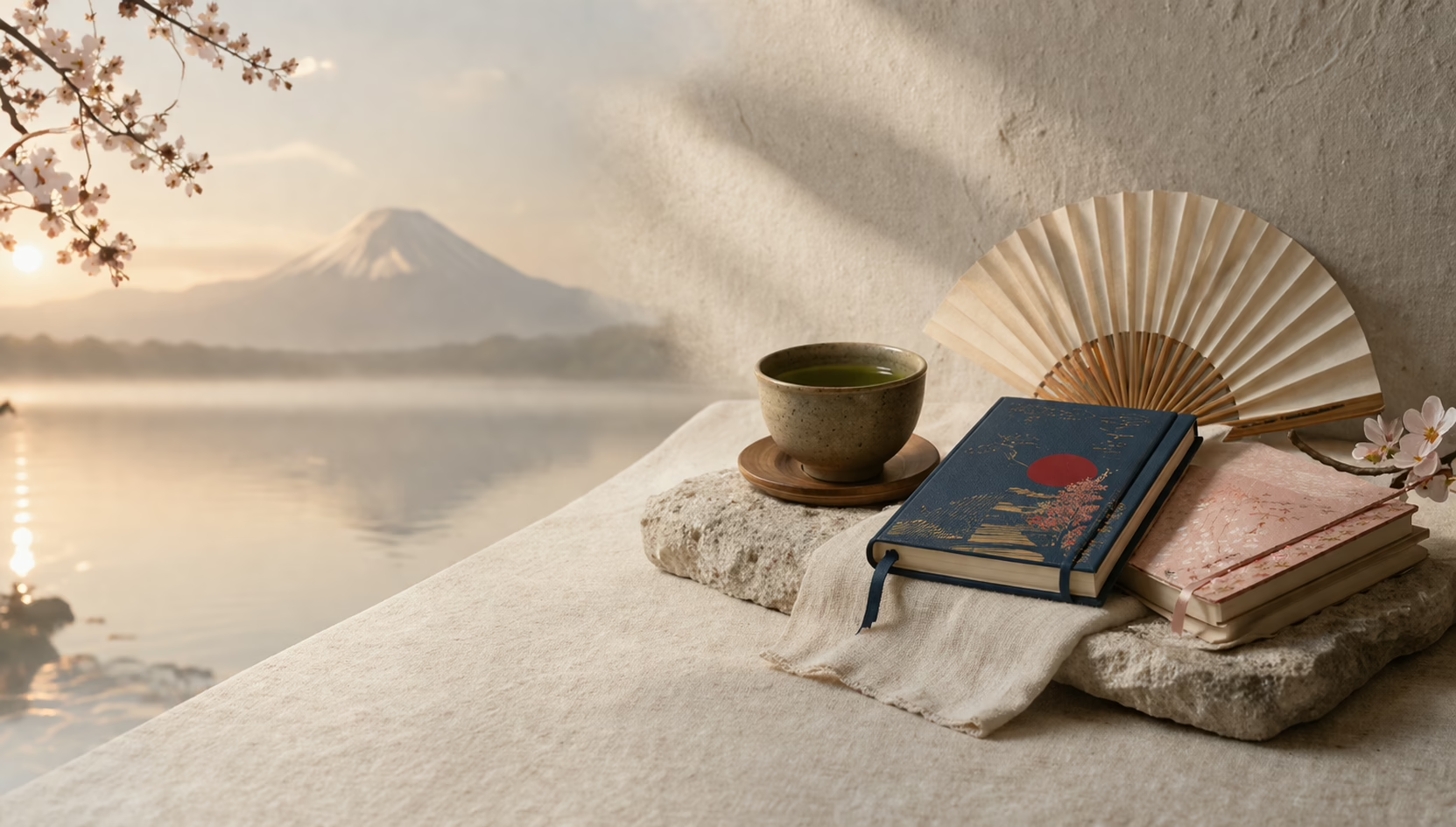
The Cultural Reflection Collection runs on single Japanese concepts, ninety days at a time, on screen or on paper. The Return asks what makes your days worth living. The Interval asks how much room you leave in them.